The Anatomy of Artistry: A Masterclass in Form
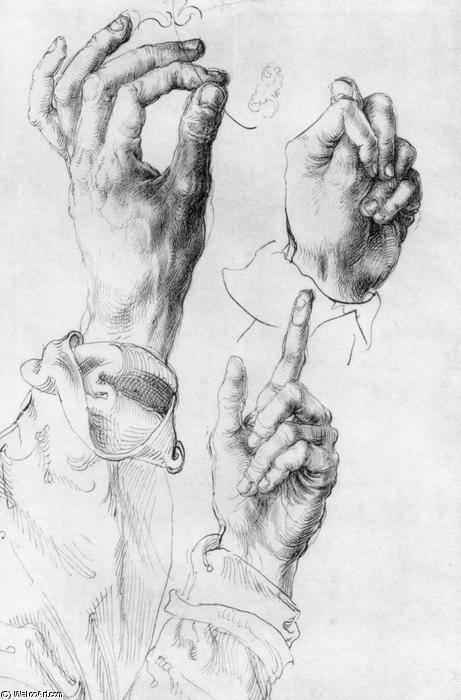
In the quiet, focused realm of the Renaissance workshop, certain works exist not as finished icons for altarpieces, but as profound meditations on the very essence of life itself. Albrecht Dürer’s Handestudien is precisely such a masterpiece—a breathtaking exploration of human anatomy captured through the delicate yet decisive medium of graphite and pencil. This intricate drawing serves as a window into the mind of a genius, revealing a meticulous study of hands in various states of repose and motion. Each limb, each knuckle, and each fingernail is rendered with an almost scientific precision that transcends mere sketching, transforming a simple anatomical exercise into a dynamic composition of overlapping forms and rhythmic gestures.
The visual impact of the piece lies in its incredible tactile quality. Through the masterful application of hatching and cross-hatching, Dürer breathes life into the paper, simulating the subtle textures of weathered skin, the tension of tendons, and the soft play of light across a curved surface. The dark, sharply defined lines create a striking contrast against the paper, lending a sculptural three-dimensionality to the work. As the eye wanders through the fragmented composition, one feels the weight and volume of the hands, as if they were carved from stone rather than drawn with lead. It is a dance of shadows and light that captures the very pulse of human existence.
A Legacy of Precision and Human Connection
To understand Handestudien, one must look to the heart of the Northern Renaissance. Dürer, a titan of Nuremberg, brought a unique synthesis of German craftsmanship and Italian anatomical curiosity to his work. This drawing embodies that duality; it possesses the rigorous, detailed spirit of the artisan tradition while reaching for the profound naturalism championed by masters like Leonardo da Vinci. While there is no explicit narrative or religious iconography present, the subject matter carries a deep, inherent symbolism. The hand is the primary instrument of human creation, labor, and connection. In these studies, we witness the tools of the artist, the hands of the worker, and the very vessels through which humanity interacts with the world.
For the discerning collector or interior designer, this artwork offers a sophisticated elegance that transcends temporal boundaries. Its monochromatic palette and organic, flowing shapes make it an incredibly versatile piece for modern curation. Whether placed in a minimalist gallery setting or used to add a layer of intellectual depth to a classical study, Handestudien commands attention through its quiet intensity. It is more than a reproduction; it is an invitation to contemplate the beauty of detail and the enduring power of human observation. Owning such a piece means bringing a fragment of the Renaissance spirit into one's personal space, fostering an atmosphere of reflection, artistry, and timeless grace.