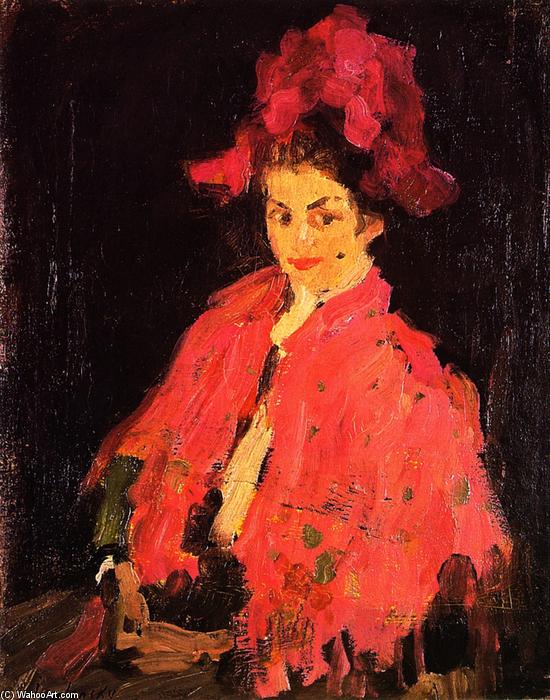
Alexej Georgewitsch von Jawlensky war eine Schlüsselfigur der Neuen Künstlervereinigung München und des Blauen Reiters. Sein Werk, wie „Karneval“, spiegelt die expressionistische Betonung subjektiver Erfahrung und emotionaler Tiefe wider.
Entdecken Sie Alexej von Jawlenskys kraftvollen Expressionismus! Mystische Köpfe, leuchtende Farben & Pionier der Blaue Reiter Bewegung. Russischer Künstler mit deutscher Wirkungsstätte.
A Portrait of Festive Emotion: Exploring Alexej von Jawlensky’s Carnival
The early 20th century witnessed an artistic revolution fueled by movements like Expressionism, driven by a desire to transcend mere representation and delve into the depths of human emotion. Among these trailblazers stood Alexej Georgewitsch von Jawlensky (1864-1941), a Russian-born painter whose unwavering commitment to subjective experience cemented his legacy as a cornerstone of German art history. His masterpiece, *Carnival*, painted in 1902, embodies the very essence of Expressionist aesthetics—a bold confrontation with feeling rather than a placid reflection of reality.
The Expressionist Vision: Beyond Surface Appearance
Expressionism wasn’t simply about color; it was fundamentally concerned with conveying inner turmoil and psychological intensity. Artists like Jawlensky rejected academic conventions, prioritizing intuition over meticulous observation. They sought to capture the raw nerve of experience—fear, joy, grief—transforming them into visual symbols that resonated beyond literal depiction. *Carnival* exemplifies this ethos perfectly. It’s not merely a portrait; it's an attempt to distill the spirit of celebration and simultaneously acknowledge its underlying anxieties. The artist deliberately eschewed traditional compositional strategies, opting for a stark black background against which the woman’s vibrant attire—a scarlet hat adorned with a feather—dominates the canvas. This deliberate imbalance serves to amplify the emotional impact, forcing the viewer to confront the complexities of human feeling.
Technique and Texture: Jawlensky's Mastery of Oil Paint
Jawlensky’s artistic prowess resided not only in his conceptual vision but also in his technical execution. He favored oil paint on canvas, a medium that allowed for unparalleled textural richness and depth. The artist meticulously applied pigment to create subtle gradations of color and surface irregularities—a technique visible throughout his oeuvre, including *Hyacinth Pots* and *Village in Bavaria*. In *Carnival*, this meticulous layering contributes significantly to the painting’s palpable atmosphere. One can almost feel the velvety smoothness of the black background juxtaposed against the textured sheen of the woman's coat and hat. This deliberate manipulation of materiality underscores Expressionism’s belief that art should engage all senses, fostering a visceral connection between artist and audience.
Symbolism Within Color: Red as Embodiment of Joyful Tension
The color palette employed in *Carnival* is deliberately symbolic—a masterful orchestration designed to communicate profound emotional truths. Predominantly black, the background represents darkness, repression, perhaps even impending doom. However, it’s punctuated by splashes of crimson and pink, embodying the exuberant energy of carnival celebrations. The scarlet hat, a focal point of the composition, symbolizes not just festive adornment but also an assertion of individuality—a defiant gesture against conformity. Jawlensky's use of color isn’t arbitrary; it’s carefully calibrated to heighten emotional resonance. The juxtaposition of red and black creates a dynamic tension that mirrors the psychological complexities inherent in human experience.
A Legacy of Emotional Intensity: Carnival's Enduring Relevance
*Carnival*, housed at the Stiftung Saarlandischer Kulturbesitz in Germany, continues to captivate viewers today—a testament to Jawlensky’s enduring artistic vision. It stands as a powerful reminder that art can transcend time and circumstance, speaking directly to our deepest emotions. More than just a beautiful painting, *Carnival* is an invitation to contemplate the interplay between joy and sorrow, certainty and doubt—themes that remain perpetually relevant in navigating the challenges of modern life. Its exploration of psychological depth and masterful technique solidify Jawlensky’s place as one of Expressionism's most influential figures, ensuring his masterpiece retains its power to inspire generations of artists and collectors alike.