Alexej von Jawlensky’s “Variation (13)” – A Raw Expression of Inner Turmoil
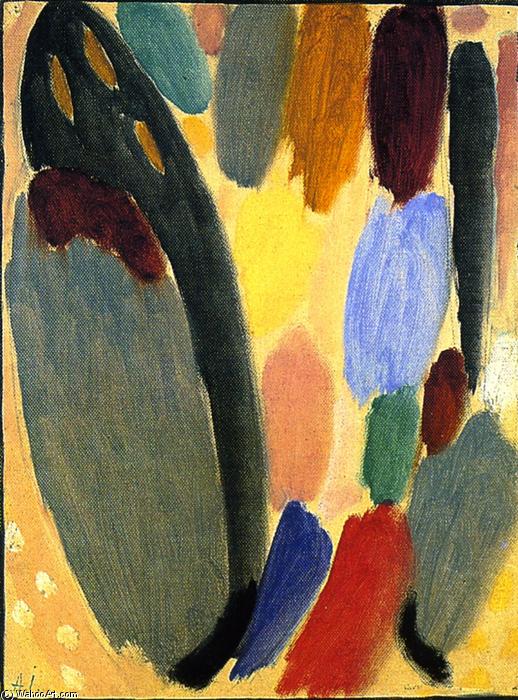
Alexej von Jawlensky's "Variation (13)," painted in 1918, is a profoundly moving work that encapsulates the artist’s intensely personal and emotionally charged approach to abstraction. This piece, dominated by a turbulent interplay of blues, reds, greens, yellows, and oranges, isn’t merely a collection of colors; it's a visual manifestation of raw feeling – a direct response to the anxieties and uncertainties of a world on the brink of immense change. The seemingly chaotic arrangement of circles, squares, and triangles speaks to a deliberate fracturing of form, mirroring perhaps the artist’s own internal struggles and his desire to strip away superficial appearances to reveal something deeper.
Jawlensky's artistic journey was marked by a relentless pursuit of authentic expression. Born in Torzhok, Russia, he experienced a nomadic existence before finding stability in Munich, where he became a central figure within the New Munich Artist’s Association and the influential “Blue Rider” group. This association with figures like Wassily Kandinsky and Franz Marc fostered an environment of experimentation and radical artistic inquiry, yet Jawlensky remained steadfastly committed to his own unique vision – one rooted in religious symbolism, folk art traditions, and a deeply felt spirituality.
Technique and Materiality: A Controlled Chaos
The painting’s surface is characterized by thick, impasto brushstrokes—a hallmark of Jawlensky's technique. He applied the paint with a deliberate physicality, building up layers of color that create a tactile quality and imbue the work with an almost sculptural presence. This heavy application isn’t haphazard; it’s carefully controlled, contributing to the sense of contained energy within the composition. The use of oil paints allowed for rich pigmentation and blending, yet Jawlensky frequently employed dry brushwork to retain sharp edges and a sense of immediacy – a technique that intensifies the impact of each shape.
The color palette itself is crucial to understanding the work’s emotional power. Jawlensky eschewed bright, optimistic hues in favor of darker, more somber tones, punctuated by bursts of intense color. This deliberate contrast evokes feelings of both pain and hope, reflecting the artist's complex relationship with faith and doubt.
Symbolism and Spiritual Resonance
"Variation (13)" resonates deeply with the iconography of early Christian art, particularly Byzantine icons. The simplified forms, the flattened perspective, and the use of bold color recall the spiritual intensity of these traditional images. Jawlensky was profoundly influenced by Russian Orthodox religious traditions, evident in his recurring motifs of faces – a theme he explored extensively in works like "The Saviour’s Faces" (1918-20). These faces aren't portraits in the conventional sense; they are representations of spiritual archetypes—symbols of suffering, redemption, and ultimately, transcendence.
The title itself, “Variation,” suggests a process of transformation – a shifting of perspective, a journey through emotional states. It’s a reflection of Jawlensky's artistic method: constantly experimenting with form and color to arrive at a deeper understanding of the human condition. The painting invites viewers to contemplate their own experiences of doubt, faith, and ultimately, the search for meaning in a chaotic world.
A Legacy of Emotional Intensity
Alexej von Jawlensky’s “Variation (13)” stands as a testament to his unwavering commitment to emotional expression. It's a powerful reminder that art can be more than just aesthetic pleasure; it can be a conduit for profound human experience. As a hand-painted reproduction, this artwork retains the artist’s unique energy and intensity, offering a tangible connection to one of the most significant figures in early 20th-century art.