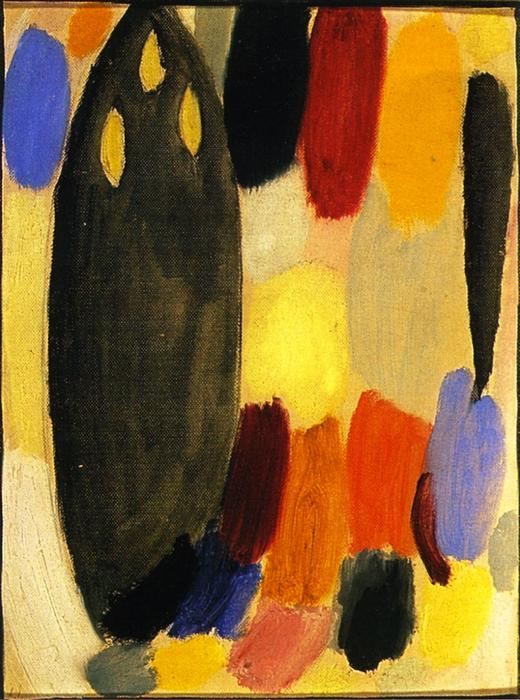
Experience Alexej von Jawlensky’s raw Expressionist triptych, "Variation: Enlightenment," a powerful exploration of emotion and spirituality through bold colors and dynamic forms, perfect for art lovers seeking a profound visual journey.
Variation: Enlightenment - A Triptych by Alexej von Jawlensky
This captivating triptych, tentatively titled "Variation: Enlightenment," offers a profound glimpse into the intensely expressive world of Alexej von Jawlensky. Executed in 1919, during a pivotal period in his career, this work exemplifies his signature style – a raw and emotionally charged approach to abstraction that prefigures much of later Expressionism. The painting’s power lies not in representational accuracy but in the visceral impact of its forms and colors, inviting viewers into a deeply personal and contemplative space.

At the heart of the composition is a dominant black circle, radiating an almost unsettling presence. This isn’t merely a shape; it's a concentrated point of energy, a void that simultaneously draws you in and pushes you away. Surrounding this central element are dynamic shapes – fragments of color, angular forms, and swirling lines – rendered with thick, impasto brushstrokes. The palette is deliberately restrained, dominated by deep blues, ochres, and blacks, punctuated by flashes of vibrant red and yellow. This limited range amplifies the emotional intensity, creating a sense of contained chaos.
The Expressionist Impulse
Jawlensky’s work during this period was deeply influenced by the burgeoning Expressionist movement in Germany. Rejecting the academic traditions of the time, he sought to convey inner emotions and subjective experiences directly onto the canvas. His approach aligns with the broader aims of artists like Kandinsky and Kirchner – to strip away illusionistic representation and access a more fundamental truth through color and form. The triptych format itself adds another layer of complexity, suggesting a journey or unfolding process, mirroring the artist’s own exploration of spiritual and emotional depths.
Symbolic Resonance & Technique
The scattered blue circles are particularly intriguing. Often interpreted as representing the infinite or the divine, they echo the religious iconography prevalent in Jawlensky's childhood – a reflection of his deep-seated spirituality. Jawlensky’s technique is characterized by its physicality and urgency. He built up layers of paint with vigorous brushwork, creating a textured surface that vibrates with energy. The use of impasto—thickly applied paint—adds to the sense of movement and dynamism, further intensifying the emotional impact. This wasn't about meticulous detail; it was about conveying raw feeling through direct manipulation of the medium.
A Legacy of Emotional Intensity
“Variation: Enlightenment” stands as a powerful testament to Alexej von Jawlensky’s artistic vision. It is a work that demands attention, inviting viewers to confront their own emotions and perceptions. This hand-painted reproduction captures not just the visual elements of the original but also its profound emotional core – a legacy of intensity and spiritual searching that continues to resonate with audiences today. It's a piece perfect for collectors seeking a truly impactful addition to any art collection or interior space.