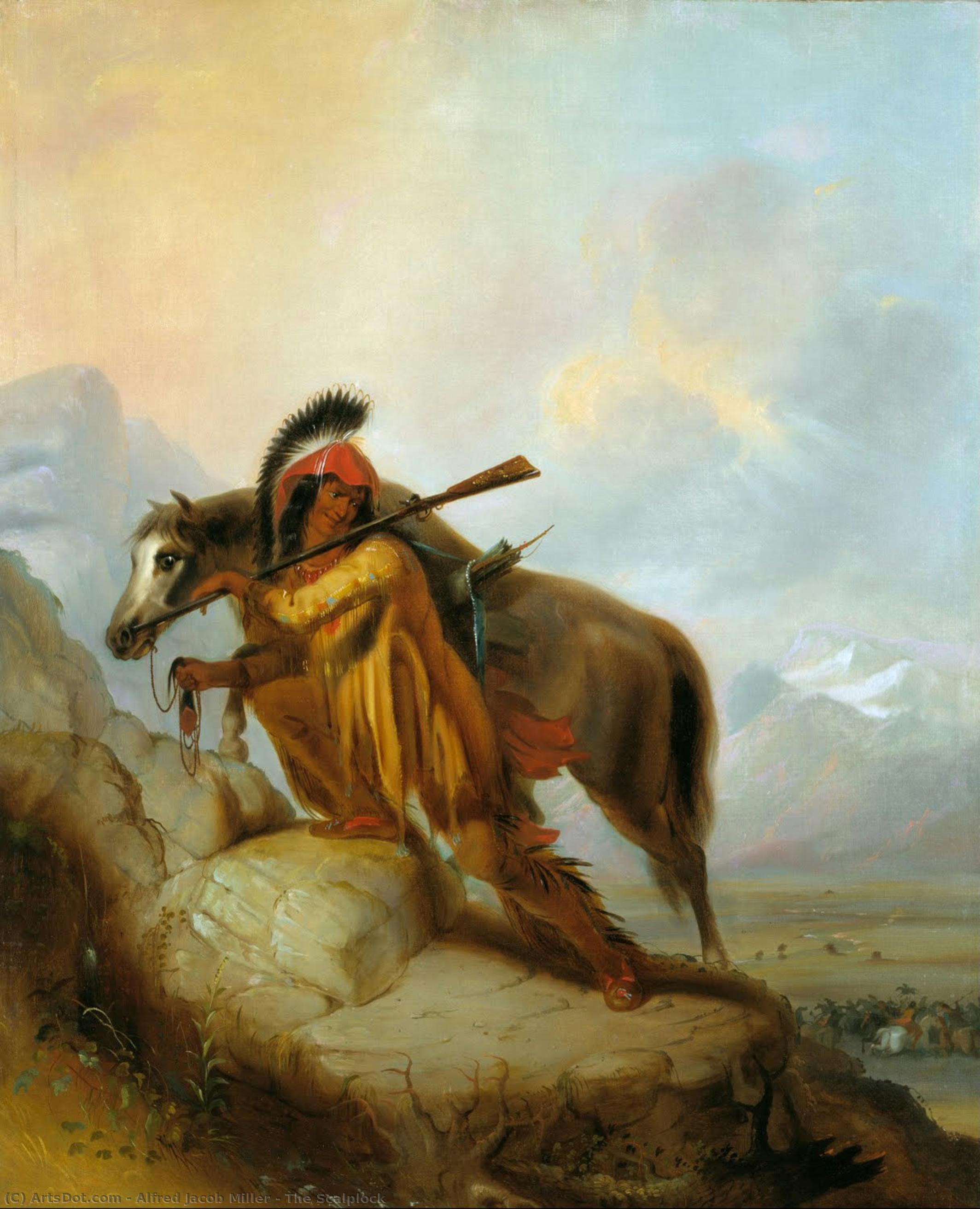
Experience 'The Scalplock' by Alfred Jacob Miller – a captivating 1874 portrait of a Native American on horseback. A stunning glimpse into frontier life, expertly rendered in romantic realism.
Entdecken Sie Alfred Jacob Miller (1810-1874), den amerikanischen Künstler, der das Leben im Westen & die Kultur der Ureinwohner mit Realismus & Romantik meisterhaft festhielt.
Denver Art Museum
(Denver, Vereinigte Staaten von Amerika)
Das Museum für zeitgenössische Kunst Denver (MCA Denver) präsentiert innovative Ausstellungen von internationalen Künstlern und fördert den Dialog zwischen Kunst, Kultur und Gesellschaft.
Alfred Jacob Miller’s “The Scalplock”: A Window Into the American Frontier
Alfred Jacob Miller (1810-1874) stands as an unparalleled visual storyteller of the American West, specifically capturing the essence of the fur trade era and the profound connection between Native American tribes and their environment. Unlike many artists of his time focused solely on landscapes or portraits, Miller dedicated himself to documenting a rapidly disappearing world—a mission he accomplished with remarkable precision and imbued with a distinctive blend of realism and romanticism that continues to resonate today. His artistic journey began outside formal academic institutions, nurtured by an innate talent honed by early exposure to influential artists like Thomas Sully, demonstrating a path less traveled yet undeniably impactful on the trajectory of American art history.
Miller’s formative education at John D. Craig’s Academy in Baltimore lacked a dedicated art curriculum—a seeming disadvantage that paradoxically fostered a stylistic independence crucial to his later achievements. This unconventional approach culminated in a transformative voyage to Paris in 1832, where he immersed himself in the rigorous discipline of life drawing at the École des Beaux-Arts and absorbed the artistic traditions of Europe. This foundational experience wasn’t merely about mastering technical skills; it instilled an acute observational capacity—a cornerstone of Miller's ability to portray subjects with breathtaking accuracy and emotional depth.
“The Scalplock,” painted circa 1858-1860, exemplifies Miller’s signature style perfectly. Executed in watercolor on paper, the artwork depicts a Native American man seated atop a horse, wielding a rifle—a symbol of both survival and dominion over the wilderness. The composition is meticulously crafted, prioritizing detail and capturing the rugged beauty of the Rocky Mountains landscape. Observe the careful rendering of textures – from the weathered skin of the figure to the rough fur of the horse’s mane – reflecting Miller's commitment to portraying reality with unflinching honesty. Furthermore, the inclusion of two birds—one perched prominently near the upper left corner and another positioned towards the lower right—adds a layer of symbolic richness. Birds often represent freedom, spirituality, and connection to nature, reinforcing the painting’s overarching theme of exploration and reverence for the natural world.
The artwork's historical context is inextricably linked to the fur trade boom of the mid-19th century, when American entrepreneurs aggressively pursued lucrative contracts with European nations to acquire furs from Native American tribes. Miller’s depiction captures not only the practical realities of this endeavor—the tools and attire of the traders—but also conveys a palpable sense of cultural encounter and apprehension. The man's gaze directs towards the viewer, conveying both confidence and vulnerability – mirroring the complex dynamics inherent in interactions between European settlers and indigenous populations during this period.
“The Scalplock” transcends mere representation; it evokes an emotional response rooted in admiration for Miller’s artistic skill and a deeper appreciation for the spirit of the American West. Its meticulous detail invites contemplation on themes of resilience, tradition, and the enduring relationship between humanity and wilderness—themes that continue to inspire artists and collectors alike. The painting resides within the collection of William T. Walters, Baltimore, MD (Accession Number 37.1940.192), a testament to Miller’s lasting legacy as one of America's foremost chroniclers of its frontier heritage.