A Portrait of Quiet Sorrow: The Soul of Modigliani’s ‘Boy in a Blue Shirt’
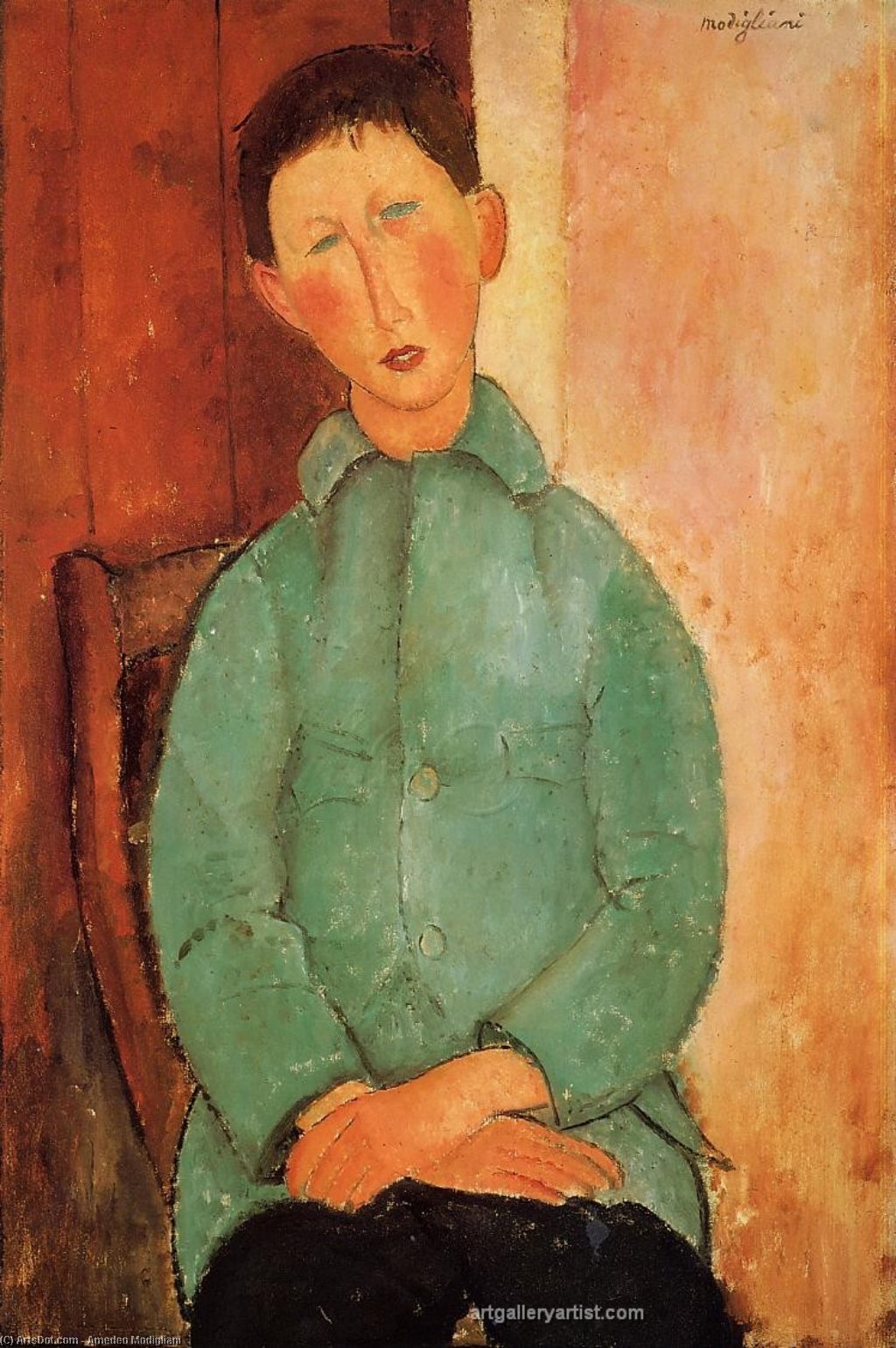
In the quiet corners of art history, few images possess the haunting, rhythmic elegance found in Amedeo Modigliani’s Boy in a Blue Shirt. At first glance, the composition appears deceptively simple: a young boy sits poised upon a chair, his gaze fixed directly upon the viewer with an intensity that feels both intimate and distant. Yet, beneath this stillness lies a profound emotional depth—a vulnerability that transcends the canvas. The boy’s hands are clasped before him, a gesture of introspective solitude, while the presence of two figures in the background and the soft suggestion of a couch ground the scene in a domestic reality. This setting does not merely provide a backdrop; it creates a sanctuary of memory, where the subject is caught in a moment of profound, silent contemplation.
Modigliani’s signature expressionist style is on full display here, as he moves away from the rigid constraints of realism to capture the psychological essence of his subject. The painting is characterized by the artist's iconic use of elongated forms and stylized features, most notably in the boy’s almond-shaped eyes. These eyes, perhaps the most arresting element of the work, are deliberately distorted to reflect an inner turmoil rather than a literal likeness. By abandoning anatomical perfection, Modigliani invites us to look past the surface and engage with the spirit of the child, making the piece an extraordinary study in human fragility and the beauty found within melancholy.
Mastery of Light and Historical Resonance
The technical execution of Boy in a Blue Shirt reveals the meticulous hand of a master. Working with oil on canvas, Modiglanci employed a sophisticated glazing technique, layering thin, translucent veils of pigment to achieve a luminous, ethereal glow. This method allows light to penetrate the surface, creating subtle tonal variations that lend the boy’s blue shirt and the surrounding shadows a sense of breathing life. The result is a painting that feels less like a static image and more like a flickering memory, possessing a soft, atmospheric quality that makes it an ideal centerpiece for any sophisticated interior seeking to evoke a sense of calm and intellectual depth.
To understand this work, one must also consider the turbulent era of its creation. Painted in 1916, amidst the shadows of World War I, the painting vibrates with the anxieties of a world in flux. Modigliani’s work often engaged with the heavy philosophical currents of his time, including the Nietzschean concepts of mortality and suffering. There is a palpable tension between the beauty of the boy's form and the underlying sense of loss that permeated the European consciousness during the Great War. For the collector or designer, this piece offers more than mere decoration; it provides a window into a pivotal moment in modern art, where the grotesque and the beautiful dance in a delicate, eternal embrace.
Whether displayed in a sunlit gallery or a moody, contemporary study, a high-quality reproduction of this masterpiece brings with it an aura of timeless sophistication. It serves as a profound conversation starter, drawing the eye through its striking lines and capturing the heart through its unmistakable capacity for empathy and grace.