Explore the life & work of Arthur B. Davies, a pivotal figure in American Modernism. Discover his unique style, role in the 1913 Armory Show, and lasting influence on art history. Learn about collecting Davies' works.
Arthur B. Davies (1862-1928): Ein Schlüsselgestalt der US-Moderne & Ashcan School, bekannt für seine ätherischen Gemälde und die Organisation der bahnbrechenden Armory Show.
Entdecken Sie die Phillips Collection in Washington D.C.! Einzigartige Sammlung moderner Kunst in intimem Ambiente – Renoir, Van Gogh & mehr.
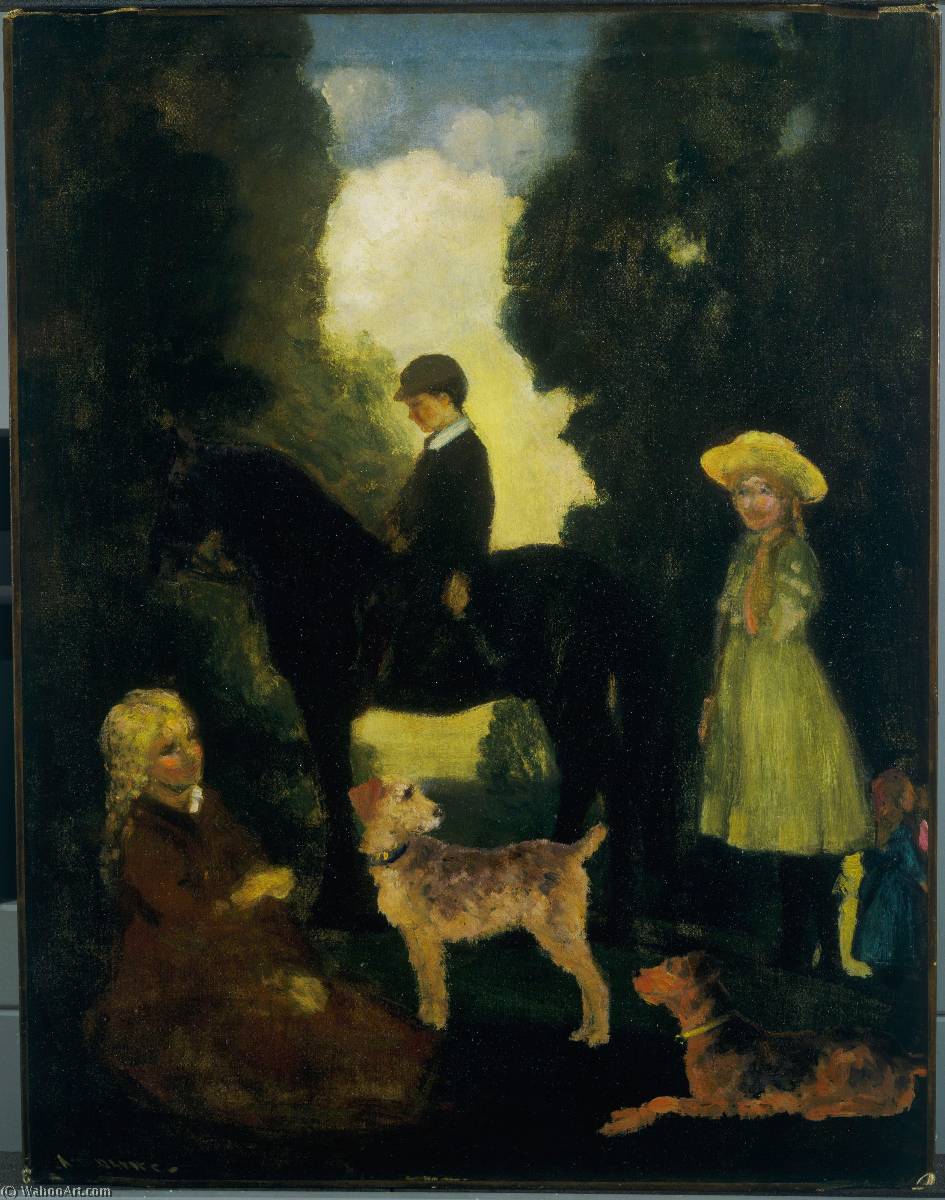
A Mystic in the Modern Age: Exploring Arthur B. Davies’ “Children, Dogs and Pony”
Arthur Bowen Davies (1862 – 1928), born in Utica, New York, stands as a fascinating anomaly within the trajectory of American art—a figure simultaneously rooted in the traditions of landscape painting and propelled forward by the burgeoning currents of European modernism. His artistic journey began with an undeniable reverence for the natural world, fostered by witnessing George Inness’s evocative canvases during a touring exhibition that captivated him and instilled in him a mastery of technique honed through meticulous observation. Yet Davies refused to confine himself solely to replicating picturesque vistas; he possessed an inner conviction—a profound desire to communicate something beyond mere visual representation—a yearning that would define his distinctive artistic vision.
Following formative studies at the Chicago Academy of Design, Davies embarked on a path marked by experimentation and intellectual engagement. He wasn’t merely reacting to stylistic trends; he actively wrestled with philosophical questions about humanity's relationship with nature and spirituality. This preoccupation is powerfully conveyed in “Children, Dogs and Pony,” completed in 1905—a deceptively simple monochrome composition that belies its complex layers of meaning. The painting depicts three children accompanied by dogs and horses against a backdrop of stylized trees, capturing a fleeting moment of idyllic rural life.
Davies’ stylistic approach is characterized by a deliberate restraint – a technique rooted in Impressionistic principles yet tempered with a distinctly American sensibility. He eschewed the vibrant palettes favored by many European contemporaries, opting instead for a muted tonal range that emphasizes form and texture rather than coloristic illusion. This masterful control of pigment allows Davies to capture the subtle nuances of light and shadow, creating an atmosphere imbued with tranquility and warmth. The artist’s meticulous attention to detail—evident in the expressive rendering of the horses' musculature and the careful depiction of foliage—underscores his commitment to portraying nature with uncompromising accuracy.
Beyond its technical prowess, “Children, Dogs and Pony” resonates deeply with symbolic significance. The inclusion of children represents innocence and vitality – qualities Davies wished to celebrate amidst the anxieties of a rapidly changing world. Animals, particularly dogs and horses, symbolize companionship, loyalty, and connection to the earth—themes central to Davies’ broader philosophical concerns. Furthermore, the horse itself carries connotations of nobility and freedom, mirroring Davies' belief in the transformative power of artistic contemplation.
The painting’s emotional impact is palpable. It evokes a feeling of nostalgia for simpler times – a longing for communion with nature and the uncomplicated joys of childhood. Davies skillfully utilizes tonal gradation to convey this mood, drawing viewers into a contemplative space where beauty and serenity reign supreme. “Children, Dogs and Pony” isn't merely a depiction of a pastoral scene; it’s an embodiment of Davies’ artistic philosophy—a testament to his conviction that art can illuminate the deepest recesses of human experience. Its enduring appeal lies in its ability to transport us back to a moment of pure joy and connection – a timeless reminder of the beauty inherent in the natural world and the importance of preserving childlike wonder.