A Glimpse into Romanticism: The Soul of the Orient
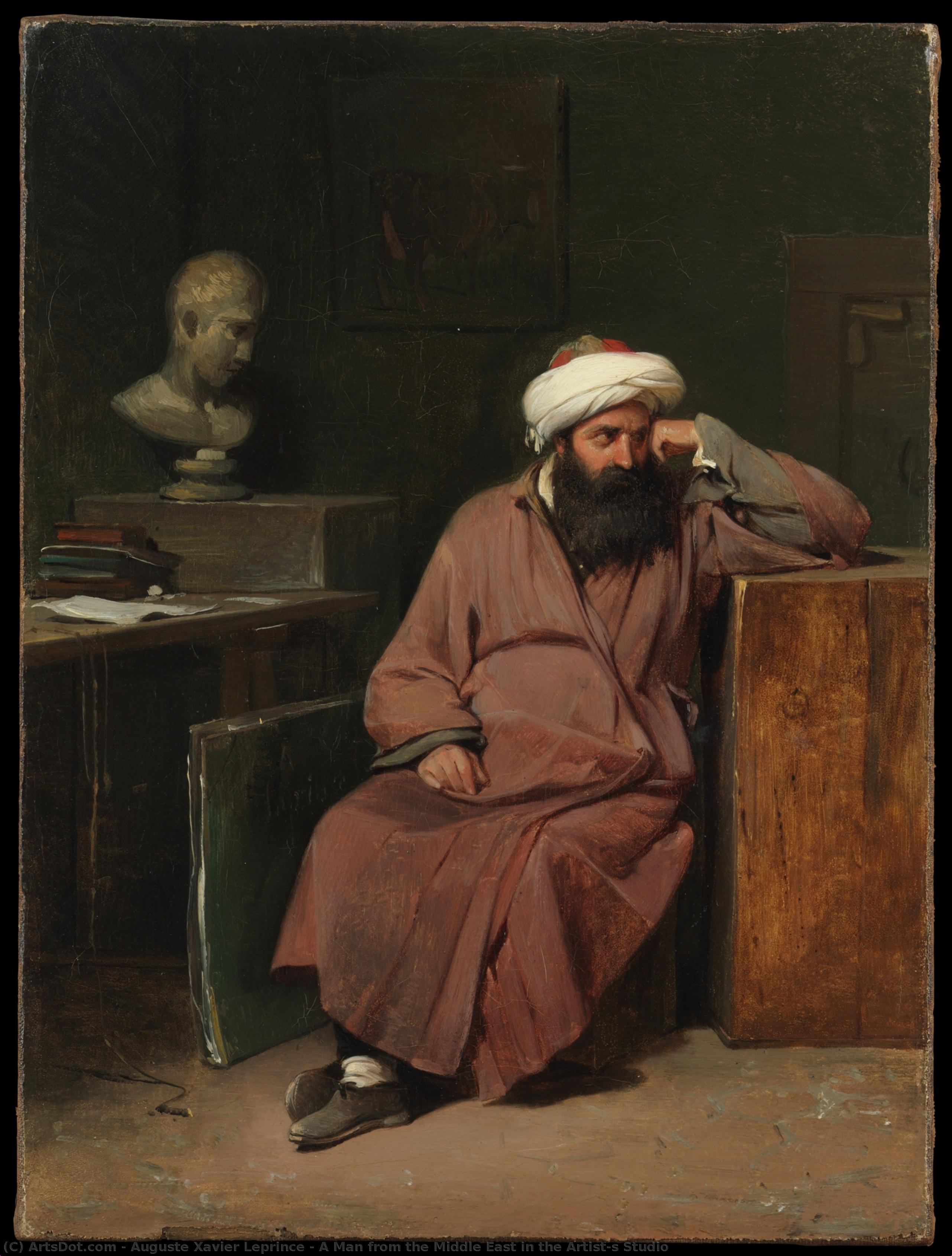
In the quiet intimacy of an artist's studio, Auguste-Xavier Leprince captures a moment that transcends mere portraiture, offering instead a profound meditation on identity and the exotic. A Man from the Middle East in the Artist's Laboratory, completed around 1823, serves as a mesmerizing window into the Romantic era—a period defined by an intense yearning for the unknown and a deep fascination with distant, evocative landscapes. The subject, draped in the rich textures of traditional Middle Eastern attire, sits in a state of pensive repose. With his hands pressed thoughtfully against his face and a turban crowning his brow, he becomes more than a model; he is a symbol of wisdom and spiritual depth, inviting the viewer to contemplate the mysteries of a world far removed from the streets of Paris.
The painting breathes with the atmosphere of 19th-century Orientalism, a movement heavily influenced by Napoleon’s expedition to Egypt. Through Leprince's eyes, we see the influence of contemporaries like Gericault and Girodet, yet there is a unique, understated elegance here that avoids the purely theatrical. The presence of books scattered upon the table suggests a bridge between cultures—a meeting point where Eastern tradition meets Western intellectual inquiry. This subtle narrative layer transforms the studio from a simple workspace into a sanctuary of cross-cultural dialogue and philosophical exploration.
Mastery of Light and Texture
Technically, Leprince demonstrates a virtuosity that belies his tragically short life. The artist employs chiaroscuro with masterful precision, using dramatic contrasts between light and shadow to sculpt the sitter's features and imbue the composition with a palpable sense of volume. Light falls softly across the folds of the man's red robe, highlighting the heavy, luxurious weight of the fabric, while the subtle sheen on his turban provides a brilliant focal point that draws the eye inward. Every brushstroke serves to enhance the realism of the scene, from the weathered texture of the skin to the delicate reflections dancing upon the tabletop.
For the discerning collector or interior designer, this piece offers an unparalleled depth of character. The meticulous rendering of textures—the tactile quality of the cloth, the organic presence of the books, and the soft glow of the background—creates a sensory experience that commands attention. It is a work that does not merely sit upon a wall but actively engages with the space it inhabits, casting a shadow of historical intrigue and sophisticated grace over any room.
An Eternal Legacy for the Modern Collector
To possess a reproduction of this masterpiece is to hold a fragment of history’s most romanticized era. The emotional impact of the work lies in its ability to evoke nostalgia for a time of discovery and profound human connection. It is an ideal selection for those seeking to infuse their interiors with a sense of worldly sophistication and quiet intellectualism. Whether placed in a sunlit library or a moody, contemporary study, Leprince’s vision provides a timeless anchor of beauty and contemplation.
As we look back at the "brilliant flame" of Auguste-Xavier Leprince, we find that his ability to capture the human spirit remains undiminished. This portrait stands as a testament to the enduring power of art to bridge the gap between the familiar and the exotic, making it a cornerstone piece for any collection dedicated to the profound beauty of the Romantic movement.