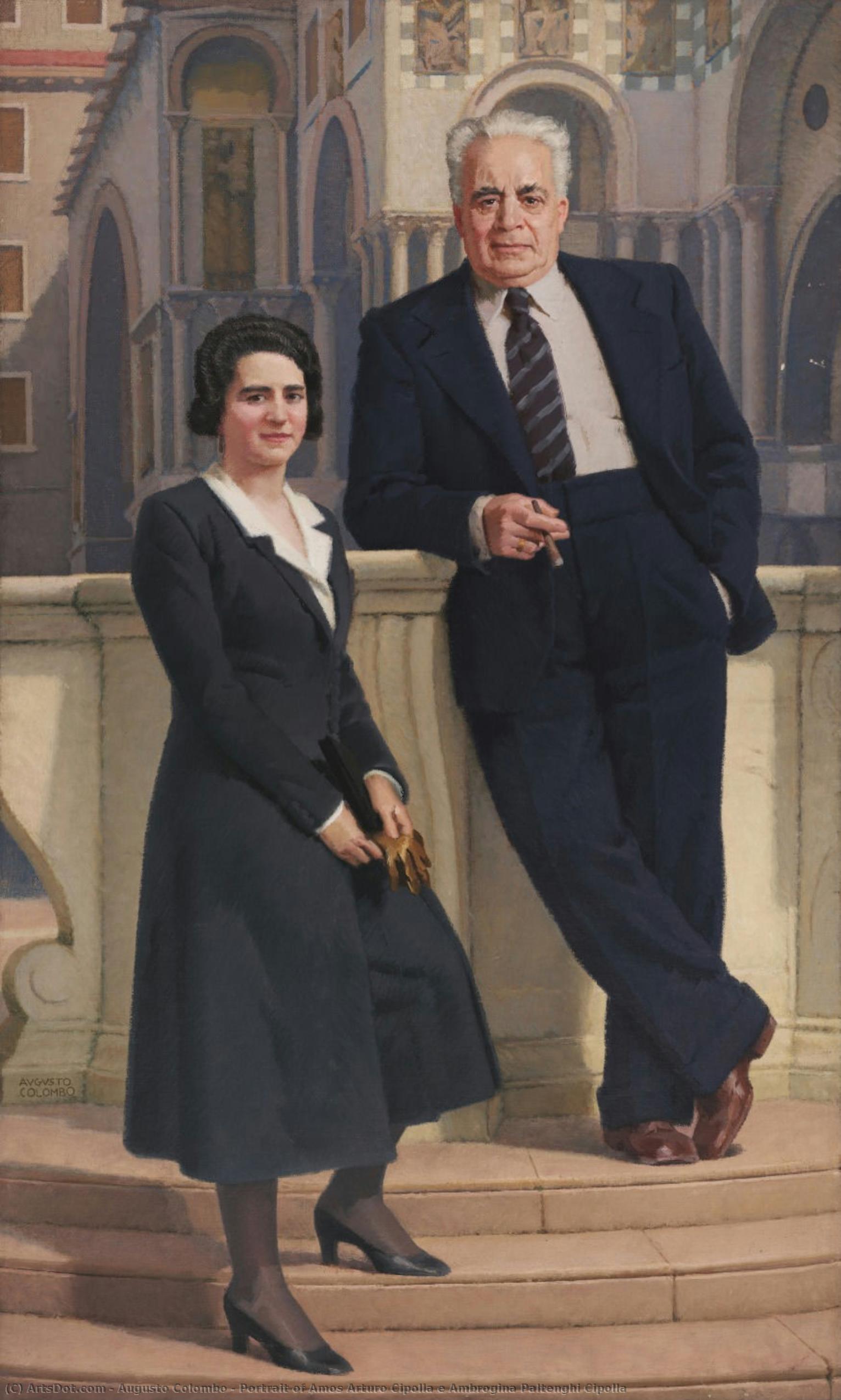
Admire Augusto Colombo’s ‘Portrait of Amos Cipolla,’ a poignant 1940 oil painting featuring a man & his daughter. Explore realism, Venetian backdrop & a touching story of loss & remembrance.
Entdecken Sie Augusto Colombo (1902-1969), einen italienischen Maler, bekannt für große religiöse Kompositionen und Porträts. Erforschen Sie sein Erbe der Mailänder Kunstschule und antifaschistische Themen des 2. Weltkriegs.
Erkunden Sie das Ca' Granda – Ospedale Maggiore Policlinico in Mailand! Entdecken Sie eine tausendjährige Geschichte der biomedizinischen Versorgung und Forschung durch Kunst, Archive, medizinische Instrumente und Meisterwerke von Segantini, Hayez & Carrà. Kostenloser Eintritt. Öffnungszeiten Mo-Sa.
Amos Cipolla, from Lodi, who lost his mother at 4 months and a father at 18, first worked as a baker, then successfully attempted to work as a real estate broker; later he opened a grocery store, also working as a court expert. The great affection of his life is his daughter Ambrogina, who unfortunately dies of a sudden illness. In 1939 his father allocated 100,000 lire to the Ospedale Maggiore in her memory. The commission of the portrait is entrusted to Enrico Sacchetti, who refuses, because, having moved to Florence, he was unable to perform the portrait from life. Then, on the recommendation of the benefactor himself, the task was assigned to Augusto Colombo, fixing the compensation and the delivery. And when Amos Cipolla expresses the desire that the daughter also appears in the picture, Colombo adjusts the fee, asking for an additional 2000 lire. The picture appears less happy than others by the same artist: the combination of two figures, one painted live and the other modeled on a photograph, generates a discontinuity and compositional rigidity between the two subjects. Even the environment, painted with cold colors and very defined backgrounds, does not help to create an atmosphere of everyday life and naturalness: identifiable in a glimpse of the Piazzetta dei Leoncini with the northern side of the Basilica di San Marco in Venice, probably a memory of a happy journey of the benefactor with his daughter, it appears as a theatrical backdrop, on which the two characters seem cut out.