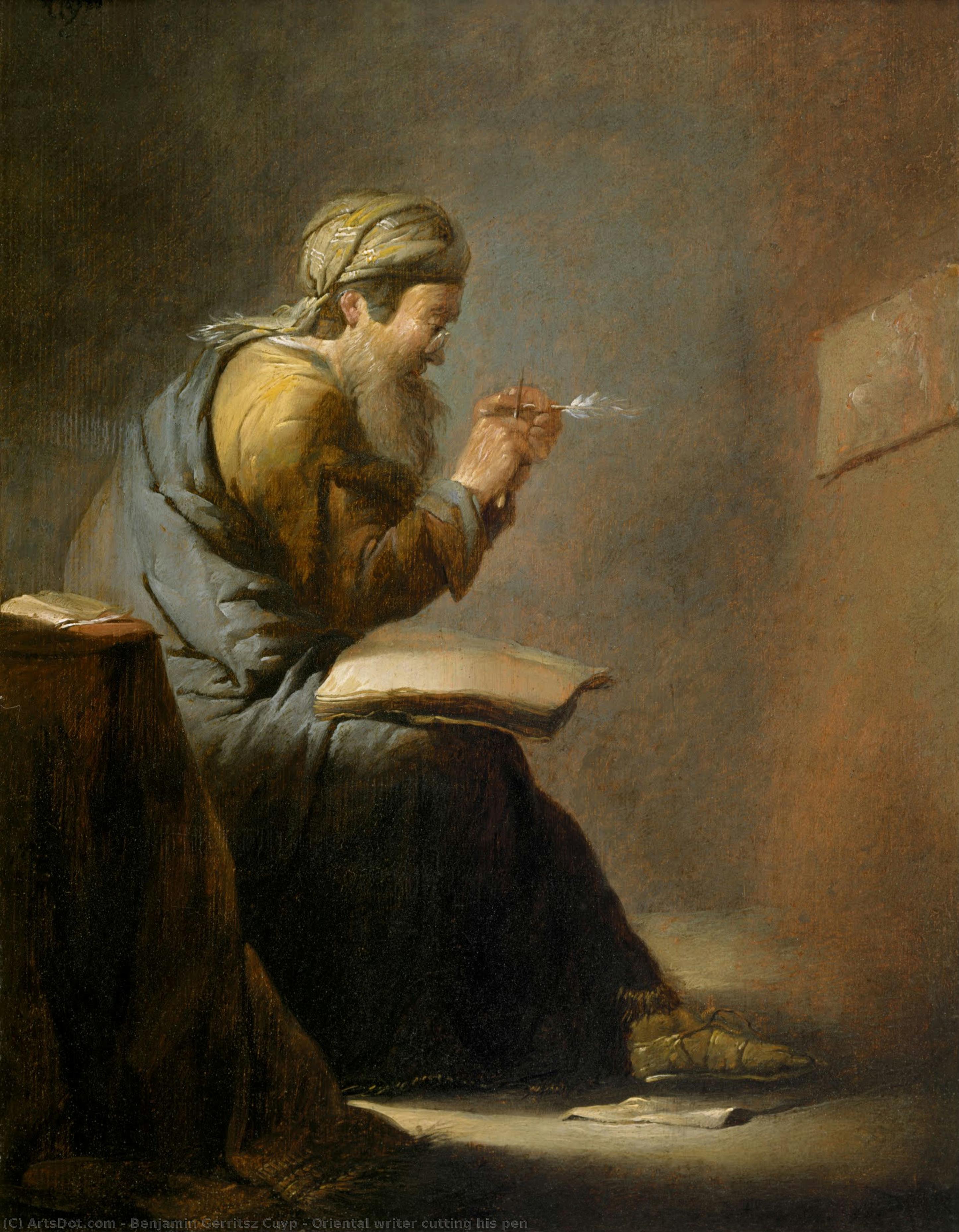
A Moment Frozen in Time: The Intimacy of Benjamin Gerritsz Cuyp
In the quiet, shadowed corners of the Dutch Golden Age, certain paintings possess the power to halt time, inviting the viewer into a private, meditative sanctuary. "Oriental writer cutting his pen" by Benjamin Gerritsz Cuyp is one such masterpiece. This intimate genre scene captures a profound moment of solitary focus, where the world outside ceases to exist, leaving only the rhythmic, tactile ritual of the scholar at work. The subject—an elderly man with a weathered face and a dignified beard—is caught in a state of deep concentration. As he prepares his instrument, there is a palpable sense of patience and devotion to his craft, a quality that resonates deeply with anyone who has ever found solace in the quietude of study or creative labor.
The composition is masterfully orchestrated to draw the eye toward the interplay of light and shadow. The man, adorned in a simple hat that frames his contemplative expression, serves as the emotional anchor of the piece. Around him, the subtle presence of a book and the distant, enigmatic figure in the background suggest a larger narrative of intellectual pursuit and domestic life. A clock, visible upon the wall, acts as a poignant memento mori, a gentle reminder of the fleeting nature of time, contrasting beautifully with the timelessness of the man's focused task. For collectors and interior designers, this painting offers more than mere decoration; it provides a window into a vanished era of contemplative grace.
Mastery of Light and the Dutch Tradition
Technically, the work showcases the remarkable skill Benjamin Gerritsz Cuyp inherited and refined through his connection to the illustrious Cuyp lineage. While his cousin Aelbert would later become famous for sweeping, sun-drenched landscapes, Benjamin found his brilliance in the nuanced textures of genre painting. His brushwork here is deliberate and evocative, capturing the coarse texture of the man's clothing, the soft sheen of his beard, and the heavy, atmospheric quality of the room's shadows. The use of chiaroscuro—the dramatic contrast between light and dark—creates a sense of three-dimensional depth that makes the scene feel remarkably tangible.
The palette is grounded in the earthy, warm tones characteristic of the period, which lends the artwork an enduring warmth. This tonal harmony makes the piece exceptionally versatile for high-end interior curation. Whether placed in a library, a study, or a sophisticated living space, a reproduction of this work brings an air of historical prestige and intellectual depth. It serves as a conversation piece that speaks to the importance of tradition, the beauty of the mundane, and the enduring allure of the Dutch Golden Age's mastery over light and human emotion.