A Dramatic Encounter in the Colonial Wilderness
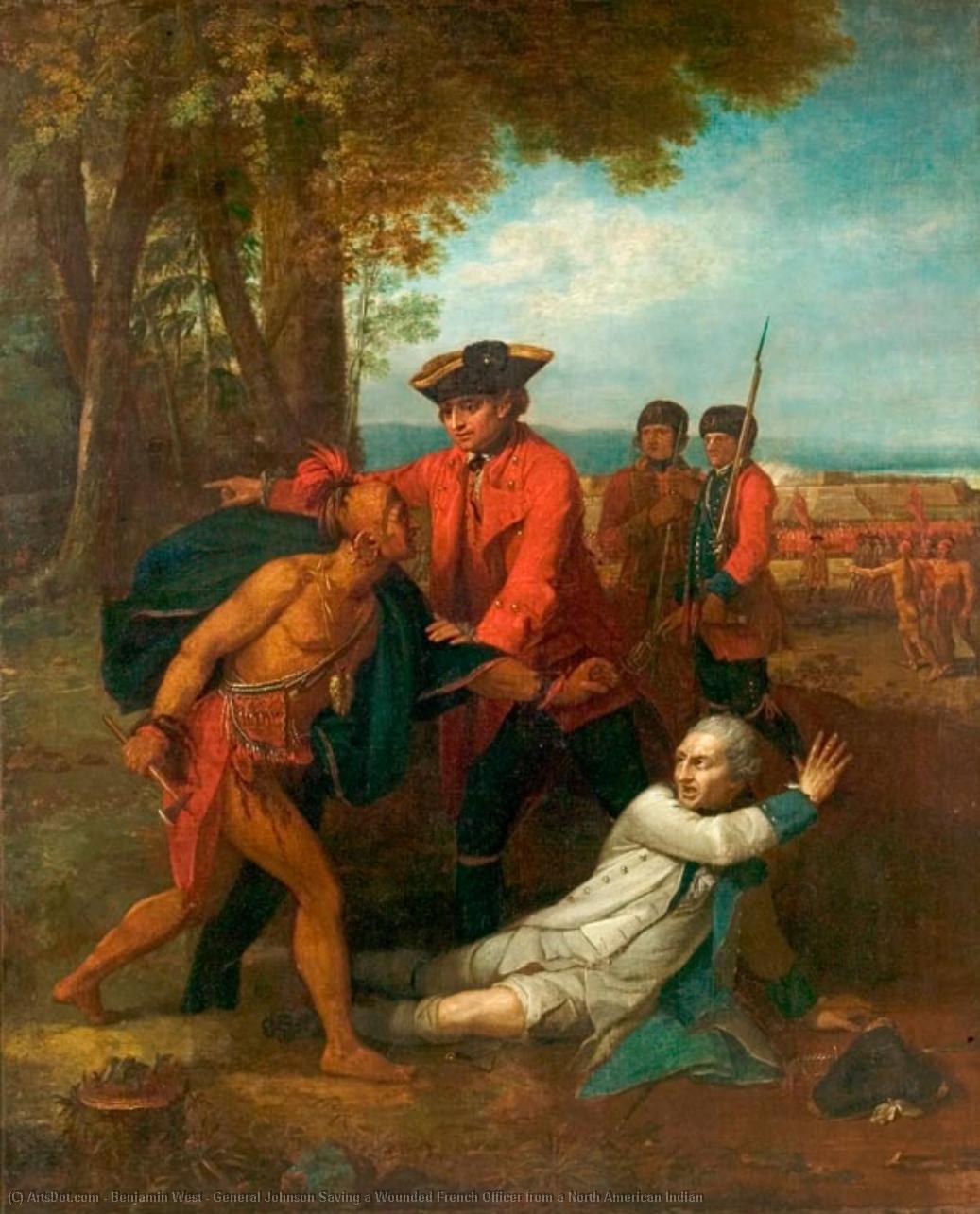
In the heart of a turbulent era, Benjamin West captures a moment of profound tension and unexpected mercy in his 1768 masterpiece, General Johnson Saving a Wounded French Officer from a North American Indian. The canvas unfolds as a theatrical stage where the raw violence of frontier warfare meets a singular act of human compassion. At the center of this swirling drama, a figure clad in striking red stands poised with a sword, his presence commanding the eye amidst the chaos of battle. Below him, a wounded French officer lies vulnerable upon the earth, a poignant symbol of the fragility of life during the colonial conflicts that shaped the North American continent. The composition is masterfully balanced by the presence of horses and secondary figures, creating a sense of depth that pulls the viewer into the thick of the struggle.
West, an artist who famously bridged the gap between the rugged landscapes of his American youth and the refined halls of the British Royal Academy, employs a style that anticipates the emotional intensity of Romanticism while maintaining the structured clarity of Neoclassicism. His technique utilizes light and shadow to sculpt the figures, lending them a monumental quality that elevates this historical event into the realm of epic legend. The brushwork, though precise in capturing the textures of fabric, steel, and skin, possesses an atmospheric fluidity that evokes the humid, unpredictable air of the wilderness. For the discerning collector, this painting offers more than just a depiction of history; it provides a window into the psychological landscape of an era defined by shifting allegiances and the clash of empires.
Beyond its historical documentation, the artwork serves as a profound meditation on the concept of chivalry amidst savagery. The symbolic interplay between the swords, the fallen soldier, and the looming threat of the indigenous warrior creates a narrative arc that explores the thin line between enmity and empathy. This piece is particularly captivating for interior designers seeking to introduce a sense of heritage, drama, and intellectual depth into a space. Whether placed in a grand library or as a focal point in a sophisticated study, a high-quality reproduction of this work brings with it an aura of timeless storytelling. It invites conversation, prompting observers to reflect on the complex layers of human nature—the capacity for conflict and the enduring impulse toward mercy that survives even in the darkest hours of war.