A Monument of Ambition Under Shadow
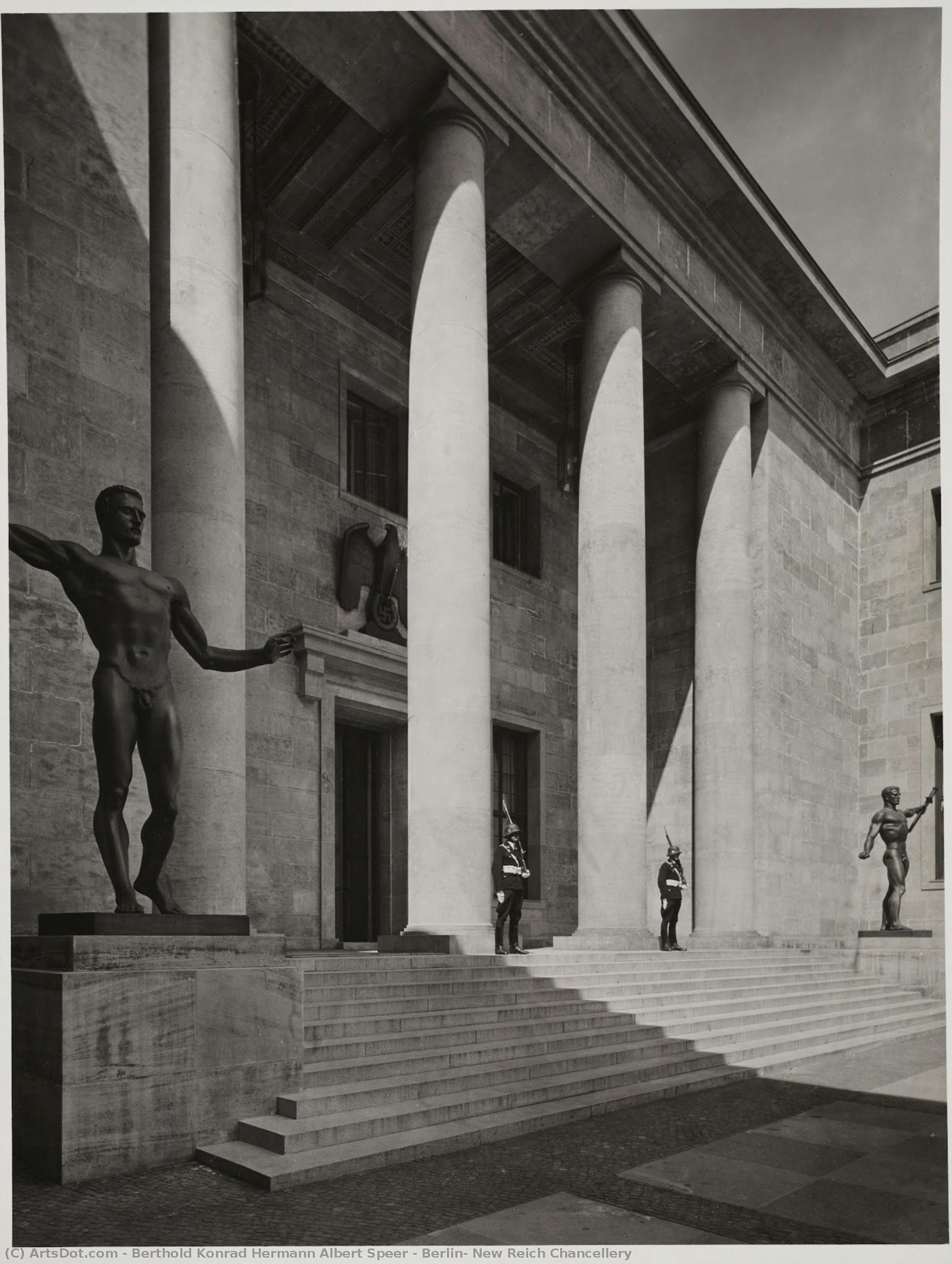
In the stark, monochromatic realm of 1943, a single photograph captures more than just stone and mortar; it freezes a moment of chilling architectural intent. The Berlin New Reich Chancellery, as seen through the lens of Berthold Konrad Hermann Albert Speer, stands as a haunting testament to an era defined by monumentalism and the pursuit of absolute authority. This black and white masterpiece does not merely document a building; it invites the viewer into a world where architecture was weaponized to project permanence, power, and an unyielding grip on history. The image presents a facade that is both breathtaking in its classical grandeur and deeply unsettling in its historical weight, making it a profound subject for those who appreciate art that challenges the conscience as much as it delights the eye.
The technical execution of this photograph reveals Speer’s innate understanding of scale and drama. Utilizing what was likely a large-format camera to achieve exceptional sharpness, the composition employs a low perspective that forces the viewer’s gaze upward, exaggerating the height of the edifice. The symmetry is near-perfect, creating a sense of rigid stability that mirrors the political ideology of the time. Through the masterful use of light and shadow, the photograph breathes life into the cold stone; sunlight streams between massive Corinthian columns, casting deep, dramatic shadows across the steps. This interplay of light creates a rhythmic verticality, where the heavy horizontal lines of the facade provide a grounding force, resulting in a composition that feels both expansive and claustrophobically controlled.
The Intersection of Form and Ideology
To gaze upon this work is to witness the fusion of classical aesthetics with a dark, utilitarian purpose. The architectural details—the meticulous columns, the imposing statues, and the sweeping staircases—are direct echoes of Roman triumphalism, designed to evoke an era of eternal empire. Every texture captured in the silver gelatin print, from the granular roughness of the stone to the smooth, almost ethereal surfaces of the flanking statues, contributes to a sense of overwhelming physical presence. The use of a wide-angle perspective captures the sheer breadth of the Chancellery, ensuring that the viewer feels small in the face of such engineered greatness.
For the discerning collector or interior designer, this piece offers a complex emotional resonance. It is a study in contrast: the beauty of classical proportion set against the grim reality of its historical context. The grayscale spectrum, ranging from the deepest blacks to brilliant whites, provides a sophisticated palette that integrates seamlessly into modern, minimalist, or even more traditional, dramatic interiors. As a reproduction, it serves as a powerful conversation piece—a window into a moment where art, architecture, and politics collided with devastating force. It is an evocative acquisition for those who seek artworks that possess not only aesthetic merit but also a profound, lingering historical significance.