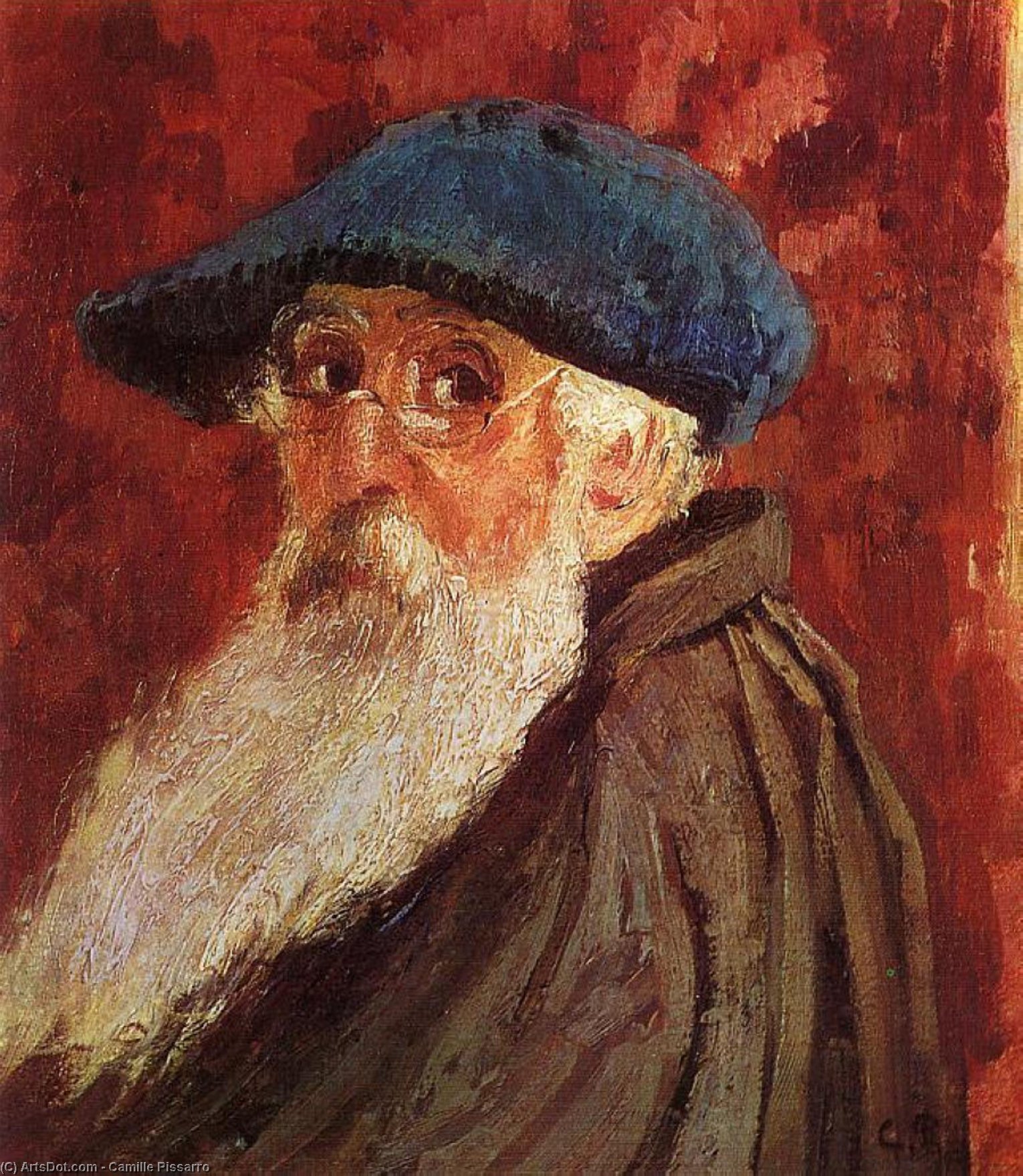
Explore Camille Pissarro’s ‘Self Portrait 1,’ a striking oil painting showcasing an elderly artist’s wisdom & melancholy. Impressionistic realism meets emotional depth.
Erkunden Sie die Kunst von Camille Pissarro: Impressionistische und Neo-Impressionistische Landschaften und Alltagsszenen. Eine zentrale Figur, die Van Gogh, Cézanne und mehr beeinflusste.
Subject and Symbolism
The canvas invites the viewer into an intimate conversation with a weathered face that bears the quiet weight of years lived in observation. A long white beard curls like riverbanks, framing eyes that have seen both light and shadow. The blue cap, simple yet dignified, anchors the portrait in a moment of stillness, while the warm wash of reds and oranges behind him suggests the fleeting blaze of memory. In this self‑portrait, Pissarro turns his own gaze inward, offering a mirror not only to himself but to every observer who has ever paused to contemplate the passage of time.
Style and Technique
Pissarro’s brushwork here is a dialogue between Impressionist spontaneity and Post‑Impressionist deliberation. Thick impasto layers burst from the canvas, especially along the beard and cloak, creating a tactile surface that seems almost alive under the eye. The loose strokes capture light as it falls from the upper left, casting gentle shadows that sculpt the face with an almost sculptural depth. Organic shapes dominate: the rounded head, the soft curves of the beard, the fluid folds of the cap—all rendered with expressive lines rather than precise detail. This technique invites the viewer to feel the texture and to sense the artist’s hand in every gesture.
Historical Context
Emerging from a life steeped in observation, Pissarro’s self‑portrait reflects his lifelong dialogue with nature and society. Born in 1830 on the island of St. Thomas, he carried a multicultural heritage that informed his sensitivity to light and color. By the time he painted this work, Impressionism had already reshaped the art world, yet Pissarro remained steadfast in his commitment to capturing fleeting moments. This portrait stands as a testament to an artist who, even in his later years, continued to explore the interplay of form, color, and emotion.
Emotional Impact and Inspiration
The painting’s emotional resonance lies in its honest portrayal of aging wisdom coupled with a subtle melancholy that hums beneath the surface. The warm background hues contrast with the cooler tones of the figure, creating a visual tension that mirrors the internal dialogue between past experiences and present reflection. For collectors and interior designers alike, this work offers more than aesthetic appeal; it becomes a focal point that invites contemplation, sparks conversation, and enriches any space with its layered narrative of time, memory, and artistic devotion.