A Symphony of Fire and Breath: Rediscovering Ulrich’s Murano
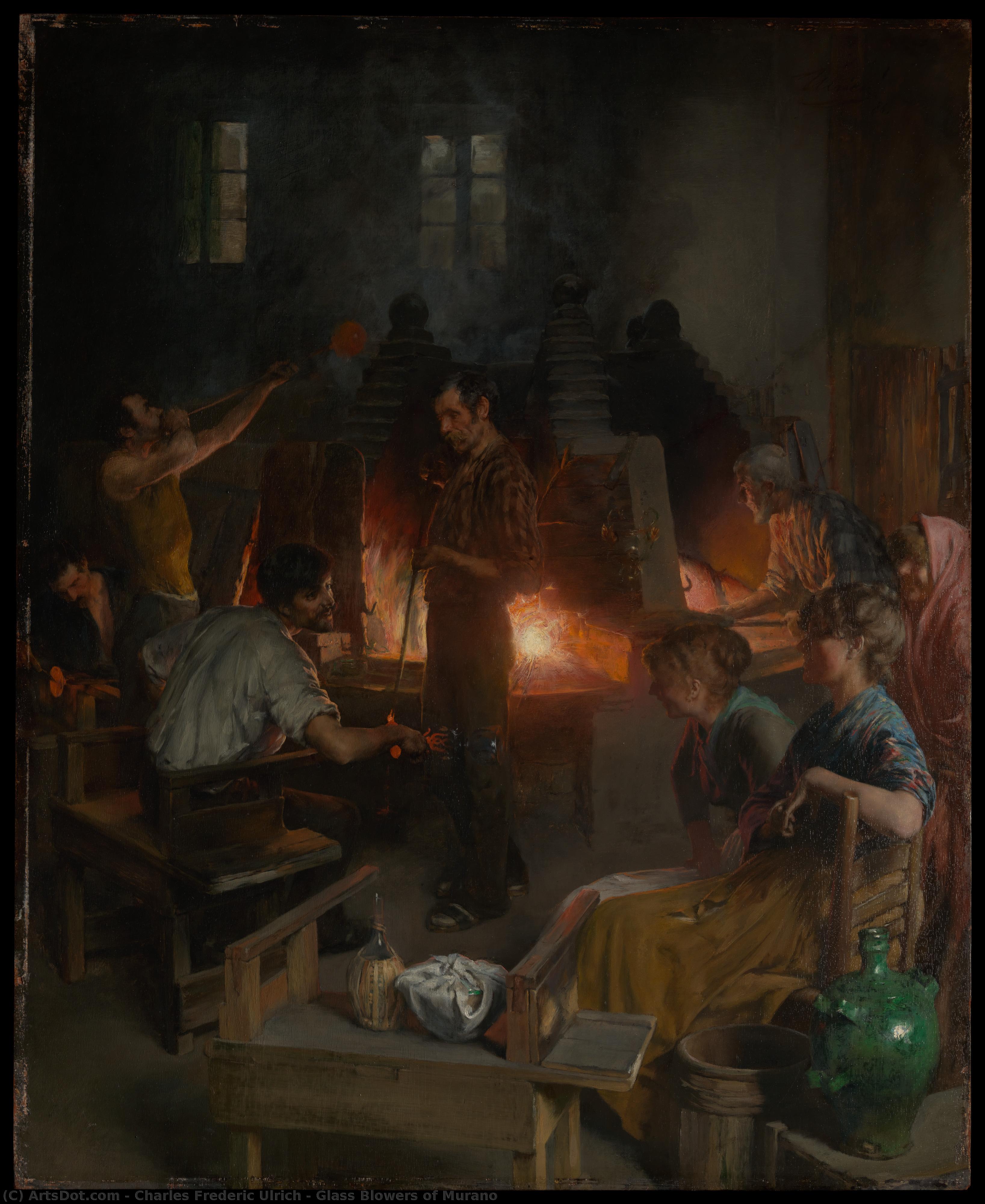
In the quiet, amber-hued depths of Charles Frederic Ulrich’s 1886 masterpiece, "Glass Blowers of Murano," one does not merely observe a scene; one enters a sanctuary of ancient skill. The canvas serves as a profound window into the heart of Venetian craftsmanship, capturing a pivotal era when the legendary art of glassblowing was undergoing a spirited renaissance. Ulrich, an American artist who found his muse amidst the storied landscapes of Europe, masterfully orchestrates a narrative of labor and light. As we gaze upon the workshop, we are drawn into a collaborative dance of artisans, their silhouettes etched against the glow of molten silica, embodying the very essence of the Arts and Crafts movement’s reverence for the handmade.
The painting transcends simple documentation to become an emotional journey through the physical demands of creation. There is a palpable tension in the air—a mixture of intense heat and focused stillness. The workshop itself, furnished with the humble tools of the trade, feels lived-in and sacred. Through Ulrich’s eyes, the heavy crucibles and sturdy benches are not just objects, but silent witnesses to a lineage of mastery passed down through generations. For the collector or the interior designer, this piece offers more than decoration; it provides a soulful anchor, bringing a sense of historical weight and artisanal dignity to any curated space.
The Alchemy of Light and Impressionistic Grace
Technically, Ulrich employs an approach that leans into the burgeoning impressionistic currents of the late nineteenth century. Rather than adhering to the rigid, clinical precision of academic realism, he prioritizes the atmosphere of the moment. The palette is a sophisticated arrangement of earthy, muted tones—deep ochres, burnt umbers, and soft shadows—which are brilliantly punctuated by the warm, incandescent splashes of light emanating from the glass itself. This interplay of light and shadow creates a sense of depth that pulls the viewer toward the center of the action, where the liquid fire meets the breath of the maker.
His brushwork is deliberate yet fluid, capturing the ephemeral quality of light as it diffuses through the workshop’s hazy air. This technique allows the boundaries between the artisans and their environment to soften, suggesting that the men and their craft are one single, breathing entity. The subtle textures of the wood, the metallic sheen of the tools, and the translucent glow of the cooling glass are rendered with a sensitivity that rewards prolonged contemplation. It is this mastery of light that transforms a scene of manual labor into a poetic meditation on the beauty of human endeavor.
A Timeless Legacy for the Modern Collector
To possess a reproduction of "Glass Blowers of Murano" is to invite a piece of history into the contemporary home. In an age dominated by mass production, Ulrich’s work stands as a defiant celebration of the unique and the meticulously crafted. The painting evokes a sense of nostalgia for a time when art was inseparable from the hands that shaped it. It serves as an inspiring focal point for those who appreciate the intersection of industrial history and fine art, offering a sophisticated aesthetic that complements both classical and modern interior design palettes.
Whether placed in a sunlit library or a moody, formal study, this artwork radiates a quiet strength. It speaks to the enduring human spirit—the desire to take raw, elemental materials and transform them into something of exquisite beauty. For the discerning enthusiast, Ulrich’s vision remains as luminous today as it was in 1886, offering a perennial source of inspiration and a profound connection to the storied heritage of Venice.