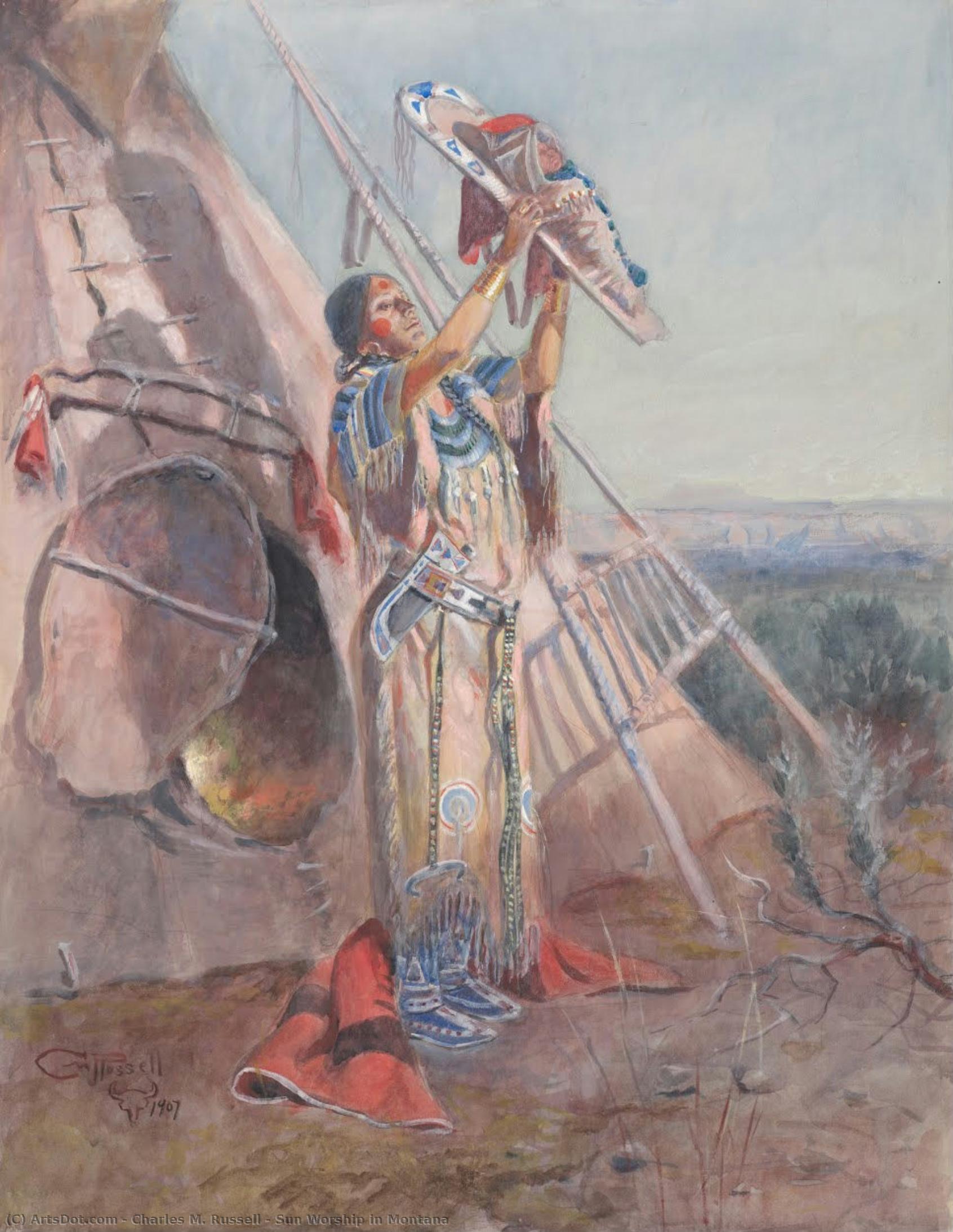
A Window into the American West: Charles Marion Russell’s “Sun Worship in Montana”
Charles Marion Russell's "Sun Worship in Montana," painted in 1907, isn’t merely a depiction of an Indigenous ceremony; it’s a profound immersion into the soul of the American West. This oil painting, now housed within the Amon Carter Museum of American Art, captures a pivotal moment – a ritualistic gathering under the vast, open sky of Montana's Judith Basin. Russell, deeply influenced by his years spent as a cowboy and his genuine fascination with Native American culture, masterfully blends realism with a romanticized vision of the frontier, creating an image that resonates with both historical accuracy and emotional depth.
The composition immediately draws the eye to the central figure, an Indigenous man adorned in traditional attire. He’s not presented as a static subject but rather as an active participant, seemingly engaged in a complex ceremony involving drums and poles arranged around him. The hazy landscape behind – a suggestion of rolling hills and distant mountains – establishes a sense of immense scale and isolation, perfectly mirroring the spirit of the West. Russell's brushwork is immediately apparent; visible impasto techniques build texture across the canvas, lending a tangible quality to the fabrics, drums, and even the very air of the scene. The use of lines is deliberate, defining the man’s form with confident strokes while subtly shaping the surrounding elements – a testament to his understanding of both anatomical structure and dynamic composition.
The Cowboy Artist and His Native American Subjects
Charles Marion Russell's relationship with Native American culture was complex and evolving. Initially, he sought to capture the romanticized image of the cowboy, but as he spent time among various tribes – particularly the Blackfeet – his perspective shifted dramatically. “Sun Worship in Montana” exemplifies this transformation. It’s a far cry from the simplistic stereotypes often perpetuated at the time; instead, Russell portrays the ceremony with respect and an evident desire to understand its significance. The painting reflects Russell's deep immersion into the daily life of Native Americans, capturing not just their appearance but also their spiritual practices.
Russell’s decision to paint this scene was likely influenced by his time living among the Blackfeet people. He meticulously documented their rituals and beliefs, striving to represent them authentically. The symbolism within the painting is rich: the drums and poles are not simply decorative elements but integral components of a sacred ceremony, representing connection to the earth, ancestors, and the divine. The figure’s posture and gaze suggest a deep concentration, inviting the viewer to contemplate the mysteries of the ritual.
Technique and Historical Context
“Sun Worship in Montana” is executed in oil paints on canvas, utilizing a technique that balances realism with expressive brushwork. The muted color palette – dominated by earthy tones—evokes the rugged beauty of the Montana landscape and the solemnity of the ceremony. Russell’s use of light is particularly noteworthy; it's soft and diffused, casting subtle shadows that enhance the three-dimensionality of the figures and objects. Note the flattened perspective, a stylistic choice common in Western art of the period, prioritizing narrative clarity over strict adherence to linear perspective.
Painted in 1907, this work reflects the burgeoning interest in the American West during the Progressive Era. Russell’s paintings were immensely popular, contributing significantly to the romanticized image of the frontier and shaping public perceptions of Native Americans. However, it's crucial to acknowledge that Russell’s portrayal, while more nuanced than some of his earlier works, still carries within it elements of colonial gaze – a Western artist interpreting and presenting a culture he didn’t fully understand. Despite this complexity, “Sun Worship in Montana” remains a powerful testament to Russell’s artistic talent and his evolving understanding of the American West.
Resources for Further Exploration