A Moment Frozen in Light: Claude Monet’s ‘Red and Pink Poppies’
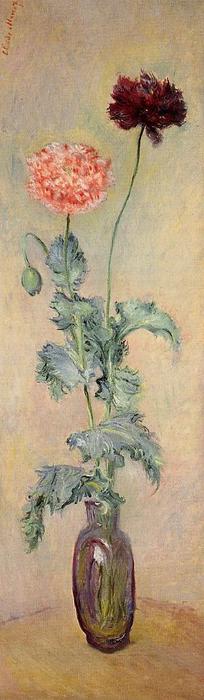
Claude Monet's 'Red and Pink Poppies,' painted in 1883, isn’t merely a depiction of flowers; it’s an exquisite distillation of Impressionism’s core philosophy – capturing the ephemeral beauty of light and atmosphere. This intimate still life, housed within the confines of a simple vase on a table, transcends its subject matter to become a profound meditation on perception itself. Monet wasn't interested in rendering photographic realism; instead, he sought to translate his immediate sensory experience onto canvas, inviting the viewer to share in that fleeting moment of observation.
The painting’s composition is deceptively simple. A cluster of vibrant poppies – one a bold crimson, the other a delicate blush pink – dominates the foreground, their velvety petals seemingly radiating with captured sunlight. The background fades into a soft, hazy grey, suggesting an outdoor setting and emphasizing the flowers' luminosity. Notice how Monet doesn’t meticulously detail each petal; rather, he employs loose, broken brushstrokes to create a sense of shimmering movement and diffused light. This technique is characteristic of Impressionism – prioritizing the *impression* of color and form over precise representation.
The Language of Light: Monet's Revolutionary Technique
Monet’s mastery lies in his innovative use of color and brushwork. He built up layers of paint, often applying them directly to the canvas wet-on-wet, allowing the colors to mingle and blend optically. This creates a remarkable sense of luminosity – as if the poppies themselves are glowing from within. The subtle gradations of pinks and reds, achieved through careful layering and juxtaposing complementary hues, contribute significantly to the painting’s vibrant yet delicate quality. He was deeply influenced by Eugène Boudin, who encouraged him to paint *en plein air* (outdoors), directly observing nature's effects on light and color.
Furthermore, Monet employed a technique known as ‘optical mixing.’ Rather than blending colors physically in the palette, he placed them side-by-side on the canvas, allowing the viewer’s eye to blend them together. This resulted in a richer, more vibrant effect than traditional blending methods would achieve. The loose brushstrokes and lack of sharp outlines further enhance this optical illusion, dissolving the forms into shimmering patches of color.
Symbolism and Emotional Resonance
While seemingly a straightforward floral arrangement, ‘Red and Pink Poppies’ carries layers of symbolic meaning. Poppies have long been associated with remembrance, particularly in relation to soldiers lost in war – a connection that resonates deeply within the context of the late 19th century. However, Monet's focus isn't on mourning; instead, he captures the transient beauty and joy inherent in nature’s cycles. The poppies represent fleeting moments of pleasure and vibrancy, reminding us to appreciate the present moment.
The painting evokes a sense of tranquility and serenity. It’s not a dramatic or imposing scene, but rather an intimate glimpse into a quiet corner of Monet's garden at Giverny. The soft light, delicate colors, and loose brushwork create a feeling of warmth and optimism – inviting the viewer to pause and contemplate the simple beauty of life.
A Legacy of Impressionism
‘Red and Pink Poppies’ stands as a quintessential example of Monet's revolutionary approach to painting. It exemplifies his dedication to capturing fleeting moments, prioritizing light and color over precise detail. This work profoundly influenced subsequent generations of artists, shaping the course of modern art and establishing Impressionism as one of the most significant movements in Western art history. Reproductions of this iconic piece offer a beautiful way to bring a touch of Monet’s luminous vision into any space – a reminder that even the simplest subjects can hold profound beauty when viewed through an impressionistic lens.