A Vision of Solitude: The Spiritual Depth of St John the Baptist
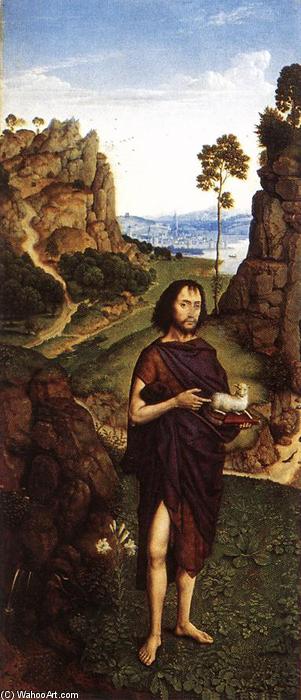
In the quietude of the Early Netherlandish tradition, few works capture the essence of ascetic devotion as poignantly as Dieric Bouts the Younger’s St John the Baptist. Created around 1470, this masterpiece serves as a profound window into a period where art and piety were inextricably linked. The painting presents the saint not merely as a historical figure, but as an emblem of spiritual fortitude. Standing solitary within a rugged, mountainous landscape, John is depicted in a moment of deep contemplation. His presence is both commanding and humble, a duality that defines his role as the precursor to Christ. As the viewer’s eye wanders from the textured folds of his purple drapery to the distant, hazy peaks of the mountains, one feels the weight of his isolation and the immense strength found in silent prayer.
The composition is a masterclass in the use of landscape to mirror internal psychological states. The dramatic backdrop of craggy terrain serves as a deliberate biblical allusion to the prophet Elijah, grounding the saint within a lineage of desert-dwelling mystics. Through the gaps in the rocky formations, a distant cityscape emerges, suggesting the world that John has renounced in favor of the wilderness. This interplay between the wild, untamed earth and the far-off civilization creates a sense of profound depth and scale, inviting the observer to contemplate their own relationship with the material and spiritual realms.
Mastery of Light and Texture in the Flemish Tradition
Technically, this work is a testament to the incredible precision achieved by the masters of the Leuven school. Adhering to the stylistic legacies of Jan van Eyck and Rogier van der Weyden, Bouts the Younger utilizes the medium of oil on panel to achieve an almost tactile realism. Every element of the painting is rendered with meticulous care; the roughness of the stones, the delicate foliage clinging to the earth, and the heavy, rhythmic folds of the saint's garment all possess a palpable presence. The artist’s ability to manipulate light—diffusing it softly across the scene—avoids harsh shadows, instead creating a luminous atmosphere that seems to emanate from within the painting itself.
For the discerning collector or interior designer, this piece offers an unparalleled sense of atmospheric richness. The palette, dominated by cool blues and verdant greens in the distance, provides a serene contrast to the warmer, earthy tones of the foreground. This careful balance of color ensures that the work can serve as a sophisticated focal point in any curated space, bringing a sense of calm, historical gravity, and intellectual depth to a room. It is not merely a decoration, but an invitation to stillness.
A Timeless Symbol of Humility and Grace
Beyond its technical brilliance, the true power of St John the Baptist lies in its emotional resonance. The small plate held in the saint's hand, containing simple sustenance, acts as a subtle symbol of sacrifice and communion. It reminds us of the beauty found in simplicity and the dignity inherent in a life dedicated to a higher purpose. In an era of constant movement and noise, this painting offers a sanctuary of stillness.
Whether viewed as a historical artifact of the Burgundian Netherlands or as a contemporary piece of fine art, the work remains eternally relevant. It embodies the humanist spirit of the 15th century—a period that sought to find the divine within the details of the natural world. Owning a high-quality reproduction of this work allows one to bring this legacy of contemplative beauty into the modern home, fostering an environment of reflection, grace, and enduring artistic inspiration.