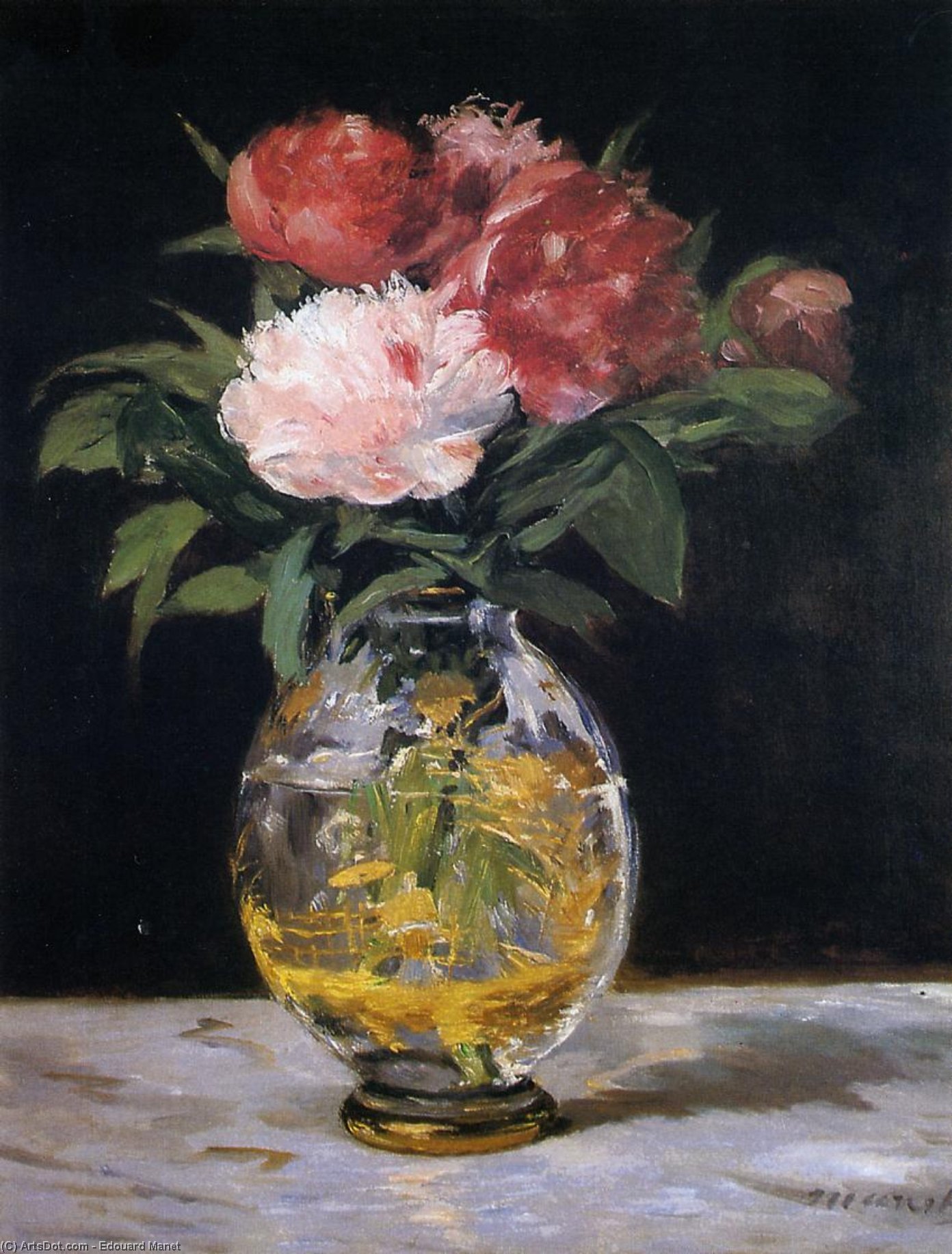
Bouquet of Flowers: A Symphony of Impressionism by Édouard Manet
Édouard Manet, a French painter and printmaker, stands as an undeniable cornerstone of modern art history. His oeuvre transcends mere representation; it embodies a radical reimagining of artistic expression—a shift away from academic conventions toward capturing fleeting moments of sensory experience. Among his celebrated works,
Bouquet of flowers (1882), residing in the Murauchi Art Museum in Tokyo, exemplifies Manet’s masterful grasp of Impressionist principles and his profound ability to distill the essence of everyday life into a visually arresting tableau. This painting isn't simply an arrangement of blossoms; it’s a deliberate manifesto of artistic innovation.
Impressionism and Manet’s Revolutionary Style
Manet’s contribution wasn’t merely stylistic—it was transformative. He spearheaded the movement away from Realism, championed by artists like Gustave Courbet, toward Impressionism, pioneered by Claude Monet and Pierre-Auguste Renoir. Unlike his predecessors who meticulously rendered detail with painstaking accuracy, Manet embraced loose brushstrokes and vibrant hues—techniques designed to convey not what the eye sees directly but rather how light dances upon surfaces. This approach profoundly influenced subsequent generations of artists, establishing a new paradigm for artistic exploration. Consider how Courbet’s unflinching depictions of laborers contrasted sharply with Manet's focus on capturing atmospheric conditions and subjective perception.
Composition and Color Palette: Capturing Ephemeral Beauty
The composition of
Bouquet of flowers is deceptively simple—a vase brimming with pink roses and purple flowers positioned on a tabletop. However, this apparent simplicity belies a carefully considered arrangement that directs the viewer’s gaze. Manet skillfully utilizes color to heighten emotional impact. The dominant shades of pink and violet imbue the scene with tenderness and elegance, mirroring the fleeting beauty of springtime blossoms. He eschews traditional chiaroscuro—the dramatic interplay of light and shadow—favoring instead diffused illumination that softens contours and enhances luminosity. This technique underscores Manet’s belief that art should strive to emulate nature's transient qualities.
Symbolism Beyond Decoration: A Reflection of Artistic Philosophy
More than just aesthetically pleasing,
Bouquet of flowers embodies Manet’s philosophical stance—a conviction that beauty resides in the commonplace. He elevates a humble floral arrangement to an artistic statement, demonstrating his ability to find grandeur within simplicity. The choice of roses and violets carries symbolic weight: roses representing love and passion, violets symbolizing modesty and remembrance. These elements resonate with broader themes of life’s fleeting moments and the importance of appreciating beauty wherever it may be found—a core tenet of Impressionist thought.
A Legacy Enduring Through Reproduction
Today, reproductions of
Bouquet of flowers continue to captivate audiences worldwide. At
ArtsDot.com, we offer meticulously crafted oil painting reproductions that faithfully recreate Manet’s original vision—allowing collectors and interior designers alike to experience the sublime beauty of this iconic artwork in their own homes. Explore our collection /art/list/?Filter=8YDMFW-Edouard-Manet-Pinks-and-Clematis-in-a-Crystal-Vase) for exceptional quality and artistic inspiration. Furthermore, delve into the broader context of Manet’s oeuvre at the Staatliche Museen zu Berlin /art/list/?Filter=A@D3BCSB-Discover-the-Staatliche Museen-zu-Berlin-Germany)), where you can admire masterpieces by Impressionists and other influential artists from the 19th century.