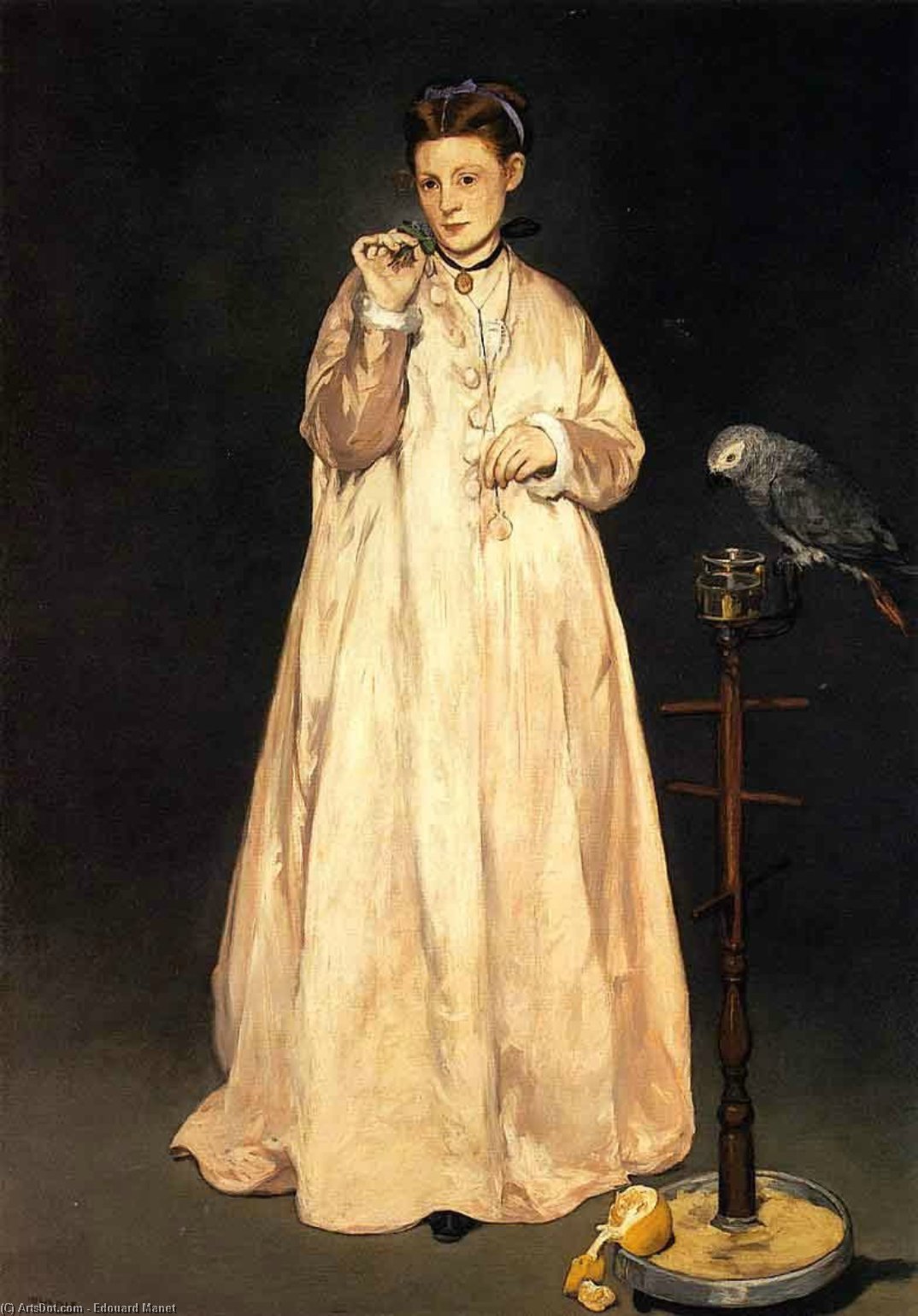
Woman with a Parrot: A Parisian Moment Captured by Manet
Édouard Manet’s
Woman with a Parrot, created in 1866, stands as a pivotal work within the burgeoning Impressionist movement and a testament to Manet’s unwavering commitment to portraying modern life with unprecedented honesty. Measuring 185 x 128 cm and currently residing at the Metropolitan Museum of Art in New York—a location that underscores its significance—the painting transcends mere visual representation, delving into themes of domestic tranquility juxtaposed against societal anxieties.
The Composition and Symbolism – A Dialogue Between Tradition and Innovation
Manet’s artistic vision is immediately striking: a woman dressed in white satin reclines gracefully on a chaise lounge, attended by a parrot perched delicately upon her shoulder. Alongside her sits another bird—a smaller specimen—resting peacefully on the table beside a bowl of fruit. This seemingly simple arrangement embodies profound symbolism. The dominant placement of the parrot on the right side creates visual balance, mirroring the woman’s position on the left. White satin represents purity and innocence, reflecting Manet's desire to portray an idealized feminine figure within the context of contemporary Parisian society. However, the inclusion of birds—particularly parrots—holds deeper connotations of freedom and exotic beauty, hinting at a yearning for escape from restrictive social conventions prevalent during the Second Empire. The table’s fruit symbolizes nourishment and abundance, yet its scattered placement subtly underscores the fragility of domestic harmony.
Artistic Style and Technique – Embracing Flatness and Light
Manet's stylistic approach distinguishes him from his predecessors—primarily Academic painters—who adhered to meticulous detail and illusionistic perspective. Instead, he adopted a flattened pictorial space characteristic of early Impressionism, prioritizing the capture of fleeting light effects over precise anatomical rendering. This deliberate simplification reflects Manet’s fascination with capturing the immediacy of experience, mirroring the spirit of the era. The artist skillfully employs muted pastel hues—primarily creams, whites, and pale greens—to create an atmosphere of serene stillness. Brushstrokes are loose and visible, conveying texture without striving for photorealistic accuracy. Notably, Manet eschewed glazing techniques favored by older masters, opting instead for direct application of pigment onto the canvas—a revolutionary decision that propelled him toward a more truthful representation of reality.
Historical Context – Reflecting Parisian Life and Artistic Debate
Woman with a Parrot debuted at the Salon of 1867 in Paris—an event fraught with artistic controversy. Critics vehemently denounced Manet’s daring departure from traditional conventions, accusing him of vulgarity and lacking seriousness. However, influential figures like Gustave Courbet championed Manet's innovative style, recognizing its ability to convey emotion and capture the essence of modern life. The painting served as a catalyst for discussions about artistic freedom and the role of art in reflecting societal values—debates that continue to resonate today.
Legacy – An Inspiration for Future Artists
Manet’s influence extends far beyond his own lifetime, inspiring generations of artists who followed him into Impressionism and subsequent movements. Jonathan Eastman Johnson, a co-founder of the Metropolitan Museum of Art, recognized Manet's pioneering spirit—particularly in portraying everyday scenes with unflinching honesty—as embodying the core principles of modern art. The painting’s enduring appeal lies not only in its aesthetic beauty but also in its profound exploration of human psychology and social commentary. For those seeking to immerse themselves in the artistic heritage of Paris,
Woman with a Parrot remains an unforgettable masterpiece—a symbol of artistic innovation and a celebration of Parisian culture. Furthermore, visiting Musée Voor Moderne Kunst Arnhem offers invaluable insight into the broader context of European art history during this transformative period.