A Visceral Window into Viennese Expressionism
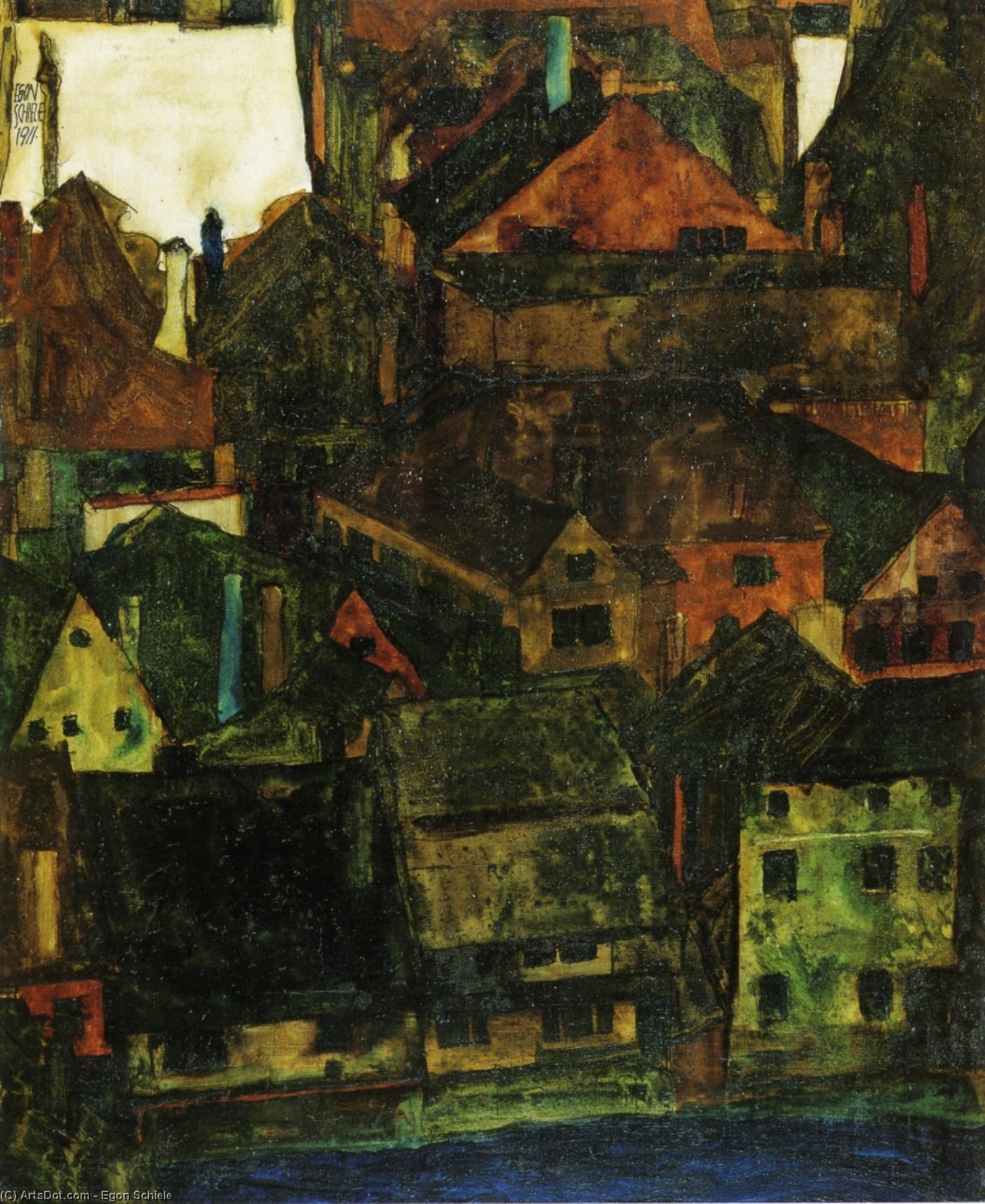
In the quiet corners of art history, few works capture the turbulent psyche of the early twentieth century as poignantly as Egon Schiele’s "Krumau." Executed in 1911, this oil on canvas is far more than a mere topographical study of a Bavarian town; it is a profound distillation of human anxiety and the restless spirit of modernity. While the eye is immediately drawn to the clustered houses and the commanding presence of a central church spire, Schiele invites the viewer into a world where the boundaries between landscape and emotion are intentionally blurred. The painting serves as a window into the heart of Viennese Expressionism, offering a glimpse into an era defined by rapid industrialization and a deep-seated searching for spiritual truth amidst social upheaval.
The subject matter, centered on Krumau am Inn, presents a scene that might at first glance appear traditional. Yet, Schiele masterfully eschews the comforts of realism to present a microcosm of societal pressure. The architecture, though detailed, feels heavy with the weight of existence, and the figures scattered throughout the frame seem less like inhabitants of a peaceful village and more like souls navigating an inescapable awareness of mortality. For the discerning collector or interior designer, this piece offers a sophisticated layer of narrative depth, providing a focal point that stimulates conversation and invites deep contemplation.
The Language of Color and Texture
Technically, "Krumau" is a masterclass in the use of impasto and expressive color theory. Schiele employs a bold, emotive palette dominated by earthy reds, vibrant yellows, and somber browns. These colors are not chosen for their fidelity to nature but for their ability to convey psychological intensity. The thick application of paint creates a tactile surface where every brushstroke ripples with energy, lending the canvas a palpable sense of movement and underlying unease. This dynamic technique ensures that the painting feels alive, vibrating with the same tension that Schiele felt in his own life.
The interplay of light and shadow within the townscape creates a rhythmic complexity that draws the viewer deeper into the composition. The way the paint is layered builds a physical texture that catches the light, making the artwork particularly striking when displayed in well-lit environments. For those seeking to adorn a space with art that possesses both physical presence and emotional gravity, Schiele’s use of medium provides an unparalleled sensory experience.
A Legacy of Emotional Truth
To understand "Krumau" is to understand the personal and historical struggles of Egon Schiele himself. Living through a period of profound existential questioning, Schiele channeled his battles with illness and loss into a style that prioritized subjective experience over objective representation. The painting reflects the broader Expressionist movement's reaction against academic traditions, seeking instead to capture the raw, unvarnished truth of the human condition. There is an inherent tension in the work—a struggle between the permanence of the stone buildings and the fleeting, fragile nature of the lives within them.
Owning a high-quality reproduction of this masterpiece allows one to bring this historical weight into a contemporary setting. Whether placed in a curated gallery space or as a centerpiece in a modern living room, "Krumau" acts as an anchor of profound meaning. It is an invitation to look beyond the surface, to embrace the beautiful discomfort of existence, and to surround oneself with art that dares to speak the language of the soul.