A Symphony of Motion and Emotion
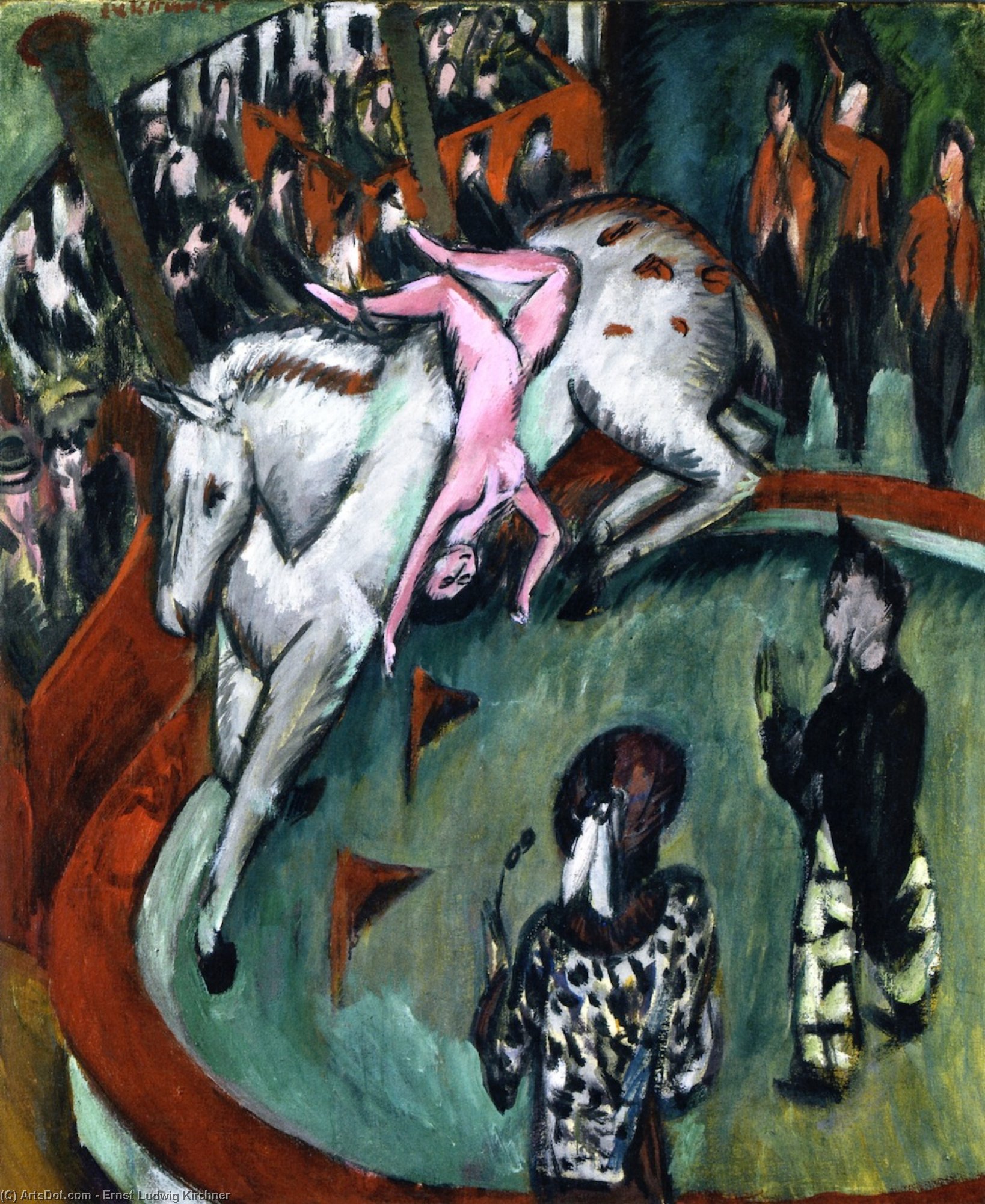
In the heart of the German Expressionist movement, few works capture the electric pulse of life quite like Ernst Ludwig Kirchner’s “Circus Rider.” Painted in 1914, on the precipice of a world about to be transformed by the shadows of the Great War, this masterpiece serves as a vibrant window into a moment of collective exhilaration. The canvas erupts with a sense of kinetic energy, centering on a skilled woman performing equestrian feats. As she maneuvers her horse through the arena, the viewer is not merely an observer but a participant in the spectacle. Kirchner utilizes a dynamic composition where geometric shapes—sharp rectangles and sweeping circles—interlock to create a rhythmic tension that mirrors the heartbeat of a crowd caught in a moment of pure, unadultered wonder.
The painting’s palette is nothing short of intoxicating. Eschewing the muted tones of traditional realism, Kirchner employs jarring, high-contrast colors to evoke the psychological intensity of the circus atmosphere. Splashes of brilliant light dance against deeper, more somber hues, creating a visual friction that is characteristic of his unique style. This technique does more than just depict a scene; it distills the very essence of feeling. For the discerning collector or interior designer, this piece offers a profound focal point—a burst of chromatic vitality that can breathe life and conversation into any sophisticated space, acting as both a historical anchor and a modern aesthetic triumph.
The Soul of Expressionism
To understand “Circus Rider,” one must delve into the turbulent era from which it emerged. Kirchner, a founding member of the influential Die Brücke (The Bridge) group, sought to bypass rational representation in favor of subjective truth. His work is deeply rooted in the anxieties and aspirations of a modernizing Germany, where industrialization and urbanization were reshaping the human psyche. The distorted forms and agitated brushstrokes seen in this work are deliberate; they are the visual language of an artist attempting to communicate the internal landscape of the soul. There is a palpable sense of urgency in every stroke, a reflection of Kirchner’s own life, marked by personal struggle and a relentless drive to capture the ephemeral nature of existence.
Symbolically, the circus serves as a powerful metaphor for the precarious balance of modern life—a spectacle of grace and skill performed amidst a backdrop of underlying chaos. The interplay between the central performer and the surrounding crowd suggests a complex relationship between the individual and the collective experience. For those looking to adorn their homes with art that possesses deep narrative weight, this reproduction offers more than mere decoration; it provides an invitation to contemplate the beauty found within instability. It is a piece that resonates with anyone who appreciates the raw, unshielded power of human emotion and the enduring allure of the spectacular.