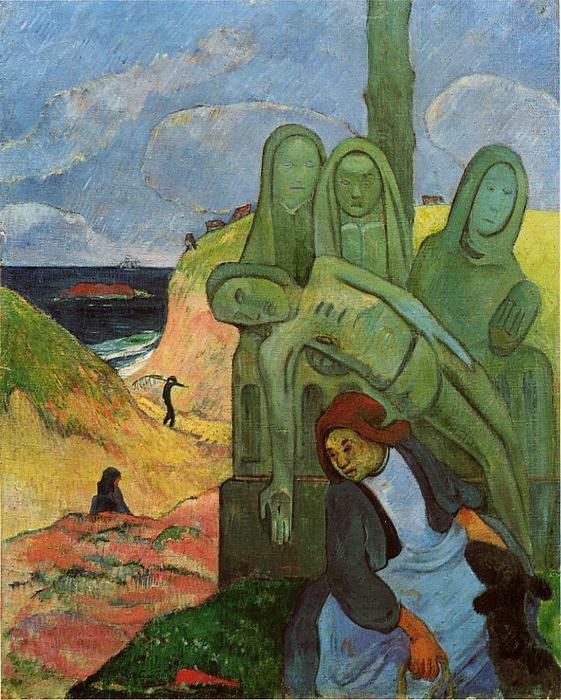
Green Christ (also known as Breton Calvary) – A Symphony of Color and Faith
Paul Gauguin’s “Green Christ,” painted in autumn 1889 during his immersive stay in Pont-Aven, Brittany, stands as a cornerstone of Symbolism within Post-Impressionist art. More than just a depiction of religious iconography—the crucifixion of Jesus—it embodies Gauguin's profound connection with Breton culture and his desire to transcend mere representation toward conveying spiritual essence. This artwork isn’t merely observed; it’s felt, resonating with the artist’s deeply held beliefs and translating them into a visual language that continues to captivate audiences today.
Background & Inspiration: Brittany’s Sacred Landscape
Pont-Aven served as Gauguin's artistic crucible—a place where he sought solace in the rugged Breton coastline and drew inspiration from its ancient traditions. The painting reflects this environment vividly, utilizing dominant hues of emerald green and golden yellow to capture the autumnal splendor of Brittany. These colors weren’t chosen arbitrarily; they mirrored Gauguin’s fascination with the spiritual significance attributed to nature within Celtic folklore—a belief that landscapes possessed a divine presence. Influenced by Breton religious rituals and artistic heritage, Gauguin aimed to express this reverence through his brushstrokes.
Composition & Symbolism: A Woman at Calvary's Foot
The central figure is a Breton woman standing before a crucifix – a motif prevalent in Breton town squares. Gauguin’s meticulous attention to detail extends beyond the visual elements; he deliberately positioned her amidst other figures dressed in traditional Breton attire, emphasizing the intersection of faith and local identity. The dog at the bottom right corner adds an element of pathos—a symbol of loyalty and companionship—further enriching the narrative tapestry. Each compositional decision contributes to Gauguin’s overarching intention: to portray a scene imbued with spiritual depth and conveying a sense of solemn contemplation.
Artistic Significance & Technique: Synthetism's Bold Expression
“Green Christ” exemplifies Gauguin’s revolutionary approach to painting—Synthetism—which departed dramatically from Impressionist conventions. Rejecting the fleeting effects of light, Gauguin prioritized expressive color and simplified forms, creating a visual language that prioritizes emotion over optical accuracy. Thick impasto – applying paint in layers with visible brushstrokes – dominates the canvas, lending texture and dynamism to the scene. This technique wasn’t merely stylistic; it served as a conduit for conveying Gauguin's inner turmoil and spiritual fervor—a reflection of his personal quest for transcendence.
Legacy & Recognition: A Timeless Masterpiece
Today, “Green Christ” resides in the Musée Royaux des Beaux-Arts de Belgique in Brussels, attracting scholars and art enthusiasts alike who appreciate its enduring power. Its influence extends far beyond the confines of the museum walls, inspiring artists across generations with its bold vision and masterful execution. For those seeking to experience Gauguin’s artistic brilliance firsthand, reproductions crafted by ArtsDot offer a remarkable opportunity to immerse oneself in the beauty and symbolism of this iconic artwork—a testament to Gauguin's legacy as one of Post-Impressionism’s most transformative figures. Explore more pieces by Paul Gauguin on ArtsDot:
Paul GauguinPaul Gauguin: Green Christ (also known as Breton Calvary)Paul Gauguin: The Yellow ChristMuseum of John Paul II CollectionThe Green Christ, 1889