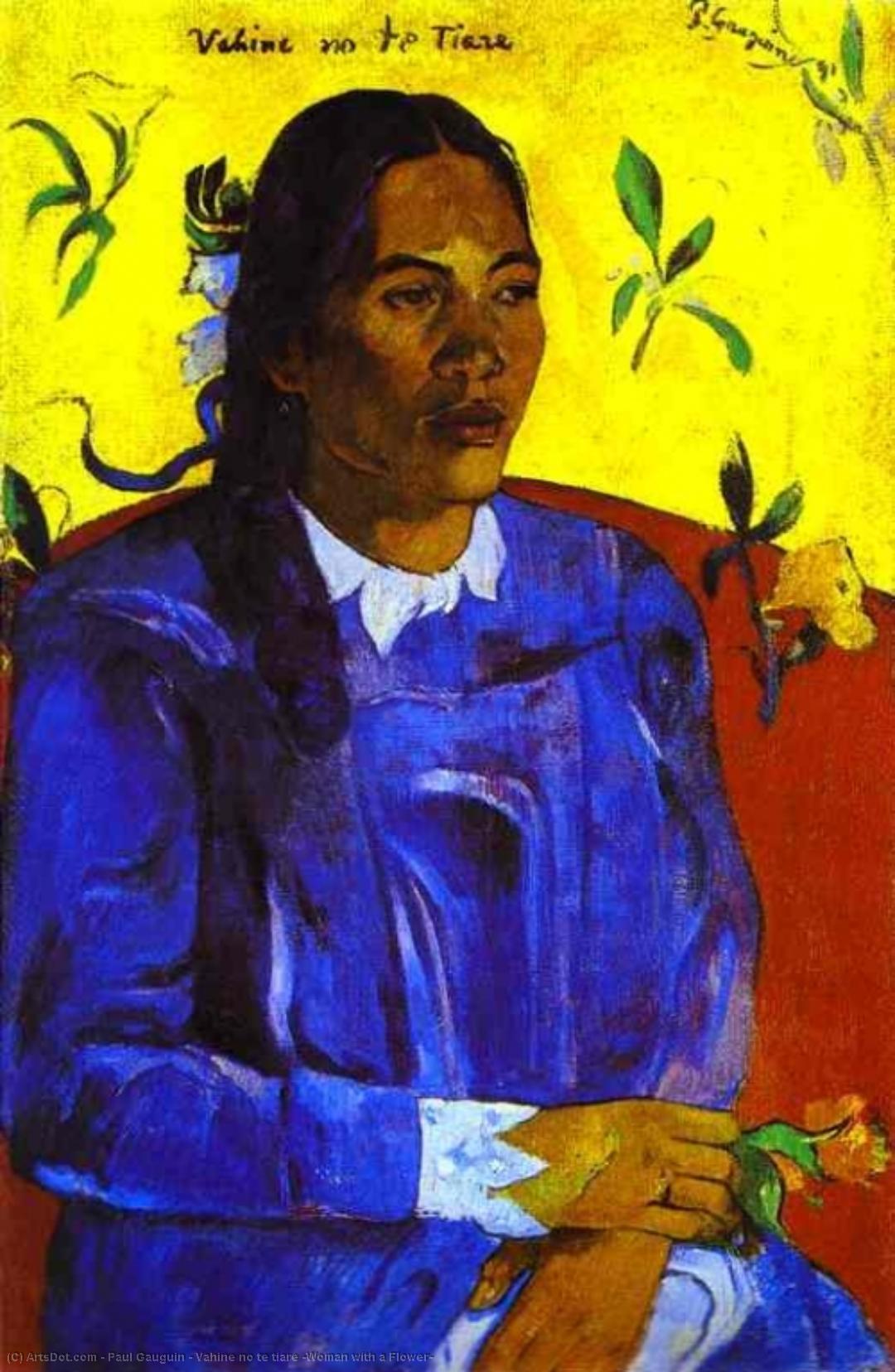
Vahine no te Tiare: A Symphony of Color and Symbolism
Paul Gauguin’s
Vahine no te Tiare – also known as
Woman with a Flower – stands as an emblem of Gauguin’s revolutionary approach to painting and his profound connection to Polynesian culture. Painted during his formative journey to Tahiti between 1891 and 1893, this artwork transcends mere representation; it embodies a deliberate quest for spiritual truth expressed through vibrant hues and bold contours—a cornerstone of the Synthetist style that would propel him into artistic prominence.
The painting depicts a Tahitian woman seated gracefully on a chair, her gaze directed towards the viewer with an enigmatic serenity. At her side rests a single flower – a hibiscus blossom – symbolizing purity, beauty, and fertility – motifs frequently revisited by Gauguin throughout his Tahitian oeuvre. The woman’s attire is simple yet striking: a flowing blue dress that contrasts sharply against the lush backdrop of tropical foliage.
- Style: Gauguin's distinctive Synthetist style departs radically from Impressionism’s preoccupation with capturing fleeting moments of light and color. Instead, he prioritizes flattened planes of color—often juxtaposed in complementary hues—to convey emotion and spiritual essence rather than photographic accuracy.
- Technique: Gauguin employed a technique characterized by thick impasto – applying paint thickly onto the canvas – creating palpable textural surfaces that imbue the image with dynamism and immediacy. This method allows for an expressive manipulation of color and form, mirroring the artist’s inner vision.
- Color Palette: The painting explodes with brilliant yellows—representing sunlight and vitality—and verdant greens—evoking the fecundity of Tahiti’s vegetation. Gauguin's masterful use of color isn’t merely decorative; it serves as a conduit for conveying mood and symbolism, reflecting his belief in art’s ability to communicate profound spiritual ideas.
- Composition: The pyramidal composition guides the viewer’s eye towards the central figure, emphasizing her importance within the landscape. Gauguin deliberately simplifies forms and reduces detail, prioritizing expressive color and texture over realistic representation.
Beyond its aesthetic qualities, Vahine no te Tiare resonates deeply with the Symbolist movement’s fascination with mythology and dreamlike imagery. Gauguin sought to capture not just what he saw but what he felt—the primal energy of nature and the spiritual communion between humanity and the divine. This painting exemplifies his unwavering commitment to conveying subjective experience through artistic innovation.
Its influence extends far beyond its time, inspiring artists like Picasso and Matisse who embraced bold color palettes and simplified forms. Today, reproductions of Vahine no te Tiare continue to captivate audiences worldwide, serving as a testament to Gauguin’s enduring legacy as one of the most transformative figures in modern art.
Explore High-Quality Reproductions at ArtsDot.com
ArtsDot.com offers meticulously crafted oil painting reproductions that faithfully capture the brilliance and spirit of Gauguin’s masterpiece. Skilled artisans utilize traditional techniques to recreate the artwork's textures and colors with exceptional accuracy, bringing its evocative beauty into your home.
/art/list/?Filter=Paul-Gauguin – Discover More About Gauguin’s Artistic Vision.
Visit
Museum Galleria d'Arte Moderna at
/art/list/?Filter=museum+galleria+d%27arte+moderna,museum,galleria,arte,moderna&.