Introduction
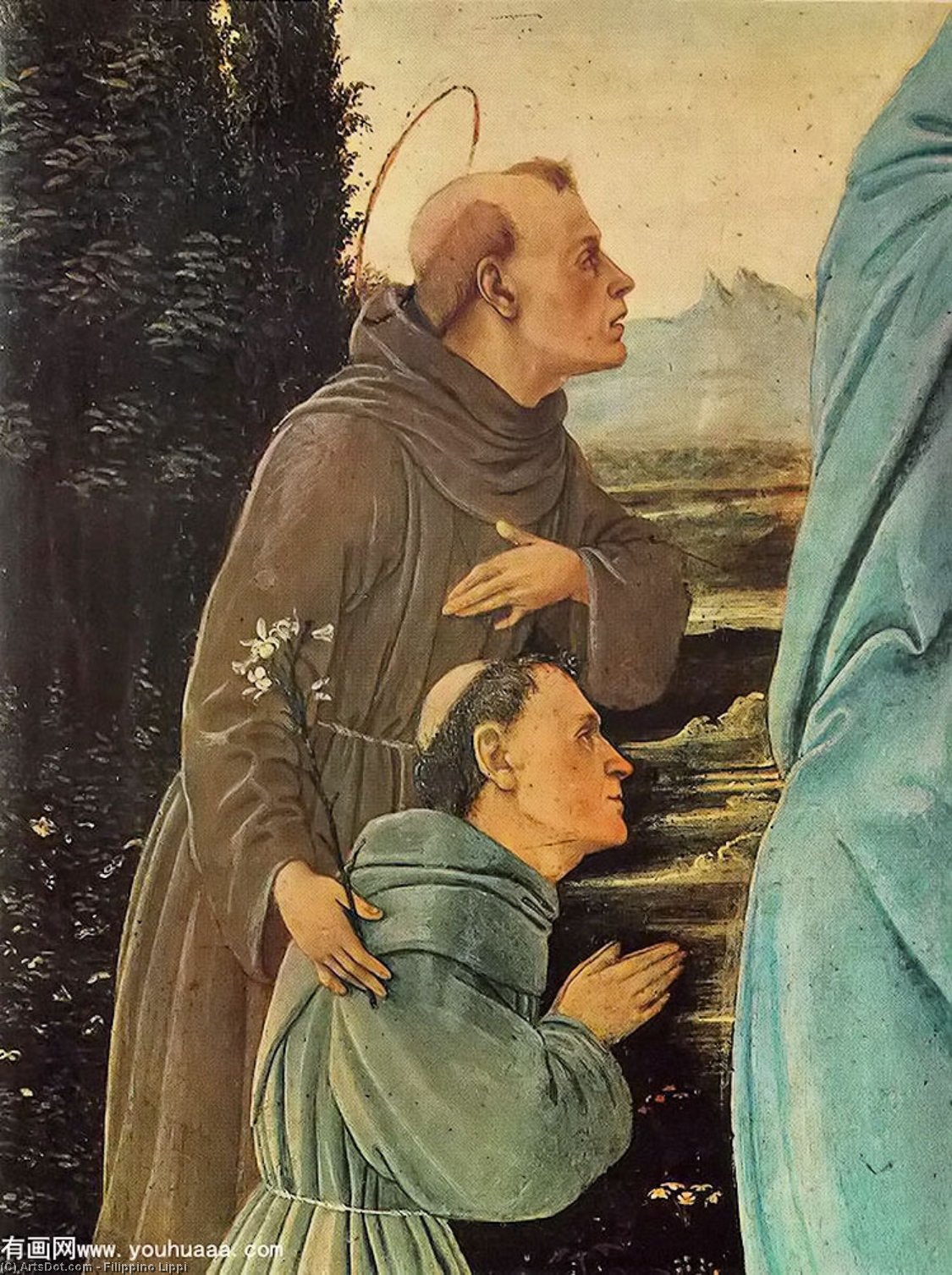
Filippino Lippi was an Italian painter from Florence who lived between 1457 and 1504. He was the son of Fra Filippo Lippi, a Carmelite friar and one of the most important painters of the early Renaissance. Filippino Lippi is known for his elegant figures, rich colors, and intricate details, which are evident in his painting Madonna with Child, St Anthony of Padua and a Friar, currently housed at the Szépmûvészeti Múzeum in Budapest, Hungary.
Description
Madonna with Child, St Anthony of Padua and a Friar is a small painting on panel that measures 57 x 41 cm. It depicts the Virgin Mary holding the Christ Child on her lap, while St Anthony of Padua stands on the left side of the composition, looking at the viewer with a gentle smile. A friar, possibly representing Fra Filippo Lippi himself, is shown on the right side, kneeling in front of the Madonna and gazing at her with devotion.
The painting is executed in tempera, a technique that involves mixing pigments with egg yolk or another binder. The colors are bright and vivid, especially the blue of Mary's robe and the red of St Anthony's habit. The details of the faces, hands, and fabrics are rendered with great precision and delicacy, revealing Lippi's mastery of the medium.
Interpretation
Madonna with Child, St Anthony of Padua and a Friar is a devotional image that invites the viewer to contemplate the mystery of the Incarnation, the belief that God became man in the person of Jesus Christ. The presence of St Anthony of Padua, a popular saint known for his preaching and miracles, suggests that the painting may have been intended as an aid to meditation or prayer.
The friar in the painting may represent the donor who commissioned the work, or it could be a self-portrait of Filippino Lippi himself. In either case, his presence underscores the importance of the religious life and the role of art in expressing and promoting spiritual values.
Historical Context
Madonna with Child, St Anthony of Padua and a Friar was painted around 1485, during the early Renaissance period in Italy. This was a time of great cultural and artistic flowering, characterized by the revival of classical learning, the development of linear perspective, and the exploration of naturalism in art.
Filippino Lippi was one of the leading painters of his generation, along with Sandro Botticelli, Domenico Ghirlandaio, and Leonardo da Vinci. He was influenced by the works of Fra Angelico, Masaccio, and other early Renaissance masters, but he also incorporated elements from northern European art, such as the use of oil paint and the attention to detail.
Conclusion
Madonna with Child, St Anthony of Padua and a Friar is a beautiful and meaningful painting that showcases Filippino Lippi's artistic talent and spiritual vision. It is an example of the rich cultural heritage of Italy and the enduring appeal of religious art.
If you are interested in owning a reproduction of this masterpiece, please visit our website ArtsDot.com, where you can find high-quality handmade oil paintings that capture the beauty and essence of the original work.