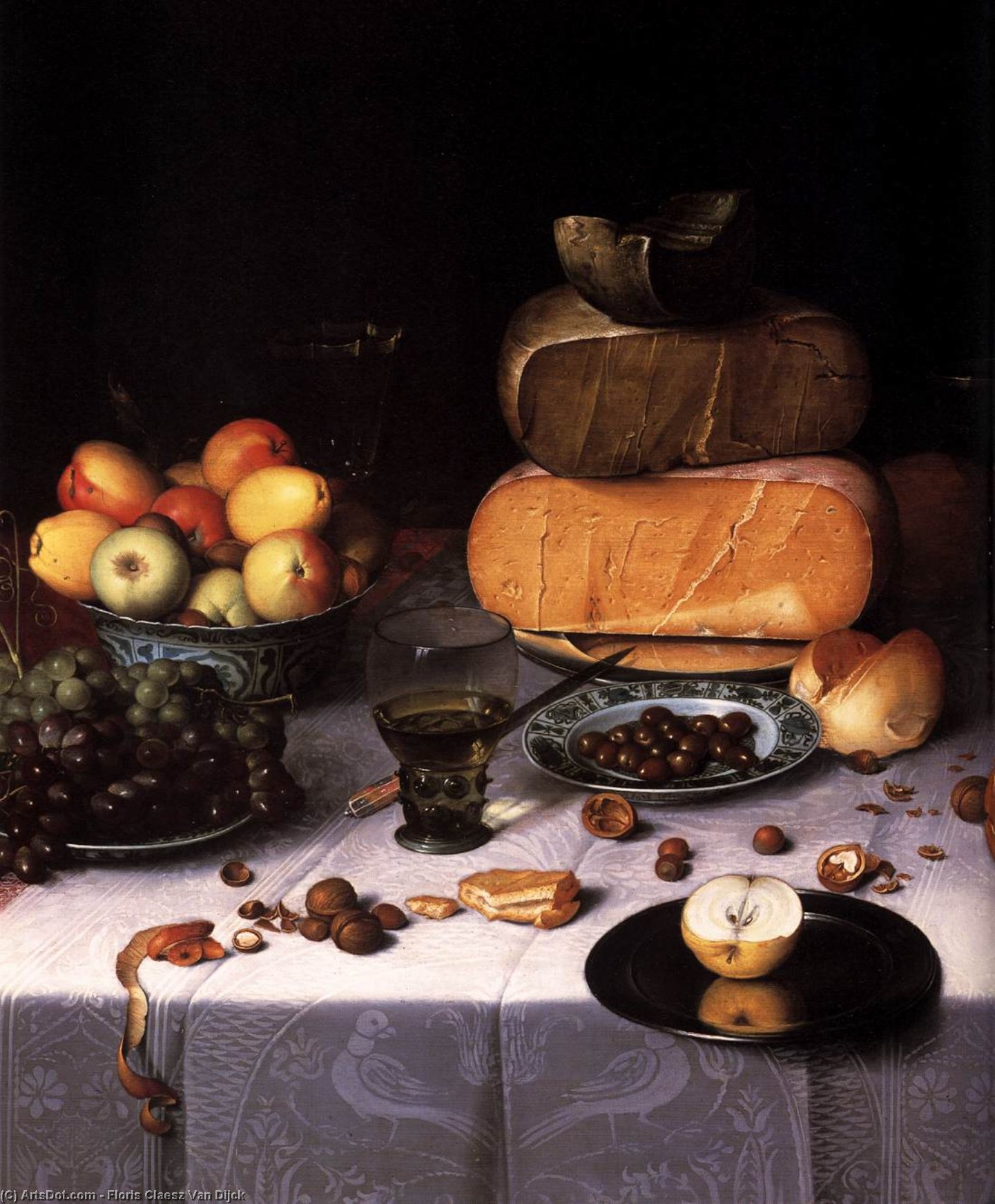
This meticulously rendered painting showcases a lavish table setting featuring apples, cheeses, bowls, wine glasses, and a cup—a testament to van Dijck's mastery of light and texture. Inspired by Raphael and celebrated in Haarlem and Rome, this piece embodies the elegance of Baroque art.
Entdecken Sie Floris van Dijcks exquisite Stillleben aus dem Goldenen Zeitalter der Niederlande! Als Meister von Bankettszenen und dem 'Ontbijtje'-Genre zeigen seine Werke Früchte, Käse und eine einzigartige künstlerische Vision.
Rijksmuseum
(Amsterdam, Netherlands)
Entdecken Sie niederländische Kunst & Geschichte im Rijksmuseum Amsterdam! Bewundern Sie Rembrandt, Vermeer u. Van Gogh Meisterwerke – eine Reise durch 800 Jahre Kultur.
Floris Claesz van Dijck: Capturing Still Life’s Delicate Balance
Floris Claesz van Dijck (c. 1575 – before 26 April 1651) stands as a pivotal figure in the transition between Mannerism and Baroque painting, embodying the refined sensibilities of the Dutch Golden Age. Often lauded as “The Divine Guido,” his legacy rests not solely on groundbreaking innovation but on a masterful distillation of classical ideals—particularly those championed by Raphael—creating an aesthetic that resonated profoundly with patrons throughout Europe. His prolific output spanned across Italy – Bologna, Rome, Naples – each location contributing to the evolution of his distinctive style and cementing his reputation as one of the most sought-after artists of his era. Examining “Laid Table with Cheeses and Fruit (detail)” offers a window into this remarkable artistic journey.
A Symphony of Light and Texture
The painting’s immediate impact is achieved through masterful manipulation of light—a hallmark of van Dijck's technique. Unlike the dramatic chiaroscuro favored by Caravaggio, he employs subtle gradations of illumination to sculpt the surfaces of his subjects. Observe how light kisses the polished pewter plate, highlighting its reflective sheen and creating an illusion of depth that draws the viewer’s eye inwards. Similarly, diffused light softens the contours of the apples scattered across the table, emphasizing their velvety skin texture and conveying a sense of quiet contemplation. This careful consideration of illumination underscores van Dijck's commitment to realism—a crucial element distinguishing him from the more stylized conventions of Mannerism.
The Baroque Influence: Order Amidst Abundance
Despite its serene atmosphere, “Laid Table with Cheeses and Fruit” bears unmistakable traces of Baroque influence. The meticulously arranged composition—the symmetrical placement of bowls and glasses—reflects a desire for balance and harmony characteristic of the period. This stylistic choice aligns perfectly with the broader artistic movement’s preoccupation with grandeur and theatricality, albeit tempered by van Dijck's inherent restraint. The artist skillfully portrays an opulent feast, yet avoids overwhelming the viewer with excessive ornamentation; instead, he invites contemplation on beauty and sensory experience—themes central to Baroque art’s expressive aims.
Symbolism Embedded in Everyday Objects
Beyond its technical brilliance, “Laid Table with Cheeses and Fruit” is rich in symbolic meaning. The apples themselves represent fertility and prosperity – a common motif in Renaissance and Baroque iconography. Their varied hues—red, yellow, green—suggest the richness of life’s seasons and symbolize hope for future generations. Furthermore, the inclusion of cheeses—particularly Gouda and Edam—references Dutch mercantile traditions and speaks to the importance of trade and wealth within the cultural landscape of the time. These seemingly simple objects are elevated by van Dijck's artistic vision into emblems of virtue and contemplation.
A Legacy Enduring Through Reproduction
Today, “Laid Table with Cheeses and Fruit (detail)” continues to inspire admiration for its exquisite craftsmanship and profound aesthetic qualities. Reproductions crafted by skilled artisans like Ocean’s Bridge allow art enthusiasts worldwide to experience the beauty of this iconic masterpiece firsthand—preserving van Dijck's legacy for generations to come. Bringing a piece of Dutch Golden Age artistry into your home is more than just decorating; it’s engaging with a timeless exploration of light, texture, and symbolic representation.