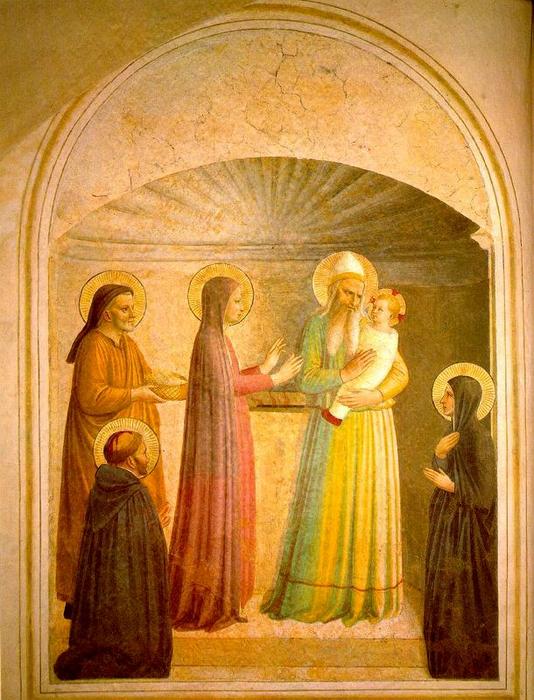
Experience the divine grace of Fra Angelico's 'Presentation in the Temple 1'. This stunning hand-painted reproduction captures Renaissance piety & beauty, showcasing masterful fresco technique & spiritual contemplation.
Erkunden Sie die ruhige Renaissance-Kunst von Fra Angelico (ca. 1395-1455): fromme Fresken, leuchtende Farben und spirituelle Tiefe. Entdecken Sie den 'Engelmaler' und sein Erbe!
A Moment of Divine Grace: Exploring Fra Angelico’s “Presentación en el Templo 1”
The fresco "Presentación en el Templo 1," attributed to the Florentine Dominican artist Fra Angelico, stands as a beacon of Early Renaissance piety and artistic brilliance. More than just a depiction of biblical narrative—the Virgin Mary presenting Jesus at the Temple—it embodies a profound spiritual contemplation that continues to resonate with viewers centuries later. Available as a stunning hand-painted reproduction on ArtsDot.com, this artwork offers an unparalleled opportunity to experience the ethereal beauty and meticulous craftsmanship characteristic of Angelico’s oeuvre.
The Fresco Technique: A Testament to Skillful Craftsmanship
Fra Angelico's mastery lay not merely in capturing religious themes but also in executing them with extraordinary technical precision. As a fresco artist, he employed tempera pigments mixed with lime plaster—a laborious process requiring careful preparation and execution under ideal weather conditions. The resulting surface is remarkably durable, preserving the vibrancy of color and detail for generations. Observe how Angelico skillfully layered translucent glazes over the underlying pigment, creating an illusionistic depth that transcends mere representation. This technique, perfected during his time at San Marco, exemplifies the Renaissance commitment to realism while simultaneously elevating the artwork beyond the purely material realm.
Historical Context: Saint Mark’s Monastery and the Florentine Renaissance
“Presentación en el Templo 1” was conceived for the Saint Mark's Friary in Florence—a pivotal institution during the burgeoning Florentine Renaissance. The monastery served as a crucible of artistic innovation, attracting luminaries like Piero della Francesca and Masaccio who championed humanist ideals alongside religious devotion. Angelico’s frescoes at San Marco were intended to inspire contemplation and reaffirm faith within the monastic community, reflecting the broader cultural landscape of the era—one grappling with questions of human dignity and divine grace. The fresco's placement within this influential space underscores its significance as a visual expression of Renaissance spirituality.
Symbolism: Mary’s Reverence and Jesus’ Divine Innocence
The composition itself is laden with symbolic meaning. Mary, depicted in serene repose, embodies humility and maternal devotion—qualities revered throughout Christian tradition. Her gaze directs the viewer's attention towards Jesus, presented as a newborn infant bathed in radiant light. This imagery underscores the sanctity of Christ’s incarnation and symbolizes divine innocence—a concept central to medieval theology. The surrounding figures—representing Simeon and Anna—represent prophetic anticipation and unwavering faith—further enriching the fresco’s spiritual narrative.
Emotional Impact: Capturing Divine Beauty
“Presentación en el Templo 1” transcends mere visual representation; it evokes a palpable sense of awe and reverence. Angelico's masterful use of color—particularly the luminous blues and golds—creates an atmosphere of ethereal beauty, transporting viewers to a realm beyond earthly concerns. The delicate rendering of drapery and facial expressions conveys profound emotion—reflecting the spiritual fervor that characterized Renaissance Florence. As a hand-painted reproduction, this artwork allows you to bring home a piece of artistic history—a timeless testament to faith, artistry, and the enduring power of visual storytelling. Explore more exquisite reproductions at ArtsDot.com or delve deeper into Fra Angelico’s legacy on Wikipedia.