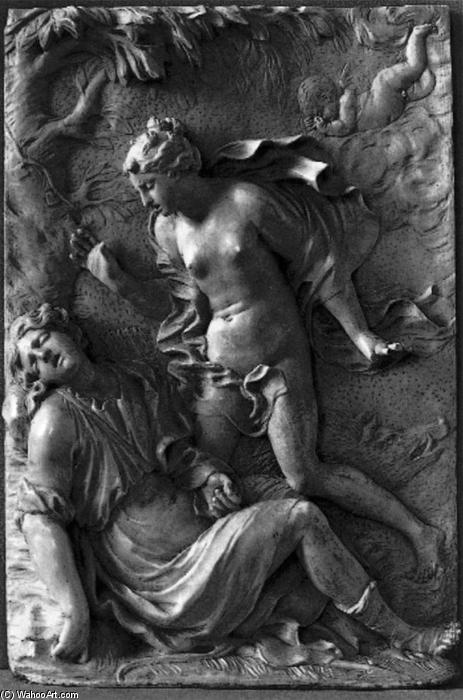
A Moment Frozen in Marble: Francis van Bossuit’s “Venus and Adonis”
Francis van Bossuit's "Venus and Adonis," crafted around 1680, is more than just a depiction of a classical myth; it’s a poignant meditation on love, loss, and the ephemeral beauty of youth. This exquisite ivory relief, now housed within the Rijksmuseum in Amsterdam, offers a rare glimpse into the burgeoning Baroque aesthetic flourishing in Flanders during the late 17th century. Bossuit's work stands as a testament to his mastery of capturing both the physical form and the emotional weight of his subject matter – a skill honed through rigorous training under masters like Jan Baptist Bernardi, yet ultimately shaped by his own distinctive artistic vision.
The scene unfolds with heartbreaking immediacy. Adonis, having succumbed to a fatal wound sustained during a hunt, lies prostrate on a bed of pomegranates, his body dramatically angled towards the viewer. His head, rendered with remarkable sensitivity, is turned upwards in a gesture of vulnerability and acceptance. Venus, radiant and sorrowful, rushes forward to embrace him, her flowing drapery swirling around her form – a deliberate choice that emphasizes both her divine status and the tragic circumstances surrounding their encounter. A winged Cupid, his face etched with grief, descends from the heavens, mirroring the goddess’s despair, while an everzwijn (boar) stands as a silent witness to this devastating tableau. The composition is meticulously balanced; the dynamism of Venus' approach contrasts sharply with Adonis’ stillness, creating a powerful visual narrative.
The Language of Form: Technique and Material
Bossuit’s technical skill is immediately apparent in the intricate detailing of the relief sculpture. Each muscle, each fold of fabric, each strand of hair has been painstakingly carved from ivory – a material prized for its luminosity and ability to capture subtle tonal variations. The artist masterfully employs *chiaroscuro*, utilizing light and shadow to sculpt volume and depth, giving the figures a tangible presence that transcends the limitations of the medium. The smooth, polished surface of the ivory contrasts beautifully with the rougher texture of the foliage in the background, further enhancing the sense of realism. The choice of ivory itself speaks volumes about Bossuit’s artistic sensibilities – it was often associated with religious imagery and considered a material worthy of depicting sacred subjects.
The meticulous attention to detail extends beyond mere representation; Bossuit clearly sought to evoke an emotional response in the viewer. He doesn't simply depict the myth; he captures the *feeling* of it – the agonizing beauty of love, the inevitability of death, and the profound sorrow of loss. The positioning of Adonis’s body, the downward tilt of his head, and the expression on Venus’s face all contribute to this powerfully emotive effect.
Symbolism and Mythological Resonance
The story of Venus and Adonis is a cornerstone of classical mythology, exploring themes of unrequited love, desire, and mortality. Venus, the goddess of love, relentlessly pursued the mortal hunter Adonis, but her affections were ultimately rejected. The tragic outcome – Adonis’s death at Venus's hands – underscores the inherent conflict between the divine and the mortal realms. Bossuit cleverly incorporates elements that amplify this symbolism: the everzwijn represents the brutal reality of mortality, while Cupid embodies the bittersweet nature of love—a source of both joy and sorrow.
Furthermore, the setting itself is laden with symbolic meaning. The pomegranates, associated with fertility and abundance, are juxtaposed against Adonis’s lifeless form, highlighting the futility of earthly pleasures in the face of death. The overall composition can be interpreted as a poignant allegory for the fleeting nature of beauty and youth, reminding us that even the most passionate love is ultimately subject to time's relentless march.
A Legacy of Elegance: Bossuit’s Influence
Francis van Bossuit’s work represents a pivotal moment in Flemish Baroque sculpture. His refined style, characterized by its delicate execution and profound emotional depth, profoundly influenced subsequent generations of artists. His emphasis on classical forms, combined with his masterful use of ivory, established him as one of the leading sculptors of his time. The “Venus and Adonis” relief stands not only as a beautiful work of art but also as a window into the artistic sensibilities of a bygone era – a testament to the enduring power of myth, beauty, and human emotion.