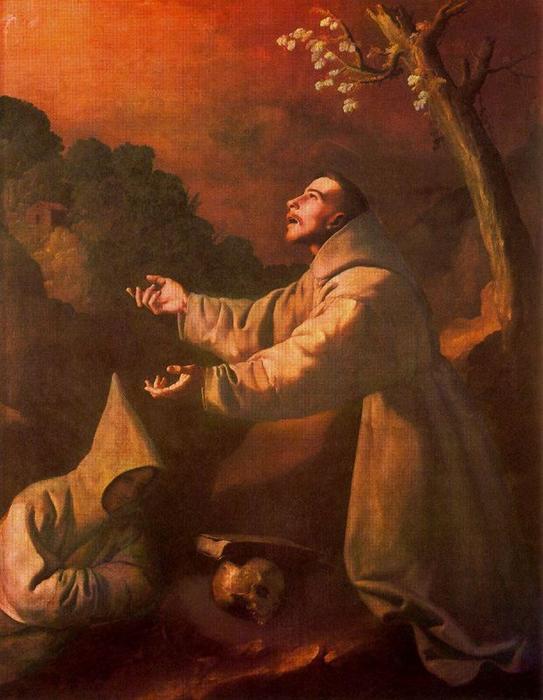
This painting showcases Diego de la Cruz's masterful blend of Flemish artistic traditions with Spanish Baroque style. Depicting Saint Francis in contemplative prayer alongside a tree and skulls, it embodies solemnity and explores themes of mortality. Rediscovered in 1966, this artwork exemplifies the artist’s skill in capturing realistic detail and conveying spiritual depth.
The Profound Reverie of *Estigmatización de san Francisco*
Francisco de Zurbarán’s *Estigmatización de San Francisco*, a work steeped in the austere piety of 17th-century Spain, offers an intensely personal and profoundly moving meditation on faith and mortality. This arresting portrait captures Saint Francis Xavier in a moment of profound spiritual crisis – his hands raised towards the heavens, seemingly consumed by prayer or perhaps wrestling with the weight of his mission as a missionary. The scene unfolds within a carefully constructed space that speaks volumes about Zurbarán’s artistic philosophy: a simple, shadowed interior punctuated by the presence of nature and the stark reminder of human fragility.
- Subject Matter: The central figure is Saint Francis Xavier, a pivotal figure in the Counter-Reformation, known for his tireless efforts to spread Catholicism throughout Asia.
- Composition: The composition emphasizes verticality, drawing the viewer’s eye upwards towards the saint's outstretched hands and the implied divine presence.
- Setting: The dimly lit interior suggests a private moment of devotion, far removed from the public spectacle of religious ceremony.
Masterful Baroque Technique & Dramatic Realism
Zurbarán was a master of *tenebrismo*, a technique popularized by Caravaggio that utilizes dramatic contrasts between light and shadow to heighten emotional impact. Here, a single, focused beam of light illuminates Saint Francis Xavier’s face and hands, rendering them with an almost sculptural quality. The meticulous detail – the texture of his brown robe, the subtle wrinkles on his skin, the delicate veins in his hands – is executed with breathtaking precision. This isn't merely a representation; it’s a palpable embodiment of human vulnerability and spiritual yearning. Zurbarán’s use of oil paint allowed for layering and glazing, creating depth and luminosity that further enhances the realism of the piece.
Symbolism: Mortality and Divine Grace
The inclusion of two skulls is a particularly potent element within this composition. Positioned strategically – one near the bottom left corner, another towards the top right – they serve as stark reminders of mortality and the transience of earthly existence. This juxtaposition with the figure of Saint Francis Xavier, in his act of fervent prayer, elevates the painting beyond a simple portrait; it becomes an exploration of faith’s ability to transcend death. The tree depicted alongside the saint further reinforces this connection between humanity and nature, suggesting a spiritual grounding rooted in the natural world.
Historical Context & Emotional Resonance
Created during the height of the Baroque period (1598-1664), *Estigmatización de San Francisco* reflects the religious fervor that gripped Spain following the Counter-Reformation. Zurbarán’s work aligns with a broader artistic movement seeking to evoke intense emotional responses in viewers, often through depictions of religious subjects. The painting's solemn atmosphere and Saint Francis Xavier’s anguished expression invite contemplation on themes of faith, suffering, and redemption. A hand-painted reproduction offers an unparalleled opportunity to experience the profound beauty and spiritual depth of this iconic work by one of Spain’s greatest Baroque masters.