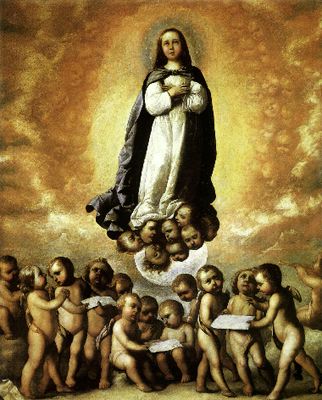
A Testament to Faith: Exploring Zurbarán’s Inmaculada Concepción 1
Francisco de Zurbarán's Inmaculada Concepción 1 stands as a profound meditation on religious devotion, a work born from the austere landscapes and deeply held faith of Extremadura. Painted during his formative years (1598-1664), this depiction of the Virgin Mary cradling the infant Jesus resonates with an intensity rarely found in Baroque art. The painting’s power lies not merely in its subject matter – a cornerstone of Catholic belief – but in Zurbarán's masterful manipulation of light, shadow, and texture to evoke a palpable sense of spiritual presence.
- The Artist's Vision: Zurbarán’s artistic journey began amidst the religious fervor of his native Extremadura. His early training under Alejandro de la Mina and Alonso de Najera exposed him to the nascent Baroque style, yet he swiftly developed a distinct approach – one characterized by an almost obsessive attention to detail and a profound understanding of human emotion.
- Technique: The painting’s dominant palette of earthy browns creates a dramatic effect, achieved through Zurbarán's signature technique of *sfumato*, a subtle blurring of edges that lends the figures an ethereal quality. The use of thick impasto – layers of heavily applied paint – adds to the textural richness and emphasizes the three-dimensionality of the Virgin Mary’s robes and the baby Jesus’s form.
Symbolism Within the Scene
The composition of Inmaculada Concepción 1 is laden with symbolic meaning, reflecting the theological significance of the Immaculate Conception – the belief that Mary was conceived without original sin. The Virgin Mary herself embodies humility and grace, her posture conveying a sense of serene contemplation. The baby Jesus, presented in Zurbarán’s characteristic manner, appears vulnerable yet powerful, representing divine innocence and redemption. Surrounding them are several angels, not as flamboyant figures of Baroque art, but rendered with a quiet dignity, emphasizing their role as messengers of God's grace.
- The Angels: The presence of multiple angels reinforces the idea of divine protection and support. Their subdued expressions contrast with the vibrant emotional intensity of Mary and Jesus, highlighting the spiritual realm’s influence on earthly events.
- Color as Symbolism: The predominantly brown tones are not merely aesthetic choices; they symbolize earth, humility, and penitence – qualities central to Christian faith.
Historical Context and Artistic Influence
Painted during a period of significant artistic transition, Inmaculada Concepción 1 reflects the shift from the Mannerist style towards the Baroque. While influenced by Najera’s training, Zurbarán quickly established his own unique voice, prioritizing realism and emotional depth over elaborate ornamentation. This work exemplifies his commitment to portraying religious subjects with unwavering sincerity, a characteristic that would define his career and secure his legacy as one of Spain's greatest Baroque painters.
Emotional Impact and Reproduction
Inmaculada Concepción 1 possesses an enduring emotional impact, inviting viewers to contemplate themes of faith, devotion, and the mysteries of the divine. ArtsDot offers a meticulously crafted hand-painted reproduction that captures the essence of Zurbarán’s original masterpiece. Each reproduction is created by skilled artisans using archival quality materials, ensuring its longevity and preserving the artwork's rich detail and vibrant colors. This is more than just a print; it’s an opportunity to bring a timeless work of art into your home or office, fostering contemplation and inspiring awe.