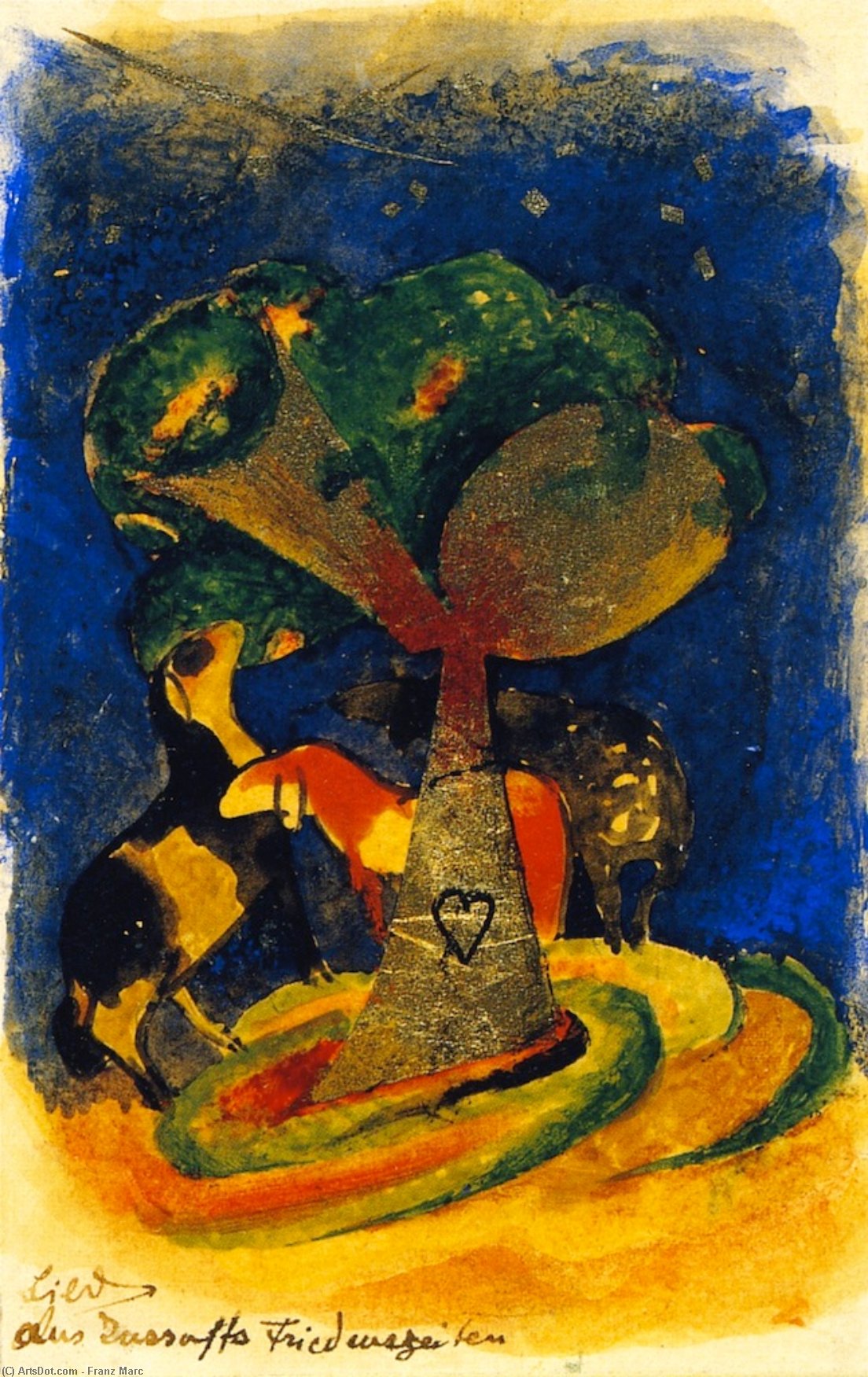
Franz Marc’s watercolor ‘A Picture from Jussuff’s Peaceable Times,’ born in 1913, embodies the spirit of Expressionism with its serene depiction of a tree pierced by a heart—a symbol of compassion and unity amidst birds and deer. Explore this evocative masterpiece and bring its tranquil beauty into your home.
A Symphony of Spirit: The Essence of Franz Marc’s Vision
To encounter "A Picture from Jussuff's Peaceable Times" is to step through a portal into a realm where the boundaries between the physical world and the spiritual soul dissolve. Created in 1913, this exquisite watercolor by the German Expressionist master Franz Marc serves as a profound meditation on harmony and the interconnectedness of all living things. At first glance, the viewer is greeted by a pastoral scene that feels both intimate and cosmic; a tree stands central, marked by a poignant, heart-shaped hollow, surrounded by a gentle assembly of animals including deer, birds, a dog, and a cat. Yet, beneath this tranquil surface lies a complex tapestry of emotion, inviting anyone from the passionate art collector to the discerning interior designer to contemplate a world far removed from the industrial chaos of the early 20th century.
The technique employed by Marc in this piece is nothing short of transformative. Eschewing the rigid constraints of academic realism, he utilized the fluid, luminous nature of watercolor to create soft washes and delicate gradations that breathe with life. His style is characterized by a deliberate simplification of form—a hallmark of the Expressionist movement. By utilizing flattened planes and rhythmic, geometric shapes, Marc achieves a visual balance that echoes the structural innovations of Cubism while maintaining an intense emotional warmth. For those looking to adorn a space with art, this piece offers a unique aesthetic versatility; its soft textures and organic compositions provide a calming focal point that can anchor a room with both sophistication and a sense of quiet wonder.
Symbolism and the Search for Inner Harmony
Every element within this composition is heavy with symbolic resonance. The heart-shaped hole in the tree trunk acts as a powerful metaphor for vulnerability and the shared pulse of life that beats within every creature. Marc, who famously sought to capture the "spiritual truth" of nature, used color not merely for decoration but as a language of the soul. In his artistic lexicon, colors were imbued with specific spiritual qualities—often associating blue with masculinity and spirituality, and yellow with feminine joy. In this peaceful assembly, the interaction between the animals—the watchful birds, the resting dog, and the wandering deer—suggests a lost Eden, a state of primordial innocence where predator and prey exist in a sacred, undisturbed equilibrium.
This pursuit of spiritual renewal was deeply rooted in the historical context of 1913 Germany. As the world stood on the precipice of profound geopolitical change, Marc’s work offered a sanctuary of peace. The painting does not merely depict a landscape; it depicts an ideal. For the collector, owning a reproduction of such a masterpiece is more than a decorative choice; it is an invitation to bring a piece of this enduring tranquility into the modern home. It serves as a constant reminder of the beauty found in simplicity and the profound strength found in vulnerability, making it an incomparable addition to any curated collection of fine art.