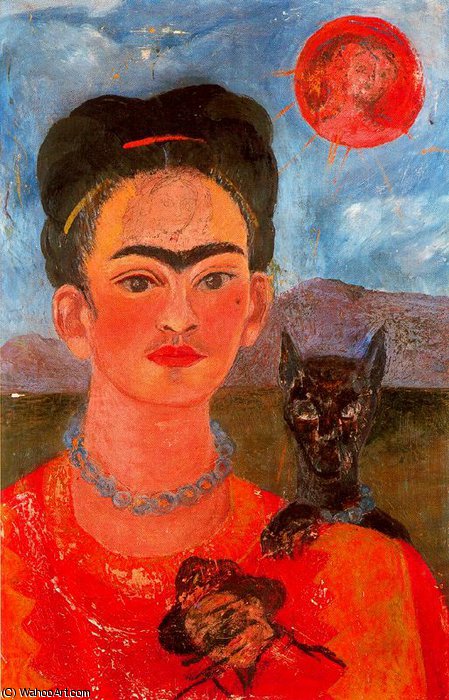
This surrealist portrait captures Frida Kahlo's spirit and explores themes of identity, pain, and resilience through vibrant colors and symbolic imagery.
Erkunden Sie Fridas Kahlos Kunst (1907-1954): ikonische Selbstporträts, Surrealismus & mexikanisches Erbe. Entdecken Sie Themen wie Identität, Schmerz und ihr feministisches Erbe.
A Defiant Gaze: Unveiling Frida Kahlo’s "The Mustache"
Frida Kahlo’s 1946 masterpiece, "The Mustache," is far more than a mere self-portrait; it is a profound psychological landscape that challenges the viewer to confront the complexities of identity and gender. In this striking composition, Kahlo presents herself with an unwavering, direct gaze that pier/s penetrates the surface of the canvas, blending a sense of vulnerability with an indomitable spirit of defiance. The painting utilizes a vibrant, almost electric palette—rich reds, sun-drenched yellows, and deep blues—to create a scene that feels simultaneously grounded in Mexican tradition and untethered from reality. Set against a backdrop reminiscent of ancient Aztec iconography, the work transcends conventional portraiture to become an emblem of self-assertion, inviting collectors and art enthusiasts alike to lose themselves in its surrealist depths.
Technique and the Spirit of Mexicayotl
The technical execution of this piece is deeply rooted in the Mexicayotl movement, a cultural resurgence that sought to celebrate indigenous Mexican traditions over European academic standards. Kahlo eschews traditional perspective and anatomical perfection in favor of a more emotive, naïve folk art style. By employing flattened planes of color and bold, deliberate brushstrokes, she achieves a sense of immediacy that feels both raw and meticulously crafted. The use of encaustic wax mixed with pigments lends the surface an extraordinary luminosity and a tactile, textural richness. This layering technique allows light to dance across the canvas, capturing subtle nuances of shadow that breathe life into the subject. For those seeking a centerpiece for a sophisticated interior, the painting’s unique texture and vibrant colorway offer a captivating visual weight that commands attention in any setting.
Symbolism, Trauma, and the Resilience of the Soul
Beyond its aesthetic brilliance, "The Mustache" serves as a poignant vessel for Kahlo's personal history and the broader social upheavals of post-revolutionary Mexico. The painting is steeped in symbolism; the inclusion of the facial hair itself acts as a subversive commentary on femininity and societal expectations, reclaiming a part of her identity that defies traditional beauty standards. The presence of the two dogs—one flanking her left and another positioned to her right—adds a layer of companionship and perhaps a connection to the natural world, grounding the surreal elements in a sense of earthly existence. Every element, from the sun-drenched sky to the intricate details of her attire, reflects a life forged in both physical pain and immense passion. To possess a reproduction of this work is to hold a piece of history that celebrates the triumph of the human spirit over adversity, making it an inspiring choice for any curated collection.