A Gaze Through the Veil of Resilience
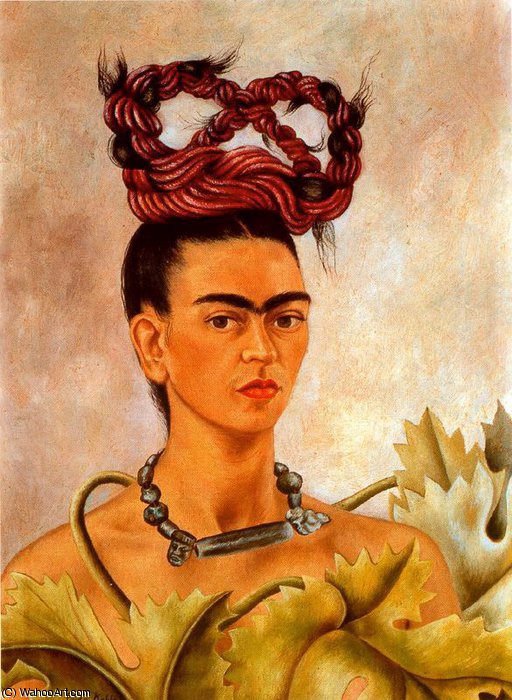
To encounter Frida Kahlo's "Untitled (3671)" is to step into an intimate dialogue with one of the most profound souls in art history. Created in 1954, during the twilight of her life, this painting serves as a hauntingly beautiful testament to a woman who mastered the art of transforming physical and emotional agony into visual poetry. The canvas presents a striking female figure, seated amidst a lush, verdant canopy that feels both protective and claustrophobic. Bathed in a palette of warm yellows and radiant oranges, the scene evokes a sense of sun-drenched tranquility, yet beneath this warmth lies an unmistakable tension—a quiet, simmering strength that defines Kahlo’s entire oeuvre.
The subject matter is deeply rooted in the artist's preoccupation with self-representation and the duality of existence. As she gazes into the distance, her expression remains contemplative, perhaps even stoic, inviting the viewer to look past the surface. The meticulous rendering of her features—including the distinctive, defiant presence of facial hair that challenged the gendered beauty standards of her era—demonstrates a fearless commitment to truth over artifice. For collectors and enthusiasts, this piece offers more than mere decoration; it provides a window into a psyche that refused to be broken by the weight of its own history.
Surrealism Rooted in the Earthly Realm
While often categorized under the banner of Surrealism, Kahlo’s technique in "Untitled (3671)" transcends the purely dreamlike. Unlike her contemporaries who sought to escape reality through the subconscious, Kahlo utilized a hyper-realistic precision to anchor her fantastical elements in the tangible world. Her brushstrokes are deliberate and controlled, capturing the subtle interplay of light as it filters through foliage, creating a sense of depth that is almost tactile. This mastery of oil on canvas allows the textures of the leaves and the soft glow of the skin to feel remarkably present.
The composition is punctuated by unexpected symbolic motifs that demand closer inspection. The strategic placement of two bananas—one near the center and another toward the periphery—introduces a layer of complex symbolism. In the context of Kahlo’s Mexican heritage, such elements often evoke themes of fertility, abundance, and the cyclical nature of life and decay. These organic forms act as silent witnesses to the woman's journey, bridging the gap between the physical nourishment of the earth and the spiritual hunger of the artist.
A Legacy of Pain and Triumph
Understanding this masterpiece requires acknowledging the crucible from which it emerged. Kahlo’s life was a tapestry woven with threads of immense trauma, most notably the devastating bus accident that left her body shattered and her spirit tested by countless surgeries. "Untitled (3671)" can be viewed as an act of reclamation—a way for the artist to reconstruct herself on her own terms. The vibrant colors and lush greenery serve as a counterpoint to the physical limitations she endured, suggesting a life force that remains unextinguished despite the shadows of pain.
For the discerning interior designer or art lover, incorporating a high-quality reproduction of this work into a space brings an unparalleled depth of narrative. It is a piece that commands attention not through loudness, but through its profound emotional resonance and historical weight. Whether placed in a contemporary gallery setting or a curated private study, "Untitled (3671)" acts as a focal point of inspiration, reminding all who behold it of the enduring power of human resilience and the transformative beauty of the creative spirit.