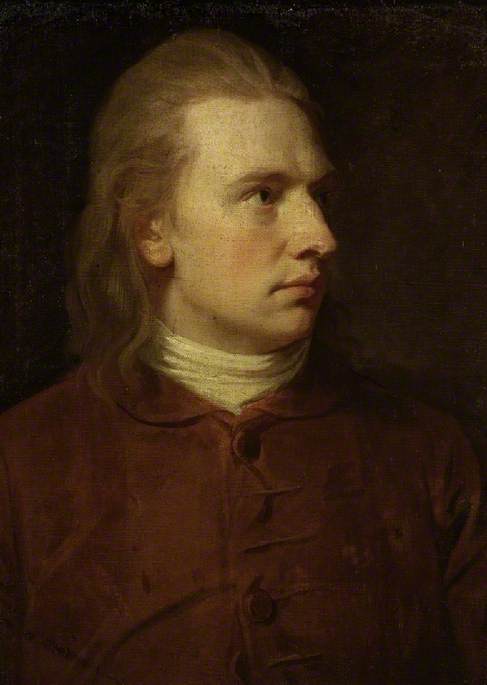
Admire George Romney's masterful portraiture style in this captivating depiction of an elegant gentleman dressed in crimson attire – a timeless piece reflecting the grandeur of the late 18th century.
Entdecken Sie George Romney (1734-1802), Meister des britischen Porträts! Erleben Sie elegante Gesellschaftsgemälde & seine faszinierende Muse, Emma Hamilton. Reproduktionen sichern!
Entdecken Sie Kunst & Geschichte im Fitzwilliam Museum, Cambridge! Erleben Sie Weltklasse-Sammlungen von antiken Ägypten bis zu modernen Meisterwerken – kostenlose Einladung!
A Portrait Steeped in Regency Elegance: Exploring George Romney’s “Possibly William Thomas Meyer”
The canvas holds an arresting stillness—a gaze directed outwards, yet utterly absorbed within itself. This is “Possibly William Thomas Meyer,” a portrait painted by George Romney circa 1795-1802, and it stands as a testament to the artist's mastery of capturing not just likeness but also the very essence of human character during Britain’s Regency era. More than simply depicting a man’s appearance, Romney skillfully conveys an aura of refined dignity and quiet contemplation—a hallmark of his distinctive style that continues to resonate with audiences today.
Romney’s Style: A Synthesis of Venetian Influence
George Romney's artistic vision was profoundly shaped by the traditions of Venetian portraiture, particularly those championed by Antonio Canova and Joshua Reynolds. Unlike the stiff formality prevalent in earlier aristocratic commissions, Romney favored a looser brushstroke technique—a deliberate departure from convention that prioritized capturing subtle nuances of expression and conveying an impression of naturalness. This approach wasn’t merely stylistic; it reflected Romney's belief that true beauty resided in portraying subjects as they genuinely were, rather than imposing idealized notions upon them. The artist meticulously observed his sitters, painstakingly studying their posture, gaze, and gestures to translate these observations onto canvas with remarkable accuracy.
Technique and Material: Layers of Light and Texture
Romney’s technique involved applying thin glazes over a preparatory underpainting—a method that allowed him to build up layers of color gradually, achieving luminous effects and capturing the subtle interplay of light and shadow. He employed pigments derived from natural sources – ochre, umber, ivory black – blending them with linseed oil to create rich textures that mirrored the fabric of Meyer’s coat and the smoothness of his skin. The artist's meticulous attention to detail extended beyond mere representation; he skillfully rendered folds in clothing and creases in skin, conveying a palpable sense of physicality without sacrificing elegance. Notice particularly the delicate brushstrokes delineating the collar—a testament to Romney’s unwavering commitment to capturing every nuance of surface quality.
Historical Context: The Rise of Aristocratic Portraiture
“Possibly William Thomas Meyer” emerged during a period of significant social and cultural transformation in Britain. The Regency, succeeding the reign of George III, witnessed an explosion of artistic patronage fueled by the wealth generated from colonial expansion and industrial innovation. Portraiture flourished as a symbol of status and prestige—a means of asserting one’s position within the hierarchy of society. Romney's commissions catered to this demand, reflecting the aspirations of influential families eager to commemorate their lineage and solidify their influence. The sitter himself was likely a gentleman of considerable standing, perhaps involved in commerce or finance – an individual whose character Romney sought to portray with sensitivity and insight.
Symbolism: Quiet Confidence and Measured Grace
Beyond its technical brilliance, “Possibly William Thomas Meyer” speaks volumes about the values of the Regency period. The dark red coat—a garment signifying wealth and authority—is worn with understated grace, suggesting a man who possesses confidence without ostentation. Romney’s careful positioning of Meyer’s gaze directs it outwards, hinting at ambition and engagement with the world beyond the confines of domestic life. Yet, there's also an element of introspection—a subtle acknowledgment of inner contemplation that underscores the importance of moral virtue and intellectual pursuits within aristocratic circles. The overall composition embodies a harmonious balance between outward appearance and inward reflection – a timeless aesthetic that continues to captivate viewers centuries later.
Emotional Impact: Capturing the Soul of a Moment
Ultimately, Romney’s “Possibly William Thomas Meyer” transcends mere visual representation; it succeeds in conveying an emotional resonance that lingers long after viewing. The soft lighting illuminates Meyer's face with warmth and compassion—creating an image that feels remarkably intimate despite its formal setting. It is precisely this ability to capture the essence of human experience – the quiet dignity, the measured grace, the subtle contemplation – that distinguishes Romney’s work from lesser portraits of his time and secures its place as a masterpiece of Regency art.