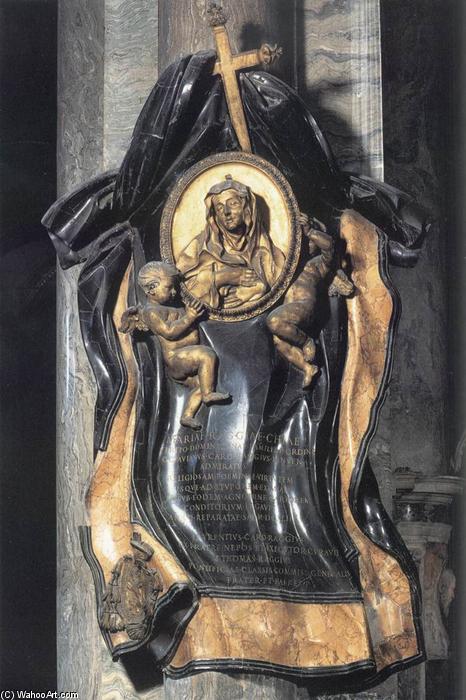
Gian Lorenzo Bernini’s ‘Memorial to Maria Raggi,’ created in 1643 for Santa Maria sopra Minerva, embodies the Baroque style's dramatic flair. Featuring a serene bust of Maria Raggi alongside angelic figures and classical columns, it exemplifies Bernini’s unparalleled skill in sculpture and architectural design.
A Symphony of Devotion: The Soul of Bernini’s Masterpiece
In the hallowed, dim light of the Roman church of Santa Maria sopra Minerva, there exists a moment where stone ceases to be inanimate and begins to breathe with the weight of human sorrow and divine ecstasy. Gian Lorenzo Bernini’s Memorial to Maria Raggi is not merely a funerary monument; it is a profound psychological landscape carved from the very essence of the Baroque spirit. To encounter this work is to witness a masterclass in how art can bridge the gap between the earthly struggle and spiritual transcendence. The sculpture commemorates Maria Ragi, a nun whose life was marked by the turbulence of war and widowhood before finding sanctuary in religious devotion. Bernini captures her not as a static figure of the past, but as a living embodiment of pietas—a soul caught in the delicate tension between the grief of loss and the luminous hope of salvation.
The brilliance of this work lies in its ability to manipulate the viewer's emotions through the sheer virtuosity of technique. Bernini, the undisputed titan of the Roman Baroque, utilized Carrara marble with a precision that defies the hardness of the medium. He achieved a tactile realism so convincing that one can almost sense the softness of the veil and the warmth of the skin beneath. By integrating gilded bronze accents into the composition, he introduced a celestial luminosity that dances across the surfaces as light shifts through the nave. This interplay of light and shadow—the chiaroscuro of sculpture—creates a theatrical illusionism, pulling the observer into a sacred drama where every fold of drapery and every subtle contour of the face tells a story of profound faith.
The Baroque Theater of Faith and Memory
Beyond its technical splendor, the memorial serves as a powerful historical artifact of the Counter-Reformation. Created during a period when the Catholic Church sought to use art as a sensory tool to inspire awe and reinforce dogma, Bernini’s work functions as a visual sermon. The sculpture does not shy away from the visceral reality of death; instead, it elevates it. Through the dynamic movement of the figures and the emotive intensity of the facial expressions, Bernini invites us to participate in Maria Raggi's spiritual journey. For the modern collector or designer, this piece offers more than just aesthetic beauty; it provides a focal point of deep contemplation and historical gravity.
For those seeking to bring the grandeur of the Roman Baroque into a contemporary space, a high-quality reproduction of this masterpiece offers an unparalleled opportunity. Whether placed in a curated gallery or as a centerpiece in a sophisticated interior, the Memorial to Maria Raggi commands attention through its complex layers of meaning. It is a work that celebrates the resilience of the human spirit and the enduring power of memory, making it an exquisite choice for those who value art that speaks to both the eye and the soul.