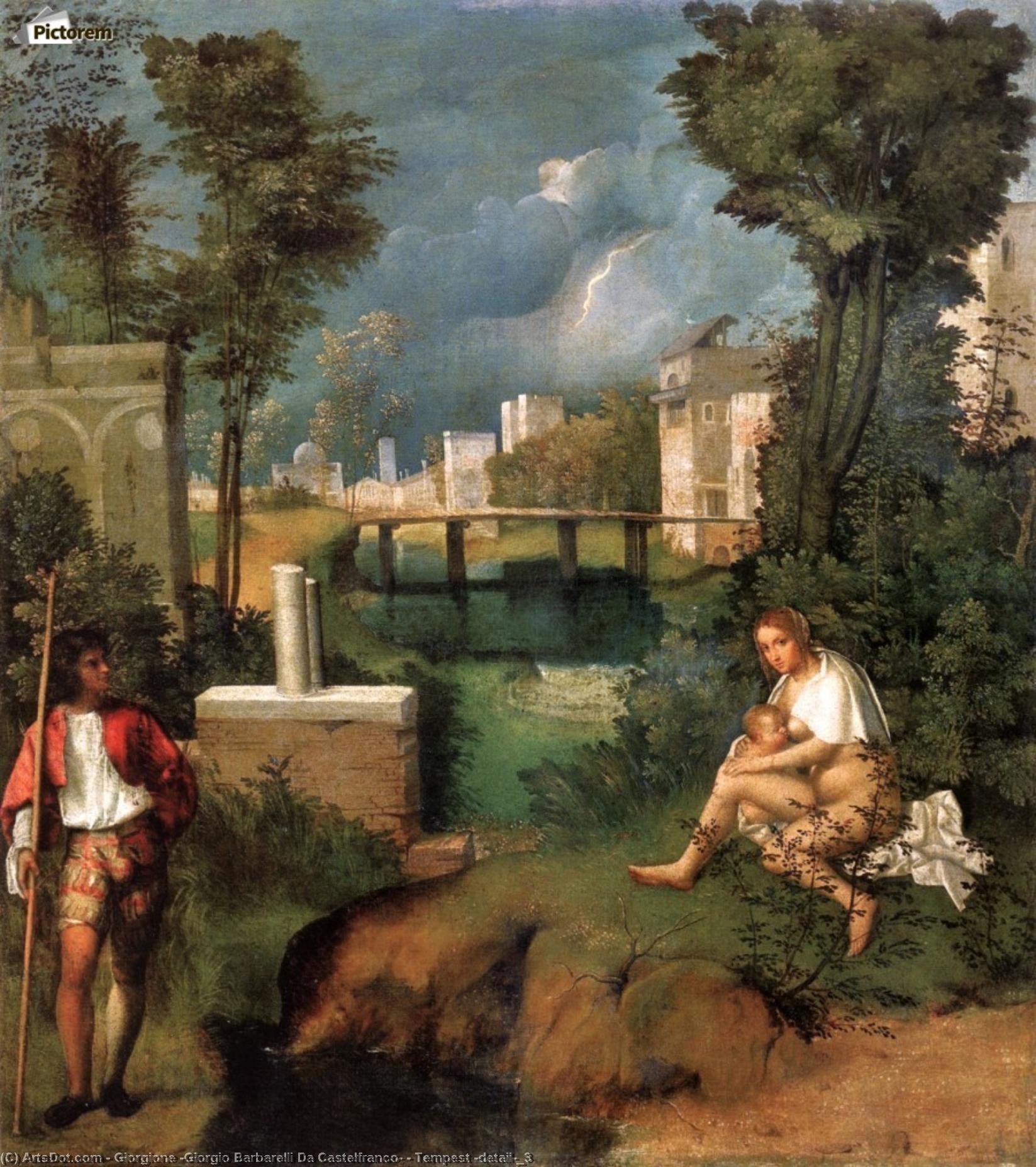
Explore Giorgione’s masterful Tempest (detail), capturing a tranquil Venetian landscape bathed in sunlight—a testament to Renaissance artistry and humanist ideals. Admire the serene composition and subtle beauty; bring this iconic painting into your home.
Entdecken Sie Giorgione (1477/8-1510), einen Schlüsselkünstler der Hochrenaissance Venedigs. Erkunden Sie seine lyrischen, rätselhaften Werke, die Farbe und Atmosphäre betonen – wie 'Der Sturm' & 'Das Konzert der Hirten'. Ein Begründer der venetischen Schule, der Tizian und andere beeinflusste.
A Venetian Masterpiece: Unraveling the Enigma of Giorgione’s Tempest
The painting “Tempest” by Giorgione, a deceptively tranquil landscape brimming with subtle complexities, stands as one of the most enduring mysteries within Renaissance art. Its beauty lies not merely in its picturesque depiction of trees and architecture but in the profound questions it poses about perception, emotion, and artistic intention—questions that continue to fascinate scholars and inspire artists today. While precise details regarding Giorgione’s life remain elusive, his influence on Venetian painting is undeniable, establishing him as a pivotal figure who pushed beyond the conventions of his time.
The Landscape Canvas: Composition and Technique
Executed sometime between 1506 and 1508, “Tempest” exemplifies Giorgione's mastery of atmospheric perspective—a technique pioneered by Venetian artists to capture the illusion of depth and realism. Notice how the artist skillfully employs muted colors, predominantly greens and browns, to convey a sense of hazy stillness. The trees are rendered with meticulous detail, their branches reaching upwards towards the diffused sunlight filtering through the foliage. This careful observation of nature is coupled with an innovative compositional arrangement—a humanist approach that prioritizes balance and harmony—reflecting the broader intellectual currents of Renaissance Venice. Giorgione’s brushstrokes are loose and expressive, eschewing the rigid linearity favored by earlier artists like Masaccio, creating a textured surface that invites contemplation.
Historical Context: Venetian Humanism and Artistic Innovation
“Tempest” emerged during a period of significant artistic ferment in Venice—a city at the forefront of humanist thought and eager to embrace new visual vocabularies. The Renaissance preoccupation with classical ideals of beauty and proportion found its expression in landscapes like this, which served as vehicles for conveying spiritual contemplation rather than simply documenting the natural world. Giorgione’s work aligns closely with the broader Venetian humanist tradition, championed by figures such as Pietro Bembo and Leonardo Bruni, who sought to reconcile Christian faith with pagan philosophy. This intellectual engagement is palpable in the painting's serene mood—a deliberate departure from the dramatic narratives prevalent in Northern European art of the era.
Symbolism Beneath the Surface: Hints of Narrative Depth
Despite its apparent simplicity, “Tempest” possesses layers of symbolic meaning that invite interpretation. The solitary figure standing near the building is often seen as representing humanity grappling with existential questions—a motif common in Renaissance art reflecting a growing awareness of mortality and the complexities of human experience. Some scholars suggest that the tempestuous sky hints at underlying tensions within Venetian society, mirroring the political instability of the time. However, Giorgione himself famously refused to elaborate on any intended symbolism, leaving it open to viewers’ imaginations—a characteristic trait of Renaissance artists who valued ambiguity and intellectual stimulation above didactic pronouncements.
Emotional Resonance: Capturing a Moment of Tranquility
Ultimately, “Tempest” succeeds in conveying a profound emotional resonance—a feeling of contemplative stillness that transcends its visual elements. Giorgione's masterful use of color and light creates an atmosphere of ethereal beauty, transporting the viewer to a place of serene contemplation. The painting’s enduring appeal lies in its ability to capture a fleeting moment of harmony between humanity and nature—a reminder that even amidst uncertainty and change, there exists a timeless aesthetic ideal rooted in observation, sensitivity, and artistic vision. Its quiet grandeur continues to inspire admiration and serves as a testament to Giorgione's unparalleled skill as a painter and his contribution to the legacy of Venetian Renaissance art.