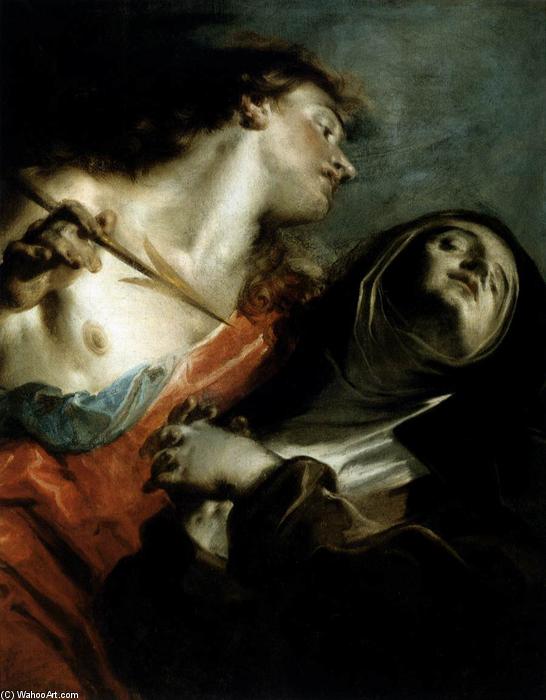
Giuseppe Bazzani’s “The Ecstasy of St Therese”: A Symphony of Light and Emotion
Giuseppe Bazzani’s “The Ecstasy of St Therese,” completed in 1745, stands as a cornerstone of Rococo art within Mantua’s ducal court—a testament to the era's fascination with opulent ornamentation and idealized beauty intertwined with profound spiritual contemplation. More than just a depiction of Saint Teresa’s visionary experience, it embodies the artistic spirit of its time, reflecting Bazzani’s masterful command of technique and his ability to convey complex emotions through subtle visual cues.
- Subject Matter: The painting portrays St Therese of Ávila, revered for her unwavering devotion and mystical communion with God. Her serene posture exudes tranquility, while the surrounding figures—a man and woman—represent earthly concerns juxtaposed against divine grace.
- Style & Technique: Bazzani’s Rococo style is characterized by delicate brushstrokes, pastel hues, and an emphasis on curvilinear forms—elements that contribute to the painting's ethereal atmosphere. The artist skillfully employs chiaroscuro, manipulating light and shadow to sculpt the figures and heighten emotional intensity.
- Historical Context: Created during the Baroque’s waning influence, “The Ecstasy” marks a decisive shift toward Rococo’s aesthetic sensibilities. It reflects the broader cultural preoccupation with aristocratic ideals of piety and refined sensibility—a response to the Reformation's moral imperatives.
- Symbolism: The knife held by the man symbolizes earthly anxieties and worldly desires, contrasting sharply with St Therese’s gaze upward toward heaven. This visual dichotomy underscores the central theme of spiritual transcendence—the aspiration for divine union amidst the challenges of human existence.
- Emotional Impact: Bazzani's masterful rendering captures a moment of intense emotional vulnerability—a palpable expression of faith and yearning. The painting invites viewers to contemplate themes of humility, devotion, and the transformative power of prayer.
The artwork’s luminous palette—dominated by soft blues and golds—further enhances its spiritual resonance. Notice how Bazzani uses light to illuminate St Therese's face, conveying her inner radiance and highlighting her connection with divine illumination. The meticulous detailing of the drapery adds textural richness and contributes to the painting’s immersive quality.
“The Ecstasy of St Therese” resides in the Szépmûvészeti Múzeum of Budapest, where it continues to inspire admiration for its artistic excellence and profound spiritual depth. Its enduring appeal stems from Bazzani's ability to distill complex theological concepts into a visually arresting composition—a masterpiece that encapsulates the essence of Rococo art’s expressive power.
Further research into Giuseppe Bazzani reveals his formative influence from Giovanni Canti, who instilled in him an appreciation for classical ideals blended with Rococo’s decorative exuberance. Collaboration with Francesco Maria Raineri broadened Bazzani's artistic horizons and fostered intellectual exchange within Mantua’s artistic milieu.
A detailed examination of “The Ecstasy” reveals its connection to Bernini’s sculpture of St Therese in Santa Maria della Vittoria—a parallel exploration of religious ecstasy through sculptural form. The painting exemplifies Bazzani's synthesis of Baroque, Lombardy and international styles, cementing his legacy as a pivotal figure in European art history.
The Web Gallery of Art provides invaluable resources for studying “The Ecstasy,” offering high-resolution images and scholarly commentary on Bazzani’s artistic oeuvre. Explore the painting's dimensions (76 x 60 cm) and date (1745) to gain a deeper understanding of its historical context.
Finally, consider the artwork’s presence on Wikimedia Commons—where it is freely accessible for educational purposes and contributes to a collaborative effort to preserve cultural heritage. The file “Giuseppe Bazzani - The Ecstasy of St Therese - WGA01527.jpg” showcases Bazzani's artistic vision in stunning detail.