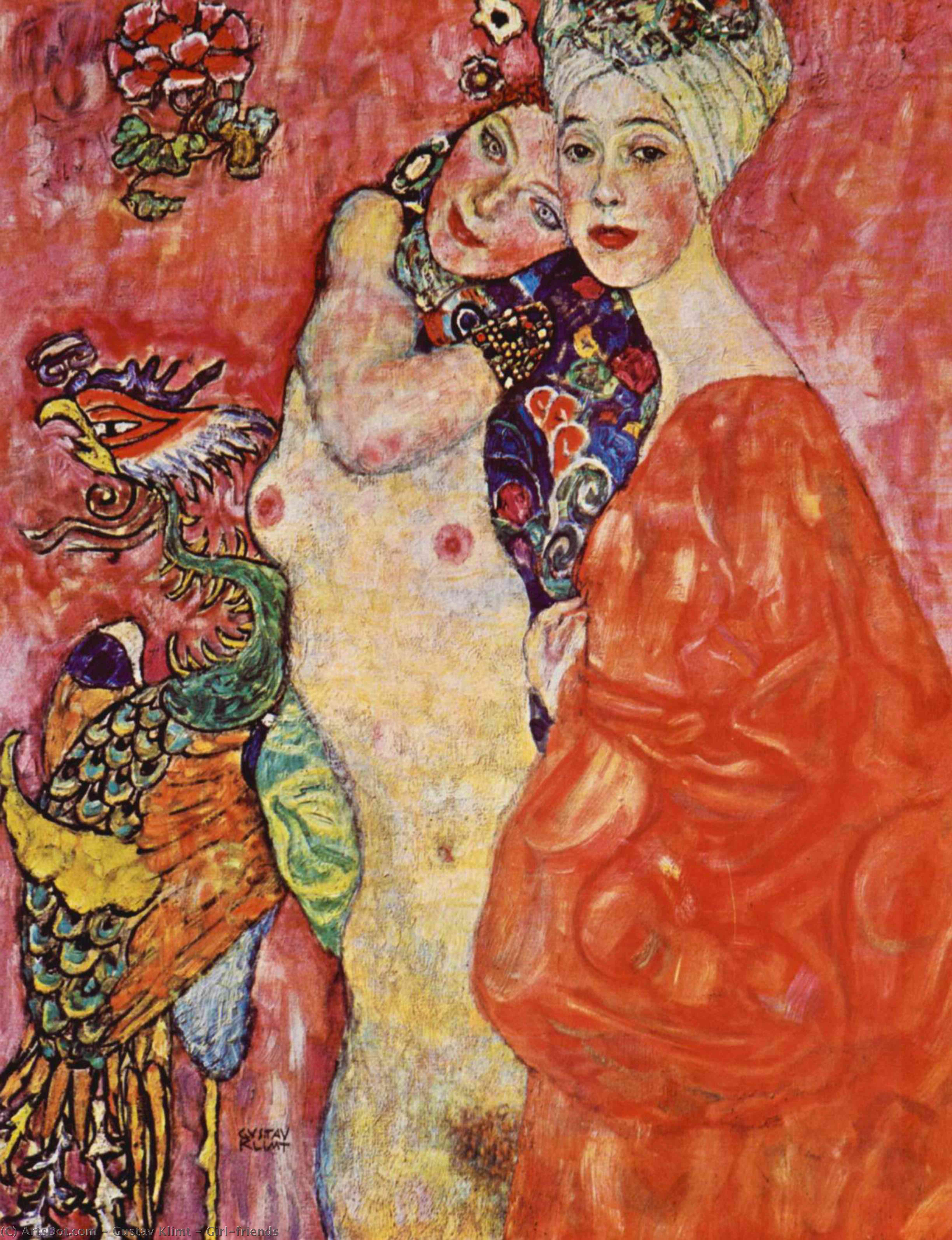
Girl-friends
Gustav Klimt’s ‘Girl-friends’, painted in 1916, stands as a testament to the artist's masterful blend of Symbolism and Art Nouveau—a stylistic fusion that cemented his place among the most influential figures of Viennese Modernism. This captivating artwork delves into themes of intimacy, femininity, and the interplay between earthly desires and spiritual contemplation, offering viewers an experience rich in visual splendor and profound emotional resonance.
Composition and Style
The painting’s central focus is a pair of women positioned close together, their arms entwined in a gesture of affectionate embrace—a motif recurrent throughout Klimt's oeuvre. Klimt skillfully employs flattened planes and shimmering gold leaf, hallmarks of his later artistic explorations, to create an ethereal atmosphere that transcends mere representation. The woman on the left leans into her companion, conveying vulnerability and tenderness, while the woman on the right turns her gaze towards the viewer, establishing a direct connection with the audience. Delicate floral patterns adorn both figures’ garments—a deliberate stylistic choice reflecting the pervasive influence of Art Nouveau's organic forms and decorative motifs.
Symbolism and Themes
Beyond its aesthetic beauty, ‘Girl-friends’ is laden with symbolic significance. The prominent bird motifs—one perched in the upper left corner and another near the center—represent freedom and aspiration, mirroring Klimt’s broader preoccupation with spiritual transcendence. Simultaneously, a dragon coiled on the lower left side symbolizes power and primal instinct—a counterpoint to the serenity conveyed by the women's embrace. These contrasting elements underscore Klimt’s exploration of duality within human experience, prompting contemplation about balance between passion and restraint. The overarching theme is one of harmonious union—a celebration of female companionship and the beauty inherent in shared vulnerability.
Artistic Influences
Klimt's artistic vision was profoundly shaped by movements preceding him, notably Symbolism and Art Nouveau. Symbolist artists sought to express inner emotions and ideas through evocative imagery rather than literal depiction, prioritizing psychological depth over visual realism—a principle evident in Klimt's meticulous attention to detail and his masterful manipulation of color and texture. Simultaneously, the Art Nouveau style championed flowing lines, organic forms, and opulent ornamentation—influences readily apparent in ‘Girl-friends’’ decorative splendor and shimmering gold leaf application. Klimt drew inspiration from Japanese art, particularly its use of asymmetry and flattened perspectives, further enriching his artistic vocabulary.
Relevance in Modern Times
Despite being created over a century ago, ‘Girl-friends’ retains an enduring appeal for contemporary audiences. Its exploration of human relationships—particularly the complexities of intimacy and desire—continues to resonate with viewers grappling with similar questions about connection and identity. Moreover, Klimt's masterful technique—the innovative use of gold leaf and his ability to imbue his canvases with palpable emotion—serves as an inspiration for artists striving to achieve artistic excellence. For more information on Gustav Klimt and his works, visit
https://ArtsDot.com. Explore our collection of handmade oil painting reproductions, including works by Klimt and other renowned artists.
- Artist: Gustav Klimt
- Birth Year: 1862
- Death Year: 1918
- Birth City: Baumgarten
- Birth Country: Austria
Biography: Gustav Klimt, born July 14, 1862, in Baumgarten near Vienna, emerged from a family touched by both artistic inclination and financial hardship. His father, Ernst Klimt, was a gold engraver, a profession that would subtly yet profoundly influence the young Gustav’s aesthetic sensibilities—the allure of gold leaf, the meticulous detail, the sheer opulence. The family's struggles meant frequent moves within Vienna, a transient upbringing that perhaps fostered in Klimt a keen observation of his surroundings and a sensitivity to human experience. Even as a child, his drawing skills were remarkable, nurtured by his father’s profession and an innate talent that quickly became apparent. In 1876, he entered the Vienna Kunstgewerbeschule (School of Applied Arts), embarking on formal training in architectural painting under Ferdinand Laufberger. This provided him with a solid technical foundation, but also exposed him to the prevailin
Additional Research: