A Vision of Mythic Movement
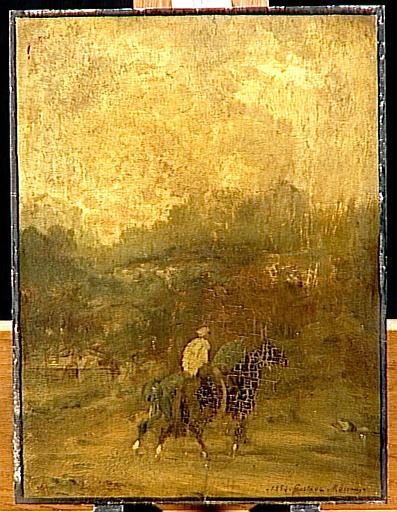
Moreau’s “Cavaliers et chevaux” (Horses and Knights) isn't merely a depiction of equestrian art; it’s an immersion into the fantastical landscapes of Symbolist imagination. Painted circa 1895, this monumental canvas embodies Moreau’s unwavering commitment to exploring the subconscious through meticulously crafted imagery rooted in ancient mythology and esoteric traditions. The scene unfolds against a turbulent sky—a hallmark of Moreau's stylistic preference—dominated by swirling clouds that lend an air of dramatic tension and otherworldly grandeur. Beneath this celestial drama lies a field dotted with trees, serving as a grounding element amidst the ethereal expanse.
- Subject Matter: The painting centers around a knight astride a horse, engaged in a spirited gallop across the meadow. This figure is flanked by another horse positioned slightly behind him, creating a dynamic interplay of movement and visual interest.
- Style: Moreau’s style aligns perfectly with Symbolism—characterized by dreamlike atmospheres, flattened perspectives, and an emphasis on symbolic representation rather than realistic depiction. He deliberately eschewed naturalistic color palettes, favoring muted hues that heighten the painting's emotional resonance.
The artist’s technique is remarkable for its precision and detail despite the stylized aesthetic. Moreau employed tempera paint on canvas—a medium known for its luminosity and durability—allowing him to achieve subtle gradations of tone and texture. His meticulous brushwork captures the musculature of the horse and knight with astonishing accuracy, subtly hinting at anatomical realism beneath the surface of symbolic abstraction. Furthermore, Moreau skillfully utilized glazing techniques—applying thin layers of translucent pigment over underlying colors—to build up depth and luminosity, enhancing the painting’s overall visual impact.
Historical Context: The Spirit of Symbolism
Moreau's artistic endeavors flourished during a period marked by intellectual ferment and disillusionment following the Franco-Prussian War. Symbolist painters rejected the materialism and scientific rationalism prevalent in their time, instead turning inward to grapple with questions of spirituality, psychology, and the subconscious mind. Influenced by thinkers like Nietzsche and Freud, Moreau sought to express profound emotional states—fear, longing, ecstasy—through evocative imagery drawn from folklore, mythology, and biblical narratives. “Cavaliers et chevaux” exemplifies this broader artistic movement’s preoccupation with exploring the hidden dimensions of human experience.
Symbolism Unveiled: Layers of Meaning
Beyond its visual splendor, “Cavaliers et chevaux” is laden with symbolic significance. The horse itself represents nobility, strength, and virility—themes recurrent in European mythology and heraldry. However, Moreau imbues the animal with an aura of melancholy, perhaps reflecting anxieties about mortality and the passage of time. The knight’s posture conveys determination and courage, yet his gaze appears distant and contemplative, suggesting a preoccupation with inner reflection. The swirling clouds serve as visual metaphors for turbulent emotions and spiritual upheaval—mirroring the artist's own intellectual struggles.
Emotional Resonance: A Dreamlike Landscape
Ultimately, “Cavaliers et chevaux” transcends mere representation; it aspires to evoke a profound emotional response in the viewer. Moreau’s masterful manipulation of color and texture creates an immersive experience that transports us into a realm of dreamlike beauty and psychological depth. The painting's subdued palette—dominated by blues, greens, and browns—promotes tranquility while simultaneously conveying a sense of unease. It invites contemplation on themes of heroism, vulnerability, and the enduring power of mythic narratives. A reproduction of this artwork would undoubtedly bring an element of timeless elegance and intellectual stimulation to any interior space.