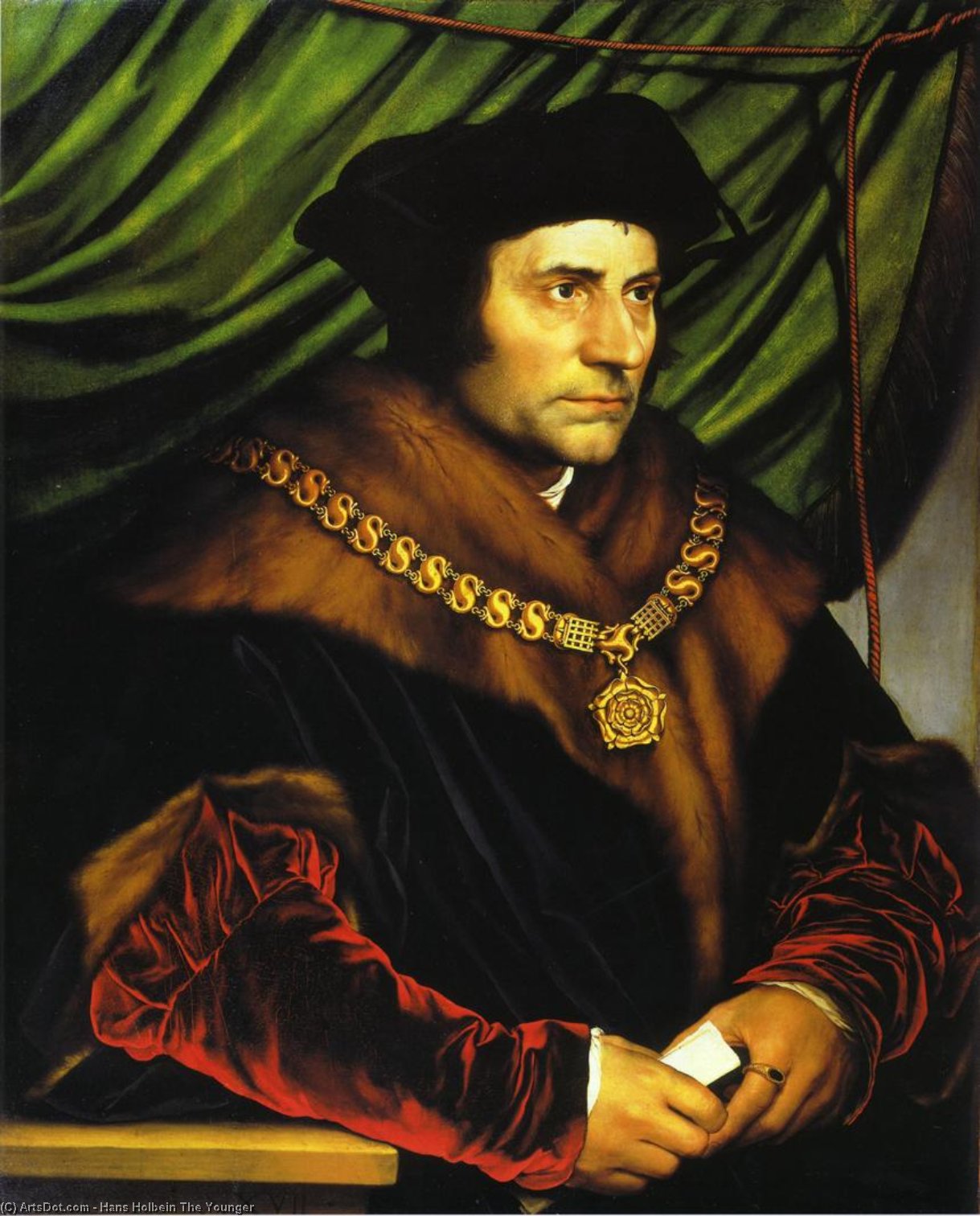
Portrait of Sir Thomas More
Hans Holbein the Younger’s Portrait of Sir Thomas More stands as a cornerstone of Northern Renaissance portraiture—a testament to Holbein’s unparalleled mastery in capturing the essence of human character and conveying profound psychological depth.
Painted in 1527, this masterpiece resides at the Frick Collection in New York City and exemplifies Holbein’s signature style: meticulous detail combined with subtle expressive gestures.
The Artist and His Style
Born around 1497 in Augsburg, Germany, Hans Holbein the Younger emerged as a pivotal figure of the Northern Renaissance. He benefited immensely from his upbringing within an artistic family; his father, Hans Holbein the Elder, was a respected painter and printmaker. Holbein’s initial training occurred within his father's workshop, laying a strong foundation in technique and observation.
Holbein’s artistic vision drew inspiration from diverse influences—Late Gothic art blended seamlessly with emerging trends of the Northern Renaissance. He absorbed stylistic elements from Italy, France, and the Netherlands, mirroring the broader intellectual currents of the era. Notably, Holbein's meticulous attention to detail—a hallmark of his oeuvre—was honed by studying the works of Leonardo da Vinci and Michelangelo.
The Subject: Sir Thomas More
Sir Thomas More, a prominent English lawyer, philosopher, and statesman, served as Lord Chancellor from 1529 to 1532 but tragically fell out of favor with King Henry VIII due to his unwavering opposition to the English Reformation. Holbein recognized More’s intellectual integrity and moral fortitude—qualities that resonated deeply within the humanist spirit of the time.
Holbein skillfully rendered More in a three-quarter pose, capturing him holding a book, symbolizing his erudition and devotion to scholarly pursuits. The stern gaze conveyed by More reflects his serious demeanor and unwavering conviction—a visual embodiment of his moral compass.
Artistic Significance
The Portrait of Sir Thomas More is a true triumph of portraiture—a demonstration of Holbein’s ability to convey depth and character through nuanced facial expressions and painstakingly rendered textures.
Executed in oil on panel measuring 58 x 74 cm, the painting utilizes glazing techniques to achieve luminous colors and subtle gradations of tone. Holbein's masterful brushwork captures the folds of More’s robe with astonishing realism—a testament to his technical prowess.
Context and Legacy
Holbein’s work was highly regarded during his lifetime, earning him acclaim from influential figures like Nicholas Bourbon who hailed him as “the Apelles of our time.” Despite some losses of artworks after Holbein's death, his reputation as a celebrated portraitist endured.
The painting’s symbolism extends beyond mere likeness—the Tudor Collar of Esses chain signifies More’s loyalty to the crown, while the book represents his intellectual pursuits. Holbein’s meticulous attention to detail reflects the humanist ideals prevalent during his era, cementing More's place as an icon of moral courage and intellectual integrity.
Today, the Portrait of Sir Thomas More continues to inspire admiration for its artistic excellence and profound psychological insight—a timeless masterpiece that resides at the Frick Collection, inviting viewers to contemplate the complexities of human character.