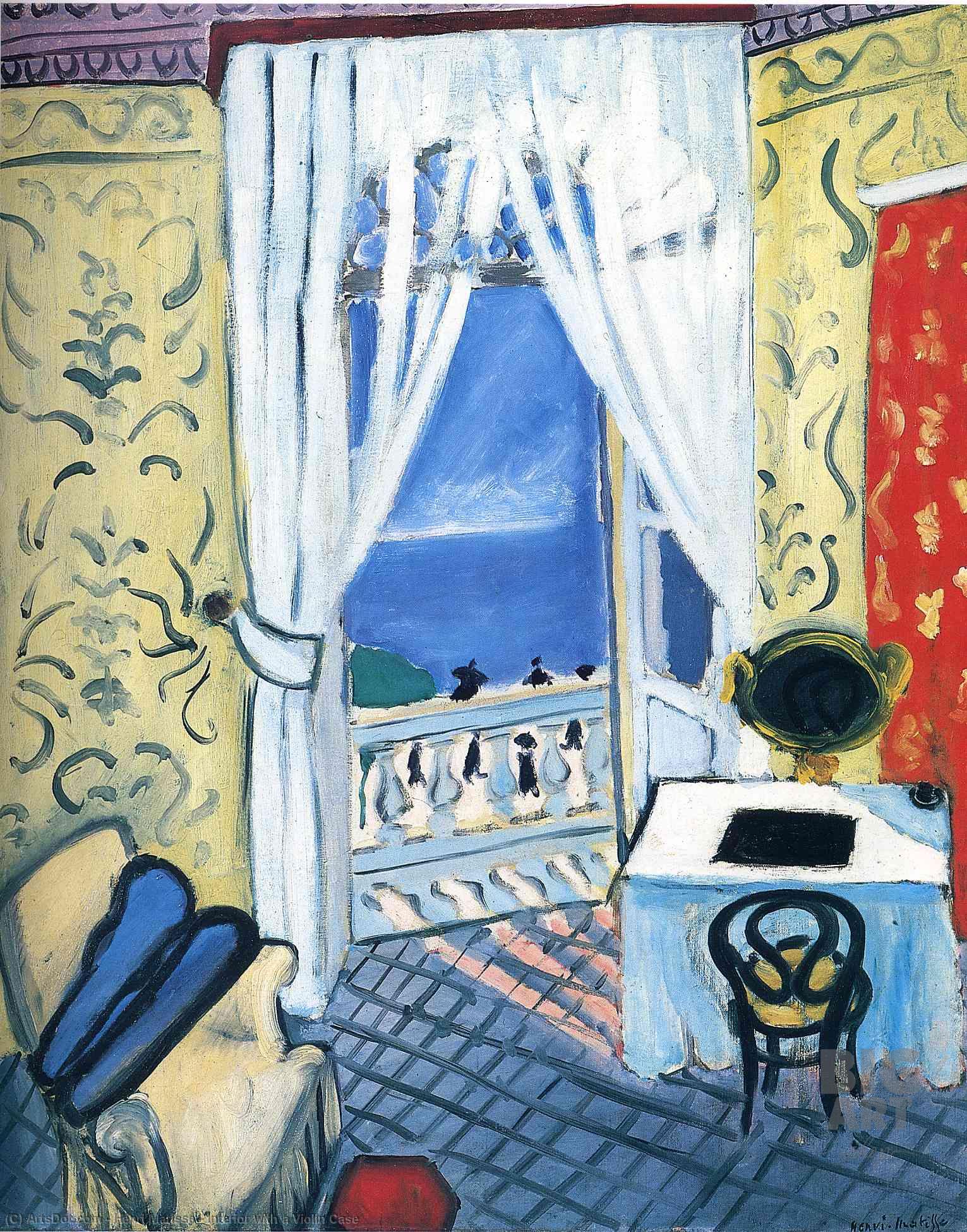
Interior with a Violin Case: A Fauvist Masterpiece
Henri Matisse’s *Interior with a Violin Case*, painted in 1919, stands as an emblem of Fauvism—a movement that irrevocably altered the course of modern art. As a seasoned art historian and content creator specializing in decorative arts, I can attest to its enduring significance and artistic brilliance. This oil on canvas piece transcends mere representation; it’s an explosion of color designed to evoke emotion and capture the essence of a domestic scene bathed in Mediterranean light.
Fauvism, originating in France around 1905-1908, championed bold, non-naturalistic hues—often jarringly juxtaposed—as opposed to Impressionist’s subtle gradations. Matisse embraced this radical approach wholeheartedly, rejecting traditional perspective and anatomical accuracy in favor of expressive brushstrokes that prioritized color above all else. The painting's palette is dominated by fiery reds and oranges for the furniture and walls, countered by tranquil blues and greens within the drapery and background—a deliberate orchestration intended to heighten visual impact.
Artist Background & Influences
Henri Émile Benoît Matisse (1869-1954) was born in Le Cateau-Cambrésis, France, a formative experience that instilled in him an early appreciation for artistic exploration. Initially drawn to law, he swiftly abandoned his academic pursuits after an appendicitis attack in 1889, recognizing art as his true vocation. His formative years were marked by studies at the Académie Julian and École Nationale des Beaux-Arts under Gustave Moreau, where he absorbed influences from masters like Jean-Baptiste-Siméon Chardin and Nicolas Poussin—artists who championed classical ideals of beauty and form.
Composition & Color Analysis
The painting depicts a serene interior space featuring a woman seated comfortably in a chair alongside a table adorned with decorative textiles. An open doorway reveals glimpses of the exterior, framing a vista of the sea – a motif recurrent throughout Matisse’s oeuvre reflecting his fascination with nature and its transformative power. Notably, a violin case rests upon the floor near the table—a subtle yet poignant detail that underscores the painting's musical dimension. Matisse skillfully utilizes color to convey mood and atmosphere; the warm hues of the furniture create a sense of warmth and intimacy, while the cooler tones of the drapery and background contribute to an overall feeling of tranquility.
- The bold color palette—particularly reds and oranges—is characteristic of Fauvist style.
- Matisse’s balanced composition directs the viewer's gaze towards the violin case, emphasizing its symbolic significance as a vessel for artistic expression.
- The inclusion of an open doorway enhances depth and invites contemplation of the surrounding environment.
MoMA & Legacy
*Interior with a Violin Case* resides within the Musée National d’Art Moderne (MoMA) in Paris, France—a testament to Matisse's enduring influence on artistic discourse. MoMA’s acquisition underscores the painting’s importance as a pivotal work of Fauvist art and its contribution to the broader evolution of modern painting. Its vibrant colors and expressive brushstrokes continue to inspire artists and captivate audiences today, cementing Matisse’s place among the giants of 20th-century art.
High-quality reproductions of *Interior with a Violin Case* are available on ArtsDot.com—allowing enthusiasts worldwide to experience the beauty and emotional resonance of this iconic masterpiece.