A Glimpse into Regency Grandeur: The Portrait of Lieut-Colonel Bryce McMurdo
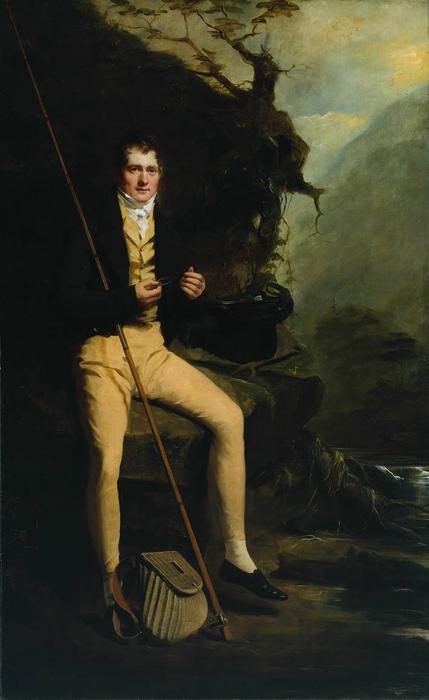
To stand before this portrait is to step directly into the polished drawing rooms and sun-dappled landscapes of early nineteenth-century Britain. Henry Raeburn, a master whose brushstrokes seemed capable of capturing not just likeness, but very spirit, has gifted us with a scene rich with narrative potential. This depiction of Lieut-Colonel Bryce McMurdo is more than a mere record of appearance; it is a carefully constructed tableau vivant, whispering tales of gentlemanly pursuits and established social standing during the Regency era.
The subject himself commands attention. Dressed in the impeccable tailoring expected of a man of his rank—the crisp suit, the formal tie, the confident bearing—he sits with an air of relaxed authority. The inclusion of the cane suggests not only support but also an element of gentlemanly accoutrement, while the object held near him, perhaps a fishing rod, anchors the portrait in a moment of leisure. This juxtaposition—the formality of his attire against the implied tranquility of the outdoor setting—is key to understanding the painting's emotional resonance.
The Artistry of Henry Raeburn: Technique and Mastery
Henry Raeburn’s genius lay in his ability to achieve a profound sense of realism while imbuing his subjects with an almost palpable inner life. While the details of the technique are rooted in the traditions of grand portraiture, one can observe the characteristic softness that Raeburn applied to skin tones, allowing the sitter's features to emerge from the background with remarkable clarity. The handling of light is particularly noteworthy; it seems to fall naturally across the scene, highlighting the textures of his coat and the sheen on his hat.
Beyond the central figure, the composition expands outward. The presence of other figures in the background, along with the visible boat nestled near the center, suggests a broader narrative context—a social outing or perhaps a moment captured during an excursion. Raeburn masterfully uses these secondary elements to give depth and scale, preventing the portrait from feeling static. It is a study in controlled composition, where every element, from the steps upon which he rests to the distant water, contributes to the overall harmony.
Historical Context and Symbolism of Leisure
The period surrounding 1800 was one of immense social fluidity and burgeoning wealth among the British gentry. Portraits like this served a vital function: they were affirmations of status. The inclusion of outdoor elements, such as the boat and the natural setting, speaks to a growing cultural appreciation for the pastoral ideal—a retreat from the rigid confines of urban life into nature's restorative embrace. For the collector or designer, understanding this context adds layers of meaning; it suggests an aspiration toward refined leisure.
The symbolism here is subtle but potent: the combination of military bearing (implied by "Lieut-Colonel"), sophisticated dress, and recreational activity paints a picture of the ideal gentleman—a man who has achieved both public success and private contentment. It speaks to a life well-lived, observed through the discerning eye of an artist.
Bringing Regency Charm Home
For those seeking to infuse a space with the elegance and narrative depth of this era, a high-quality reproduction of this work offers more than just decoration; it offers conversation. Imagine this piece gracing a library or a formal reception room. The rich tonality and the palpable sense of history lend an immediate air of cultivated taste. It invites viewers to pause, to consider the man depicted, and to appreciate the enduring skill of Raeburn’s hand. Owning this reproduction is acquiring a tangible echo of Georgian and Regency sophistication.