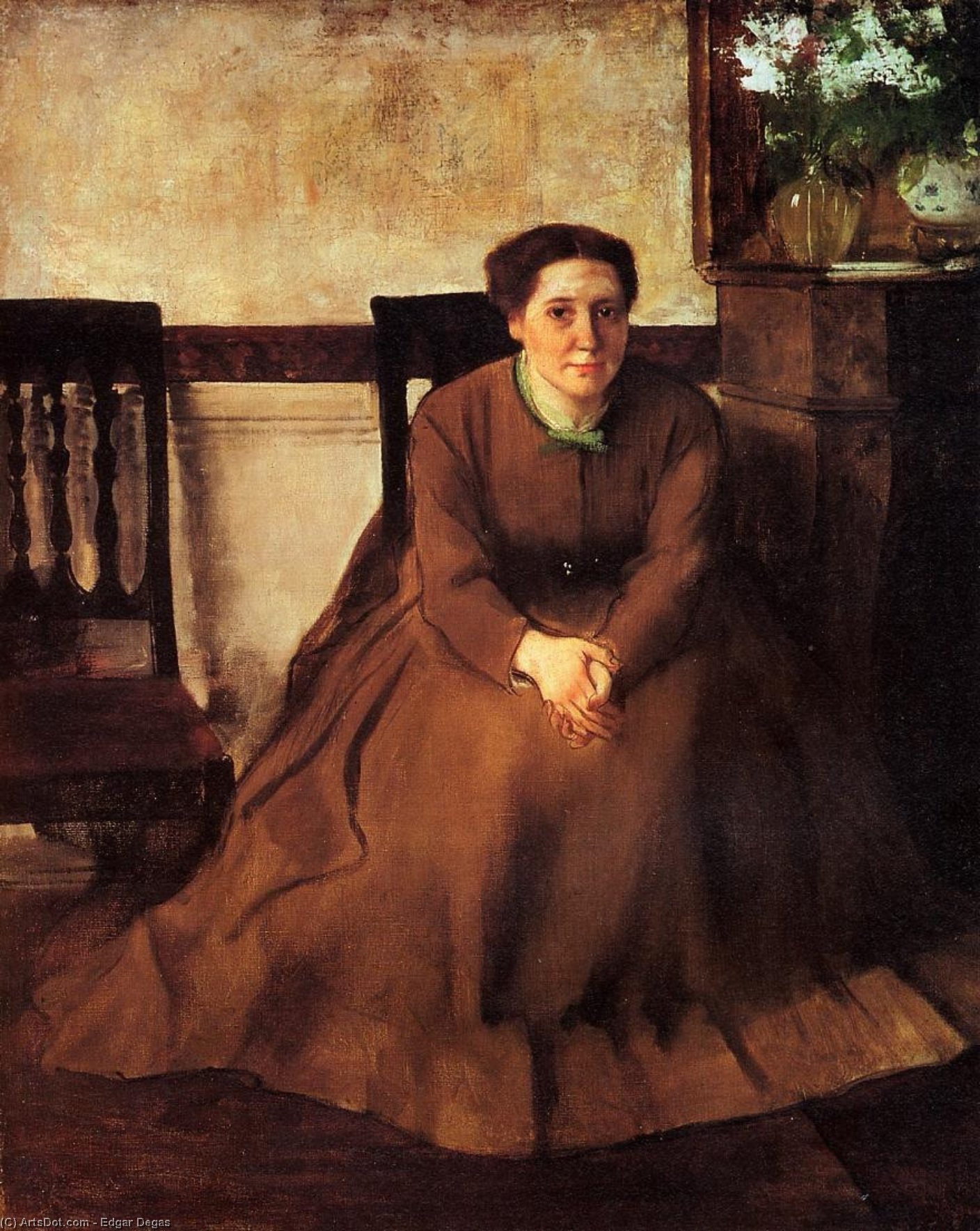
A Moment of Quiet Reflection: Edgar Degas’s ‘Victoria Duborg’
Edgar Degas's 'Victoria Duborg,' painted in 1866 and currently residing within the Toledo Museum of Art, is more than just a portrait; it’s a carefully constructed tableau of domesticity and subtle emotion. This captivating work offers a rare glimpse into the private world of a woman—Victoria Dubourg—captured with Degas's signature blend of realism and Impressionistic sensitivity. The painting immediately draws the eye to its subject, seated gracefully in an armchair, her posture suggesting both contemplation and a quiet dignity.
Degas’s genius lies not simply in his ability to render a likeness but in his masterful use of light and shadow to evoke mood. Notice how he employs diffused natural light filtering through the room, creating soft gradations across Victoria's dress and skin. The muted palette—predominantly browns, creams, and hints of floral color—contributes to this atmosphere of subdued elegance. He deliberately avoids harsh contrasts, favoring instead a delicate interplay that emphasizes the softness of the fabrics and the gentle curve of her features.
The Intimate Setting: A Window into 19th-Century Life
Beyond Victoria herself, the painting’s setting is equally significant. The room behind her—a modestly furnished interior—offers a window into the domestic life of the mid-19th century. A couch and another chair suggest a comfortable space for relaxation and conversation, while several vases overflowing with flowers add a touch of color and refinement. The prominent clock on the wall serves as a subtle reminder of time’s passage, anchoring the scene within its historical context. Degas wasn't merely painting a woman; he was depicting an entire moment in time, carefully arranged to reveal details about her social standing and personal life.
Interestingly, Degas’s choice of subject matter—a bourgeois woman engaged in quiet contemplation—reflects his fascination with the everyday lives of Parisian society. He often depicted scenes from the opera, ballet, and café culture, but ‘Victoria Duborg’ offers a quieter, more introspective perspective. The painting speaks to a desire for intimacy and understanding, qualities that are central to Degas's artistic vision.
Degas’s Technique: Observation and Impression
As an artist who resisted the label of “Impressionist,” Degas nonetheless embraced many of the movement’s core principles. He was a meticulous observer, spending countless hours studying his subjects in natural light before committing them to canvas. ‘Victoria Duborg’ exemplifies this approach—the brushstrokes are loose and suggestive, capturing the fleeting effects of light and shadow rather than striving for photographic realism.
The use of broken color – applying small dabs of paint side-by-side rather than blending them seamlessly – is particularly evident in the rendering of Victoria’s dress. This technique creates a shimmering effect that adds depth and luminosity to the fabric, while also conveying a sense of movement and spontaneity. Degas's skill lies not just in his technical proficiency but in his ability to capture the essence of his subjects—their personalities, their emotions, and their place within the world.
Symbolism and Emotional Resonance
While seemingly straightforward, ‘Victoria Duborg’ is rich with subtle symbolism. Victoria's pensive expression invites us to speculate about her thoughts and feelings. Her crossed legs suggest a sense of self-possession and inner strength, while her gaze—direct and unwavering—conveys both intelligence and vulnerability. The flowers in the vases could represent beauty, fragility, or perhaps even mortality – themes frequently explored by Degas’s subjects.
Ultimately, ‘Victoria Duborg’ is a testament to Edgar Degas's remarkable ability to capture the complexities of human experience. It’s a painting that rewards careful observation and invites us to linger in its quiet beauty, contemplating the mysteries of the human heart.