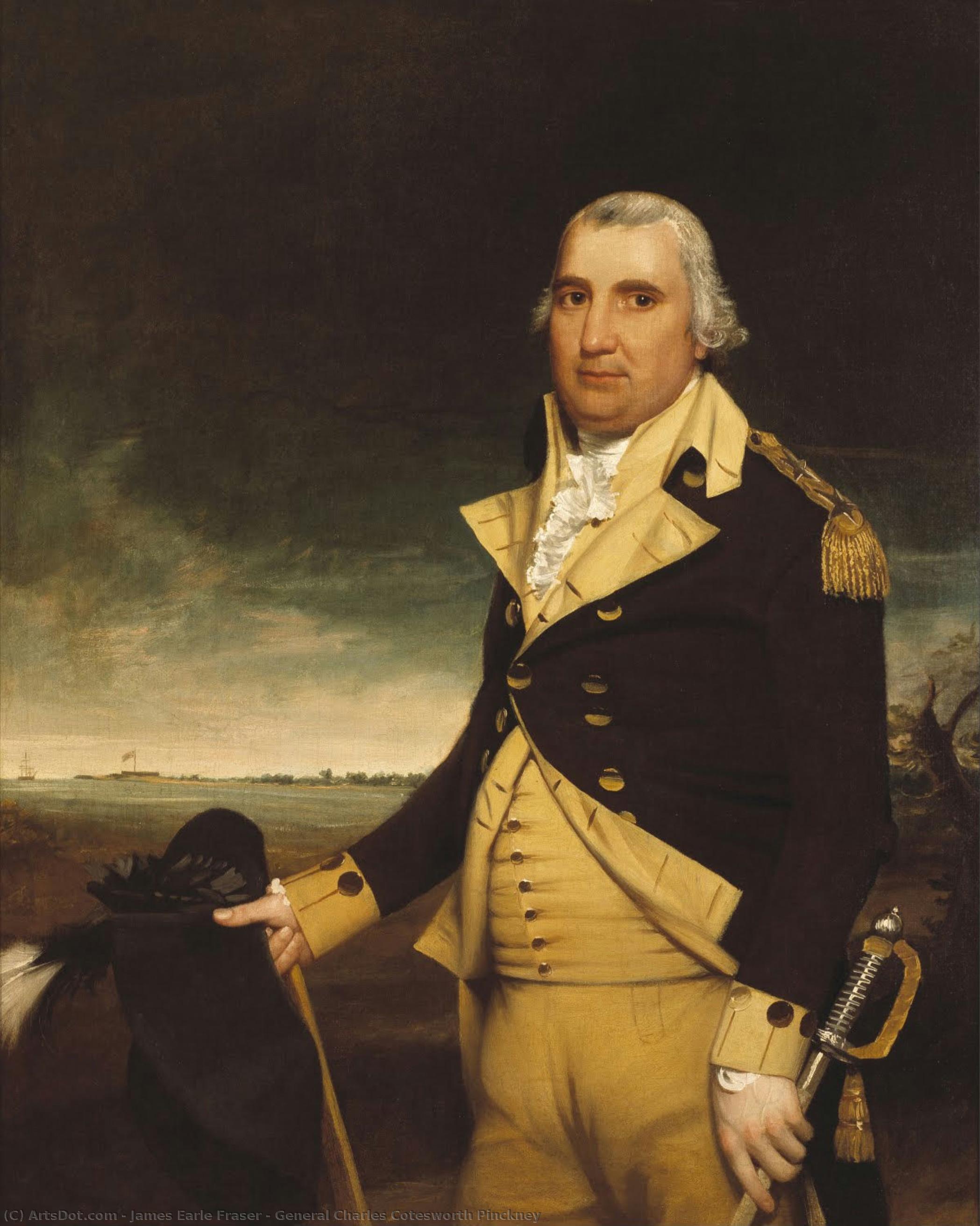
A Commander in Canvas: The Legacy of General Pinckney
In the grand tradition of late eighteenth-century portraiture, General Charles Cotesworth Pinckney emerges from the canvas not merely as a man, but as a symbol of a burgeoning nation. This evocative work by James Earle Fraser captures the essence of a Revolutionary War hero, draped in the heavy, dignified regalia of his military station. The portrait serves as a profound window into an era defined by struggle and the forging of American identity. As one gazes upon the General, there is an immediate sense of the weight of command; the meticulous rendering of his uniform and the sharp, commanding presence of his gaze suggest a man accustomed to the gravity of battlefield decisions and the complexities of political leadership.
The composition masterfully weaves together the individual with the landscape of his triumphs. Beyond the central figure, the artist incorporates the poignant setting of Sullivan’s Island, a site etched into American history as the location of the first significant victory over British forces in 1776. This inclusion transforms the painting from a simple likeness into a narrative masterpiece, where the background elements—the distant fort and the subtle movement of water—act as silent witnesses to the General's storied career. The presence of nature, including the delicate detail of birds in flight, provides a breathing, organic contrast to the rigid structure of military life, suggesting a harmony between the soldier and the land he fought to defend.
Mastery of Form and Historical Resonance
Technically, the work showcases an extraordinary command over texture and light. The artist demonstrates what contemporaries described as an "uncommon facility in hitting the likeness," particularly through the masterful execution of drapery. Each fold of the military fabric and each glint of light upon his accouterments is rendered with a realism that invites the viewer to reach out and feel the weight of the cloth. This attention to detail is not merely decorative; it serves to ground the subject in reality, making the historical figure feel tangibly present within our modern space.
For the discerning collector or interior designer, this piece offers more than just aesthetic beauty; it provides a profound sense of heritage and gravitas. Whether placed in a stately library, a formal study, or an elegant hallway, a high-quality reproduction of this portrait commands attention. It acts as a conversation piece that bridges the gap between the eighteenth century and the present day, evoking themes of bravery, duty, and the enduring spirit of the American frontier. To possess such a work is to invite a piece of history into one's environment, surrounding oneself with the quiet strength and storied elegance of a true American icon.