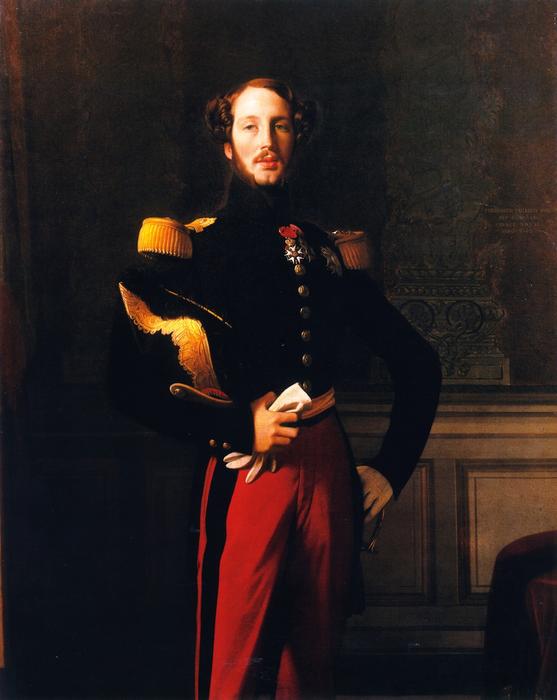
Jean-Auguste-Dominique Ingres’s Regal Portrait of the Duc d'Orléans – A Study in Neoclassical Grace
The portrait of Ferdinand-Philippe-Louis-Charles-Henri, Duc d'Orléans, painted by Jean-Auguste-Dominique Ingres in 1842, is more than simply a likeness; it’s an embodiment of the idealized aesthetic principles that defined the era. This meticulously rendered oil on canvas, currently residing within the hallowed halls of the Louvre Museum in Paris, offers a captivating glimpse into the world of French aristocracy and the artistic sensibilities of one of history's most influential painters. Ingres, a master of his craft, doesn’t merely depict a man; he constructs an image of power, dignity, and restrained elegance – qualities deeply rooted in the Neoclassical tradition yet subtly infused with the burgeoning Romantic spirit.
The Duc d'Orléans himself is presented with a remarkable degree of formality. His posture, upright and commanding, speaks to his noble lineage and position within French society. The careful arrangement of his hands – resting confidently on his hips – projects an aura of self-assurance and control. Notice the precision in every detail: the rich texture of his uniform, the subtle sheen of his jacket, the meticulously rendered buttons and lace. Ingres’s dedication to anatomical accuracy is evident throughout, creating a figure that feels both solid and remarkably lifelike. The background, deliberately muted and understated, serves not as a distraction but rather as a canvas for the subject's presence – a testament to Ingres’s understanding of composition and his ability to draw the viewer’s eye directly to the central figure.
The Language of Line: Ingres’s Neoclassical Technique
Ingres was renowned for his unwavering commitment to classical ideals, a philosophy that profoundly shaped his artistic approach. His style is characterized by an almost obsessive attention to line – a meticulous rendering of form through precise, unbroken strokes. This technique, deeply influenced by the works of Raphael and Michelangelo, lends the portrait a remarkable sense of solidity and permanence. Observe how Ingres utilizes subtle gradations of tone and shadow to sculpt the Duc’s face, creating a three-dimensional effect that transcends the limitations of two dimensions. The use of *sfumato*, a technique borrowed from Leonardo da Vinci, adds an ethereal quality to the portrait, softening edges and lending a sense of mystery to the subject's expression.
Furthermore, Ingres’s mastery of color is equally impressive. He employs a restrained palette – primarily consisting of deep blues, browns, and blacks – which enhances the formality and gravitas of the image. The subtle variations in hue create depth and dimension, while also contributing to the overall sense of sophistication. The careful layering of paint—a hallmark of Ingres’s technique—allows him to build up complex textures and achieve a remarkable level of detail.
Historical Context and Symbolic Resonance
Painted in 1842, during the reign of Louis-Philippe I, this portrait reflects the political and social climate of Restoration France. The Duc d'Orléans was a prominent figure within the royal court, representing a link to the Bourbon dynasty’s past. The choice of attire – the military uniform – is significant, signifying both his noble status and his role as a soldier-prince. It speaks to a time when military prowess was still highly valued, even amidst the shifting political landscape.
Beyond its immediate historical context, the portrait also resonates with broader symbolic themes. The Duc’s composed demeanor embodies ideals of virtue, strength, and responsibility – qualities expected of a member of the aristocracy. The image can be interpreted as a celebration of tradition, order, and the enduring power of the monarchy. It's a visual embodiment of the values that Ingres himself held dear, reflecting his deep respect for classical art and its ability to convey timeless truths.
Bringing the Masterpiece Home: A High-Quality Reproduction
ArtsDot offers meticulously crafted oil painting reproductions of this extraordinary work by Jean-Auguste-Dominique Ingres. Our skilled artisans painstakingly recreate every detail, color nuance, and textural element of the original, ensuring that your reproduction captures the full beauty and emotional impact of the portrait. Whether you’re an art enthusiast, a collector seeking to expand your collection, or simply someone looking for a stunning piece of décor, our reproductions provide an authentic and affordable way to own a fragment of this iconic artwork. Experience the enduring legacy of Ingres's genius – order your reproduction today.