Entdecken Sie Jean-Baptiste-Camille Corot (1796-1875), französischen Landschaftsmeister! Seine Werke verbinden Neoklassik & Impressionismus. Erleben Sie ruhige Landschaften & inspirierende Porträts!
A Moment Frozen in Pastoral Tranquility: Exploring Camille Corot’s “Shepherd and Shepherdess at Play”
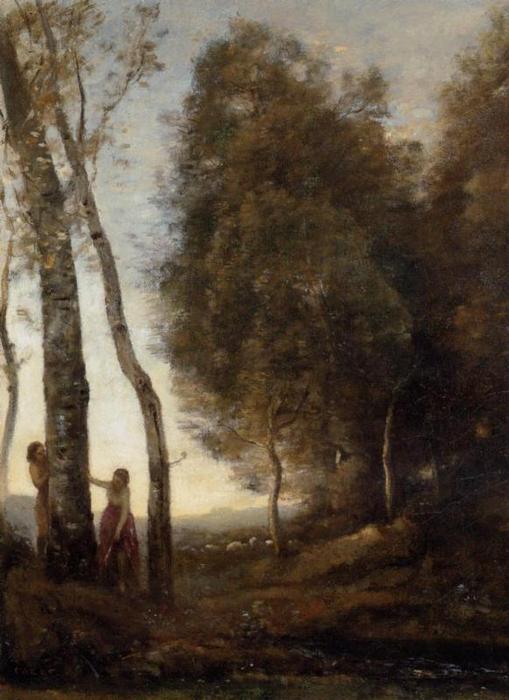
“Shepherd and Shepherdess at Play,” painted circa 1868-1870 by Jean-Baptiste-Camille Corot, stands as a quintessential embodiment of Impressionistic landscape painting—though ironically, it predates the formal movement itself. This serene depiction captures a fleeting glimpse into rural life in France during the Belle Époque, offering viewers an experience of profound stillness and connection with nature that continues to resonate today. Located within the Musée d’Orsay in Paris, the canvas invites contemplation on themes of innocence, harmony, and the sublime beauty inherent in the natural world.
The Artist's Vision: Corot's Approach to Landscape
Camille Corot (1796-1875) wasn’t merely an artist; he was a disciple of Théodore Rousseau, whose unwavering commitment to capturing atmospheric effects profoundly influenced Corot’s artistic sensibilities. Unlike many of his contemporaries who sought dramatic vistas and theatrical compositions, Corot prioritized subtlety and nuance—a deliberate rejection of academic conventions that favored idealized representations. He meticulously observed the interplay of light and shadow across the landscape, striving to convey not just what he saw but how it *felt*. This dedication to realism is evident in every brushstroke, resulting in a textured surface that mimics the organic contours of trees and foliage.
Technical Mastery: Impressionistic Techniques Employed
Corot’s technique exemplifies the core principles of Impressionism. He utilized loose, visible brushstrokes—often applied directly onto wet canvas—to achieve an ethereal quality that captures the ephemeral nature of sunlight filtering through leaves. The artist employed a palette dominated by muted greens and browns, skillfully blending colors to create atmospheric haze and depth. Corot’s layering technique – applying thin glazes over underpaintings – allowed him to build up tonal variations gradually, enhancing the illusion of luminescence and creating an immersive visual experience for the viewer. Notably, he eschewed precise delineation of forms, favoring instead suggestive contours that invite interpretation rather than rigid definition.
Symbolism Within Simplicity: Interpreting the Scene’s Narrative
Beyond its technical brilliance, “Shepherd and Shepherdess at Play” is rich in symbolic significance. The figures themselves represent pastoral innocence—a harkening back to idealized notions of rural virtue and harmony prevalent during the Romantic era. Their outstretched hands towards the trees symbolize reverence for nature and an aspiration for communion with the divine – a common motif within religious art of the time. The sheep scattered throughout the composition serve as emblems of fecundity and prosperity, reinforcing the overarching theme of abundance and tranquility. Corot’s deliberate omission of human activity contributes to the painting's contemplative mood, prompting viewers to consider the beauty of undisturbed natural landscapes.
Emotional Resonance: Capturing a Feeling of Serenity
The enduring appeal of “Shepherd and Shepherdess at Play” lies in its ability to evoke profound emotional resonance. The soft light bathing the scene imparts a palpable sense of peace and contentment—a balm for the anxieties of urban life during the Victorian age. Corot’s masterful rendering of texture and color transports us back to a bygone era, fostering an appreciation for the restorative power of nature and reminding us of the importance of slowing down and savoring simple pleasures. It's a painting that speaks not just to the eye but also to the soul—a testament to Corot’s unparalleled skill in conveying emotion through visual representation.