Jean-François Millet’s ‘Frau mit Holz und Eimer’: Ein Fenster in die Seele des französischen Landlebens
Jean-François Millet’s “Frau mit Holz und Eimer” – translated as “Woman Carrying Wood and Bucket” – is more than just a depiction of rural labor; it's a profound meditation on dignity, resilience, and the quiet beauty found in everyday existence. Painted in 1860, this oil-on-panel work, measuring a modest 39 x 30 cm, immediately draws the viewer into a world both familiar and subtly alien. Millet, born in Gruchy, Normandy in 1814, possessed an unparalleled ability to capture the essence of peasant life – a gift forged not in artistic academies but directly from his own roots as a farmer’s son. This intimate connection is palpable in every brushstroke, lending an authenticity that transcends mere representation.
-
The Scene:
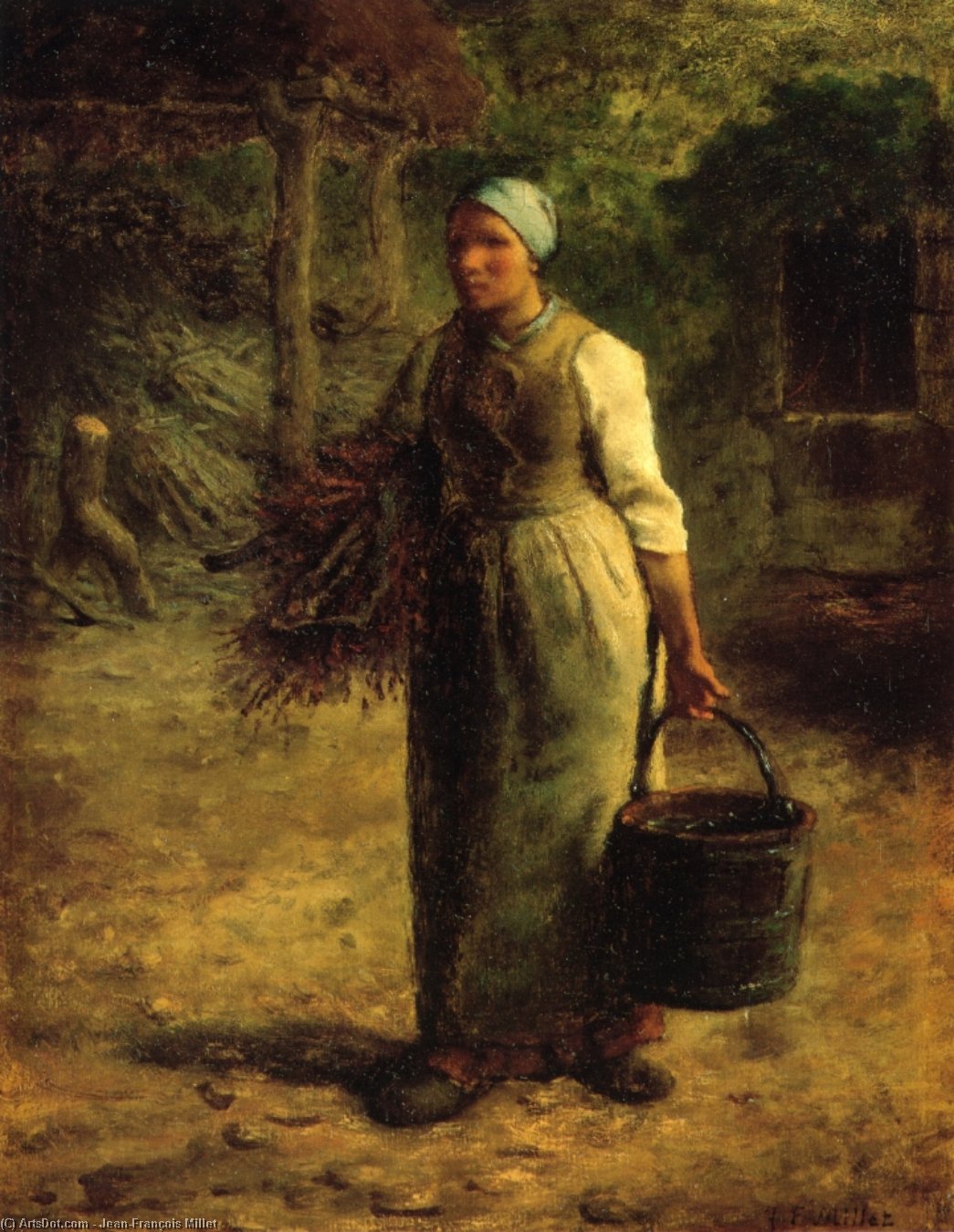
The painting presents a solitary woman traversing a dirt road or field, her posture suggesting a tireless journey. She carries a substantial load of firewood on her head and a bucket slung over her shoulder – tasks utterly commonplace yet rendered with remarkable attention to detail.
-
Realism as Revelation:
Millet’s style is firmly rooted in Realism, a movement that sought to depict life truthfully, without romantic embellishment or idealization. He doesn't shy away from the hardships of peasant life; instead, he presents them with unflinching honesty and a deep respect for his subjects.
-
Color Palette & Technique:
The muted earth tones – browns, ochres, and grays – dominate the palette, mirroring the landscape and reinforcing the painting’s grounded realism. Millet's technique is characterized by short, broken brushstrokes that create a sense of texture and movement, particularly evident in the rough fabric of the woman’s apron and the uneven surface of the road.
Symbolism Within the Mundane: A Portrait of Human Spirit
Beyond its straightforward depiction of labor, “Frau mit Holz und Eimer” is rich with symbolic meaning. The woman herself embodies a quiet strength and determination. Her head held high, her gaze directed forward, she represents not just physical endurance but also an inner resilience – the spirit of those who toil to sustain themselves and their families. The firewood and bucket are not merely objects; they symbolize sustenance and survival, essential elements of rural life. The fact that she carries them alone speaks volumes about her independence and self-sufficiency.
Interestingly, Millet’s work was often interpreted within the context of the burgeoning socialist movement in France. While he never explicitly embraced socialist ideology, his portrayal of peasant struggles resonated with those advocating for social justice. The painting subtly challenges the prevailing societal norms that often marginalized rural communities, offering a dignified representation of their lives.
Historical Context and Artistic Legacy
“Frau mit Holz und Eimer” emerged during a period of significant social and political upheaval in France. The Second Republic (1848-1852) had witnessed widespread unrest and calls for reform, fueled by economic hardship and social inequality. Millet’s art reflected this atmosphere, providing a visual commentary on the realities faced by ordinary people. The painting is now housed at the Musée des Beaux-Arts de Mulhouse, a testament to its enduring artistic value and historical significance.
Millet's work profoundly influenced subsequent generations of artists, particularly Impressionists and Post-Impressionists. His focus on everyday subjects, his use of naturalistic color, and his ability to convey emotion through simple forms paved the way for a new approach to painting – one that prioritized observation and authenticity over idealized representation. He stands as a pivotal figure in bridging the gap between academic art and modern artistic expression.
Bringing Millet’s Vision Home: A High-Quality Reproduction
Owning a reproduction of “Frau mit Holz und Eimer” offers more than just a beautiful image; it's an opportunity to connect with a pivotal moment in art history and to appreciate the profound insights of Jean-François Millet. ArtsDot.com is proud to offer meticulously crafted, hand-painted oil painting reproductions that faithfully capture the essence of this iconic work. Each reproduction is created using traditional techniques and archival materials, ensuring its longevity and preserving the rich detail and emotional depth of the original. Consider adding this powerful image to your home or office – a reminder of human dignity, resilience, and the enduring beauty found in the simplest aspects of life.