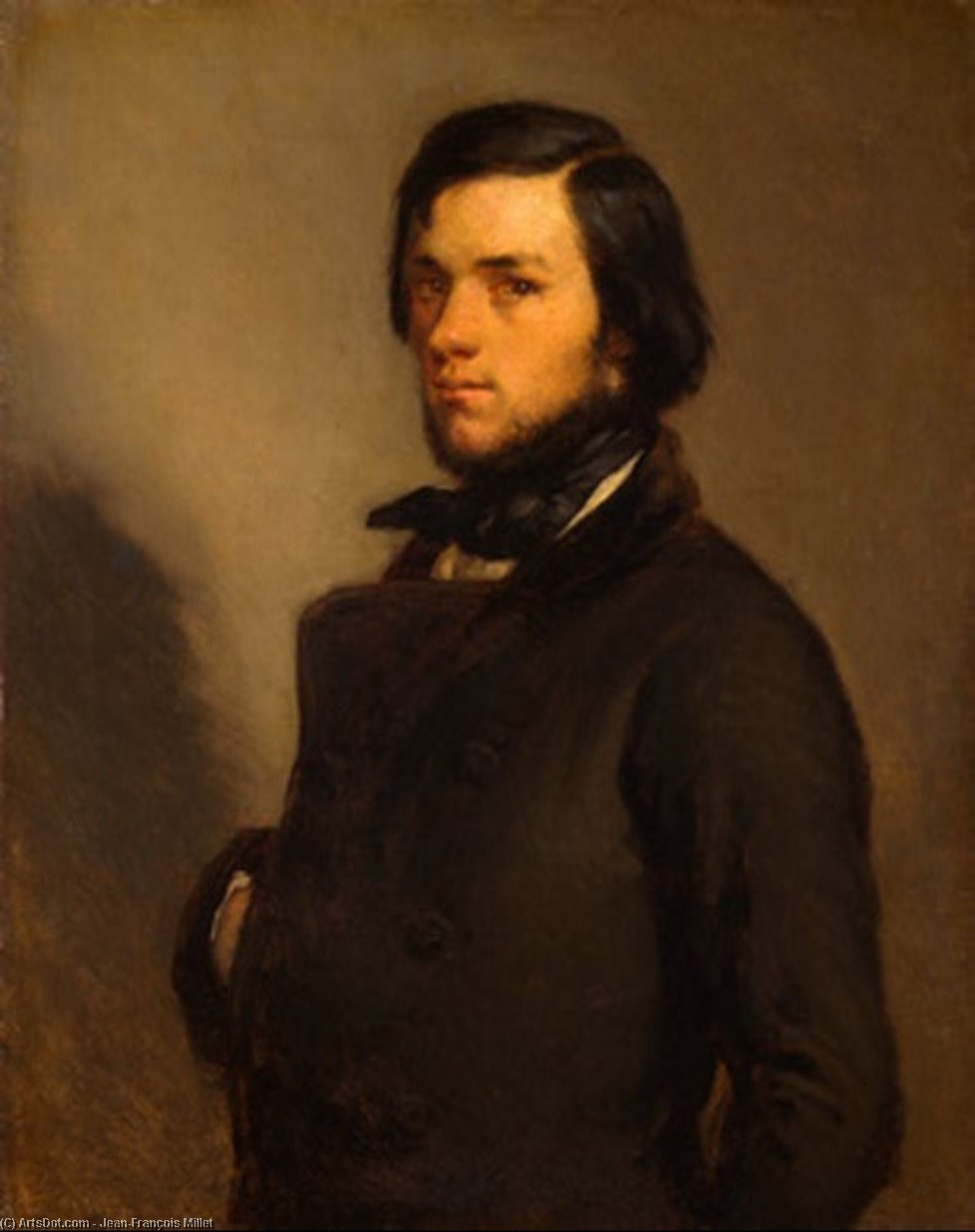
Jean-François Millet’s “Portrait of a Man”: A Window into 19th-Century French Society
The world of art often holds within it glimpses of bygone eras, frozen moments that speak volumes about the individuals who inhabited them. Jean-François Millet's "Portrait of a Man," painted in 1845, offers precisely such a window – a carefully rendered depiction of a gentleman poised between the familiar rhythms of rural life and the burgeoning complexities of modern France. This oil on canvas, measuring a modest 46 x 32 centimeters, is not merely a likeness; it’s an invitation to contemplate the social currents swirling beneath the surface of a seemingly straightforward portrait.
Millet, born in Gruchy, Normandy, in 1814, brought with him an unparalleled understanding of the working class and the land. His upbringing profoundly shaped his artistic vision, imbuing his work with a rare authenticity that resonated deeply with audiences. The subject of this portrait – a man distinguished by his beard and mustache, clad in formal attire – immediately suggests a man of standing, perhaps preparing for an important business engagement or a social occasion. The meticulous attention to detail—the texture of the fabric, the subtle shading of the face—is characteristic of Millet’s commitment to realism, a movement he championed with unwavering dedication.
The Language of Realism: Technique and Composition
Millet's mastery lies not just in his subject matter but also in his technique. The use of oil paint allows for an extraordinary depth of color and texture, creating a palpable sense of presence within the frame. Notice how Millet subtly employs light to define the man’s features, highlighting the strength of his jawline and the warmth of his gaze. The composition itself is deliberately restrained; the subject stands before a simple wall, drawing our attention entirely to his face and expression. This simplicity underscores Millet's belief that truth resided in the everyday, in the unadorned realities of human experience.
- Oil on Canvas: The chosen medium lends itself beautifully to Millet’s realistic style, allowing for nuanced shading and rich textures.
- Detailed Facial Features: Millet's skill lies in capturing the subtle nuances of the subject's expression – a hint of contemplation, perhaps even a touch of weariness.
- Restrained Composition: The simplicity of the background directs focus entirely to the figure and his demeanor.
A Reflection of its Time: Historical Context
“Portrait of a Man” was painted during a pivotal period in French history – the mid-19th century, a time of significant social and political upheaval. The rise of industrialization was transforming rural landscapes and displacing traditional ways of life, while urban centers swelled with new populations. Realism, as an artistic movement, emerged precisely to document these changes, offering unflinching portrayals of ordinary people and their struggles. Millet’s work aligns perfectly with this trend, providing a poignant glimpse into the lives of those caught between the old world and the new.
It's interesting to compare this portrait to other works by Millet, such as "Portrait of a Naval Officer" and “Portrait Of Eugene Canoville,” which share his dedication to capturing individual character with remarkable accuracy. These comparisons reveal a consistent artistic philosophy – a commitment to portraying the dignity and complexity of human life without romanticizing or idealizing.
Beyond the Canvas: Symbolism and Emotional Resonance
While seemingly straightforward, “Portrait of a Man” invites deeper interpretation. The gentleman’s attire suggests a certain social standing, yet his gaze – direct and unwavering – hints at an underlying seriousness. He is not simply presenting himself; he is engaging with the viewer, inviting us to share in his thoughts and experiences. Millet's ability to evoke such a powerful emotional response through a simple portrait speaks volumes about his artistic genius.
This painting serves as a reminder that art can transcend mere representation, offering profound insights into the human condition and the complexities of our shared history. A high-quality reproduction of “Portrait of a Man” by Jean-François Millet is more than just a decorative piece; it’s a tangible connection to a pivotal moment in French artistic and social history.