Explore Jean-Louis Forain (1852-1931), a French Impressionist master! Discover his witty paintings, watercolors & lithographs capturing Parisian life, satire & modernity.
Entdecken Sie Jean-Louis Forain (1852–1931)! Seine impressionistischen Gemälde & Aquarelle fangen das lebendige Pariser Leben, Satire & Moderne ein.
Entdecken Sie Kunst & Archäologie aus Millionen Jahren Geschichte im Ashmolean Museum! Impressionisten, Ägypten & mehr – freier Eintritt erwartet Sie!
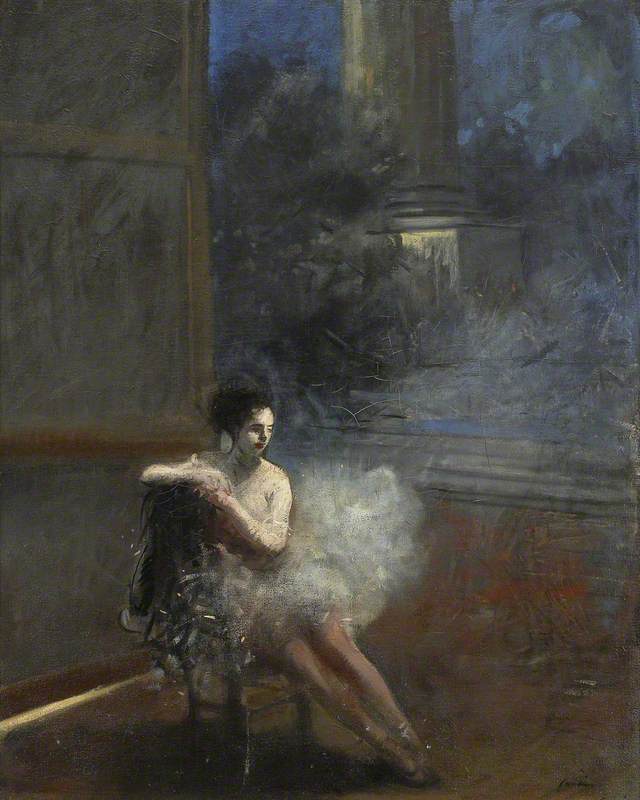
Seated Dancer | Jean Louis Forain
Jean Louis Forain’s “Seated Dancer,” painted circa 1884, is more than just a depiction of a ballerina; it's a masterful distillation of Impressionist principles and a poignant exploration of feminine vulnerability within the bustling backdrop of Parisian life. Held in Ashmolean Museum, Oxford, this artwork exemplifies Forain’s signature style – characterized by loose brushstrokes, luminous color palettes, and an unwavering commitment to capturing fleeting moments of emotion rather than striving for photographic realism.
Composition & Atmosphere
The painting's central focus is undeniably the dancer herself, positioned prominently in the lower half of the frame. Her posture—seated on the floor with crossed legs—suggests a deliberate stillness amidst the implied movement of her surroundings. The blurred background, populated by mirrors and indistinct figures representing fellow dancers, contributes significantly to the artwork’s atmosphere of backstage intimacy and quiet contemplation. Forain skillfully employs compositional techniques to draw the viewer's eye inward, fostering a sense of solitude and introspection—a hallmark of Impressionist aesthetics.
Color Palette & Light
Dominating the color scheme is a cool tonal range dominated by blues, grays, and muted greens. These hues evoke feelings of melancholy and serenity, mirroring the dancer’s internal state. Touches of warmer shades – beige and pale pink – adorn her skin and tutu, providing subtle visual warmth that prevents the painting from feeling overly somber. Crucially, Forain utilizes light to sculpt form and imbue the scene with emotional resonance. Soft, diffused illumination emanates from an unseen source, casting gentle shadows and highlighting areas of the dancer’s torso—a technique directly influenced by Impressionist luminists like Claude Monet.
Technique & Texture
Forain's brushwork is deliberately loose and expressive, prioritizing tonal variation and atmospheric effects over precise detail. Visible brushstrokes create a palpable sense of movement and dynamism, contrasting with the smoother surfaces depicting skin and fabric. This textural richness underscores Forain’s dedication to conveying mood and emotion—a core tenet of Impressionism. The artist skillfully blends colors on canvas, layering them to build depth and luminosity, resulting in an artwork that feels both tactile and emotionally resonant.
Symbolic Significance & Emotional Impact
“Seated Dancer” transcends mere visual representation; it speaks to themes of feminine resilience and quiet contemplation within the context of artistic performance. The dancer’s embrace of herself or a curtain symbolizes introspection and vulnerability—a poignant reflection on the pressures faced by women in Parisian society during the Belle Époque. Forain's masterful portrayal captures not just an image but also a feeling, inviting viewers to contemplate the beauty found in stillness amidst activity and acknowledging the profound emotional depth achievable through Impressionist art.
Historical Context & Artistic Legacy
Painted during the height of Impressionism’s influence, “Seated Dancer” embodies the movement's rejection of academic conventions and embrace of subjective experience. Forain’s work aligns with a broader artistic trend toward capturing everyday life and exploring psychological states—a legacy that continues to inspire artists today. Its enduring appeal lies in its ability to convey emotion through subtle visual cues and its masterful execution of Impressionist techniques, cementing Forain's place as one of the era’s most celebrated painters.