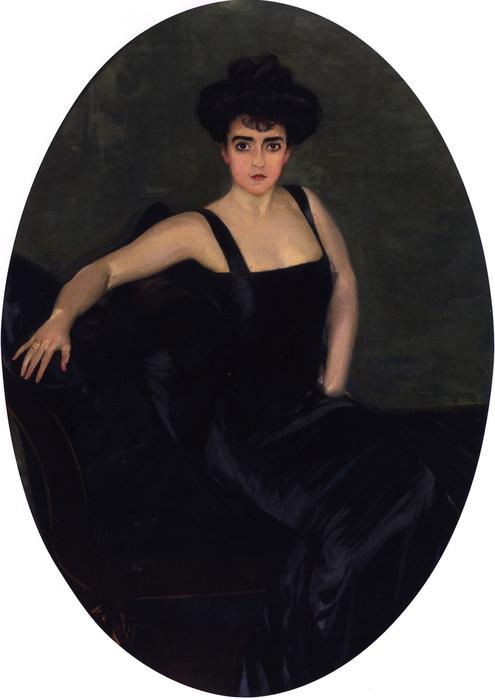
Experience the radiant light and captivating pensive mood of Joaquín Sorolla’s 1909 oil painting, "Esperanza Conill de Zanetti," a stunning portrait capturing a woman in black. Discover this exquisite Spanish masterpiece and bring its timeless beauty into your home.
A Portrait Bathed in Mediterranean Light – Esperanza Conill de Zanetti by Joaquín Sorolla
Joaquín Sorolla’s “Esperanza Conill de Zanetti,” painted in 1909, is more than a simple portrait; it's a masterful distillation of the Spanish light and spirit that defined the artist’s oeuvre. The scene depicts a woman – Esperanza Conill de Zanetti herself – seated with an air of quiet contemplation. Her dark dress, a classic choice for portraits of the period, contrasts dramatically against the luminous background, drawing immediate attention to her face and posture. Sorolla's signature technique—a rapid, almost impressionistic brushstroke—captures not just the likeness but also the very essence of the sitter’s mood, creating an image that feels both intimate and powerfully evocative.
The Painter and His Time: Sorolla’s Roman Influence
- Early Life & Tragedy: Born in Valencia in 1863, Joaquín Sorolla's early life was profoundly shaped by loss. Orphaned at the age of two by a devastating cholera outbreak, he experienced firsthand the fragility of existence – an experience that would undoubtedly inform his artistic sensibility.
- Roman Studies:
A four-year scholarship to Rome proved pivotal in Sorolla’s development. Immersed in the classical world, he absorbed the techniques of Renaissance masters, particularly their understanding of light and shadow. This influence is evident in “Esperanza Conill de Zanetti,” where the careful modeling of form and the dramatic use of light create a sense of depth and realism.
- The Spanish Golden Age:
Sorolla’s work represents a vibrant chapter in Spanish art, bridging the gap between traditional academic painting and the burgeoning modern movements. He was deeply connected to the cultural and social life of his time, capturing the energy and optimism of early 20th-century Spain.
Technical Brilliance: Sorolla’s Light and Color
Sorolla's mastery lay in his ability to capture the effects of light with breathtaking immediacy. He employed a technique known as “alla prima,” meaning "at first attempt," working directly onto the canvas without underdrawings, allowing for rapid brushstrokes and a sense of spontaneity. The painting’s palette is dominated by warm tones – ochres, yellows, and browns – reflecting the intense Mediterranean sunlight that Sorolla so famously depicted. Note the way he uses broken color to create shimmering highlights on her dress and skin, further enhancing the illusion of light and volume. His use of glazing techniques adds depth and luminosity to the overall composition.
Symbolism and Emotional Resonance
The pose itself – seated with hands gently folded in her lap – conveys a sense of quiet dignity and introspection. The pensive expression on Esperanza Conill de Zanetti’s face invites the viewer to contemplate her thoughts and feelings. While the portrait is formally elegant, it also possesses an undeniable emotional depth, reflecting Sorolla's ability to capture not just physical likeness but also the inner life of his subjects. This painting stands as a testament to Sorolla’s skill in translating emotion through light, color, and composition – a timeless image that continues to resonate with viewers today.