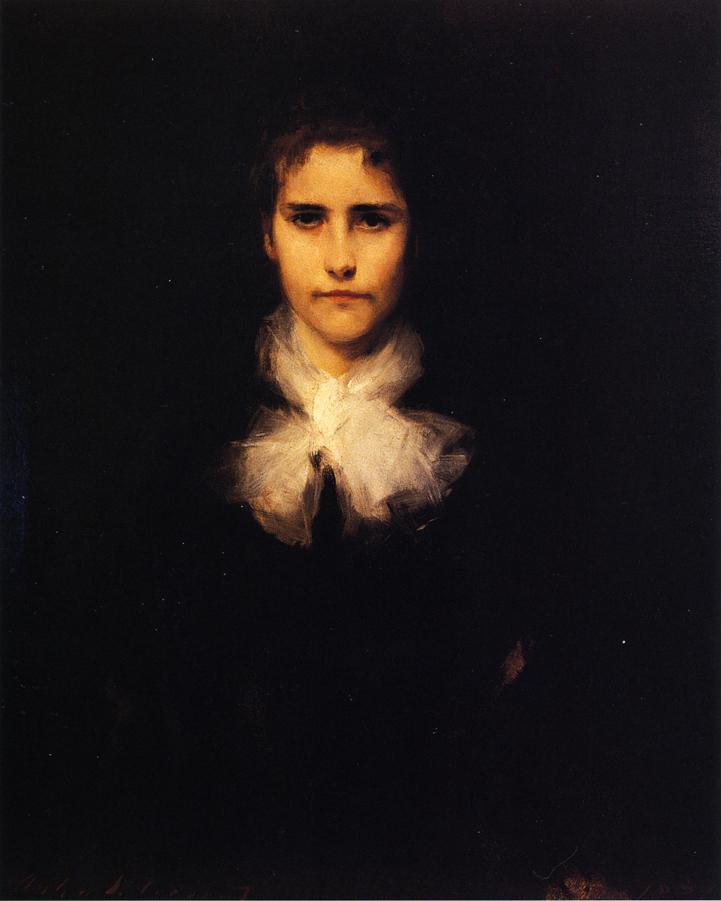
A captivating portrait by John Singer Sargent depicting Mary Turner Austin, rendered in meticulous detail against a dark backdrop. Executed in oil on canvas circa 1880, it exemplifies Sargent’s mastery of realism and captures the sitter's dignified gaze.
Erkunden Sie die Meisterwerke von John Singer Sargent! Amerikanischer Impressionist, bekannt für Porträts wie 'Madame X', Landschaften und die Erfassung der Eleganz des Goldrauschzeitalters. Entdecken Sie seine Kunst noch heute!
A Portrait Steeped in Victorian Dignity: Mary Turner Austin by John Singer Sargent
John Singer Sargent’s “Mary Turner Austin,” completed around 1880, transcends mere representation; it embodies the spirit of its era and stands as a testament to Sargent's unparalleled ability to capture psychological depth within a meticulously crafted visual form. Currently residing at the Wadsworth Atheneum in Hartford, Connecticut, this oil on canvas painting—measuring 91 x 73 cm—offers an intimate glimpse into the life of Mary Turner Austin, a prominent American socialite and philanthropist who captivated Sargent’s artistic sensibilities.
The Artist's Vision: Realism Elevated
Sargent was renowned for his masterful blending of traditional academic principles with modern Impressionistic influences. Unlike many contemporaries preoccupied with fleeting impressions of light and color, Sargent prioritized anatomical accuracy and nuanced observation—skills honed through extensive study of the human form and unwavering dedication to capturing subtle emotional expressions. This commitment is vividly evident in “Mary Turner Austin,” where Sargent employs loose brushstrokes layered upon one another to achieve a remarkable level of textural detail, particularly noticeable in the folds of Austin’s gown and collar. The artist's deliberate use of chiaroscuro—the dramatic interplay between light and shadow—further enhances the painting’s visual impact, sculpting Austin’s face with exquisite precision and conveying an aura of quiet contemplation.
A Window into Victorian Society
Painted during the height of the Victorian period (1837-1901), “Mary Turner Austin” reflects the prevailing social conventions and aesthetic ideals of the time. The sitter is dressed in fashionable attire characteristic of wealthy American women—a white collar shirt adorned with lace, paired with a ruffled bodice—demonstrating an awareness of contemporary fashion trends. More profoundly, however, the portrait speaks to Victorian values of restraint, dignity, and moral seriousness. Austin’s gaze directs unflinchingly at the viewer, conveying confidence and intellectual curiosity – qualities admired within Victorian society where outward appearances were carefully cultivated to project social status and virtue. Sargent skillfully captures this psychological dimension, inviting contemplation on themes of identity and self-presentation.
Symbolism Beneath Surface Detail
Beyond its formal composition and technical virtuosity, “Mary Turner Austin” is imbued with symbolic resonance. The dark background serves not merely as a compositional device but also as a conduit for conveying mood—creating an atmosphere conducive to introspection and highlighting the luminosity of Austin’s complexion. Furthermore, the artist's meticulous rendering of Austin’s facial features – particularly her eyes – suggests a profound understanding of human psychology. Sargent’s masterful use of tonal variations contributes to the painting’s emotional impact, fostering a connection between the viewer and the subject—a hallmark of Sargent’s artistic legacy.
Legacy and Influence
“Mary Turner Austin” cemented John Singer Sargent's reputation as one of the foremost portrait painters of his generation and continues to inspire artists and collectors alike. Its enduring appeal lies in its ability to convey both visual splendor and psychological insight – qualities that resonate across time periods. The Wadsworth Atheneum’s stewardship ensures that this masterpiece remains accessible to future generations, safeguarding a vital piece of American art history.